
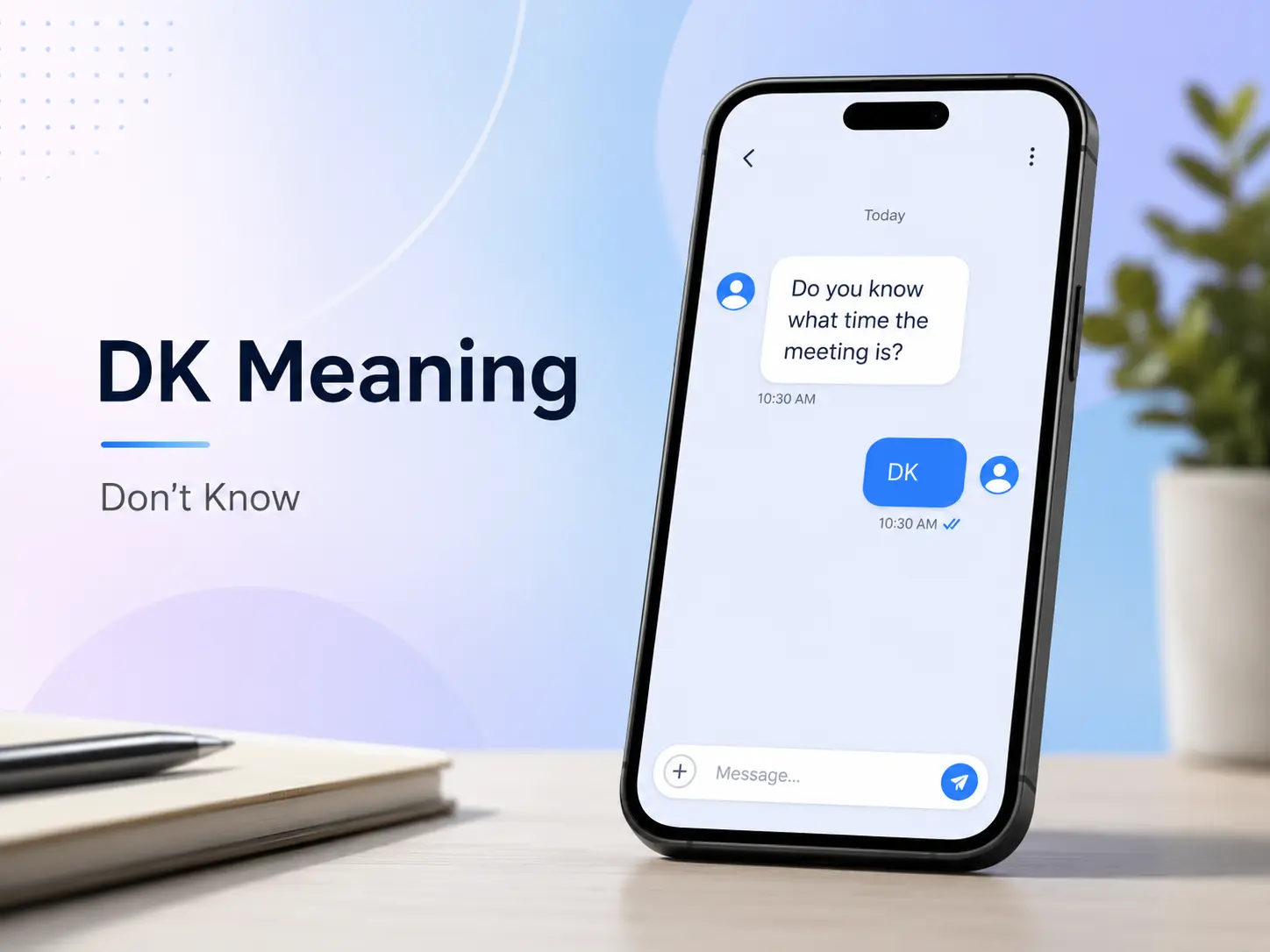
Have you ever received a message that only says “DK” and wondered what the sender meant? Short replies can save time, but they can also create confusion when you do not recognize the abbreviation. The good news is that DK Meaning is usually simple. In most text messages, DK means “Don’t Know.”
People use DK when they are unsure, lack information, or want to answer quickly. However, the tone can change depending on the situation. A friendly “dk lol” may sound relaxed, while a plain “DK” can feel blunt. The abbreviation can also have other meanings in gaming, entertainment, geography, and specialist communities. This guide explains how to understand DK in context, use it naturally, and avoid common misunderstandings.
Quick Answer: What Does DK Mean?
DK means “Don’t Know” in most casual conversations. It is an informal text abbreviation that people use to express uncertainty or show that they do not have an answer.
For example:
Alex: “What time does the movie start?”
Sam: “DK, maybe around eight.”
Here, Sam is saying that they do not know the exact time. The surrounding question makes the meaning clear. In everyday texting, DK often works as a quick reaction, a standalone response, or part of a longer sentence.
The abbreviation is common in casual chats, group conversations, social media comments, and gaming messages. It is less suitable for formal communication because it may sound too short or careless.
What Does DK Mean in Texting?
DK as a Short Form of “Don’t Know”
The most common DK Meaning in texting is “Don’t Know.” It removes the subject “I” from the full phrase “I don’t know,” creating a shorter response.
Someone may write:
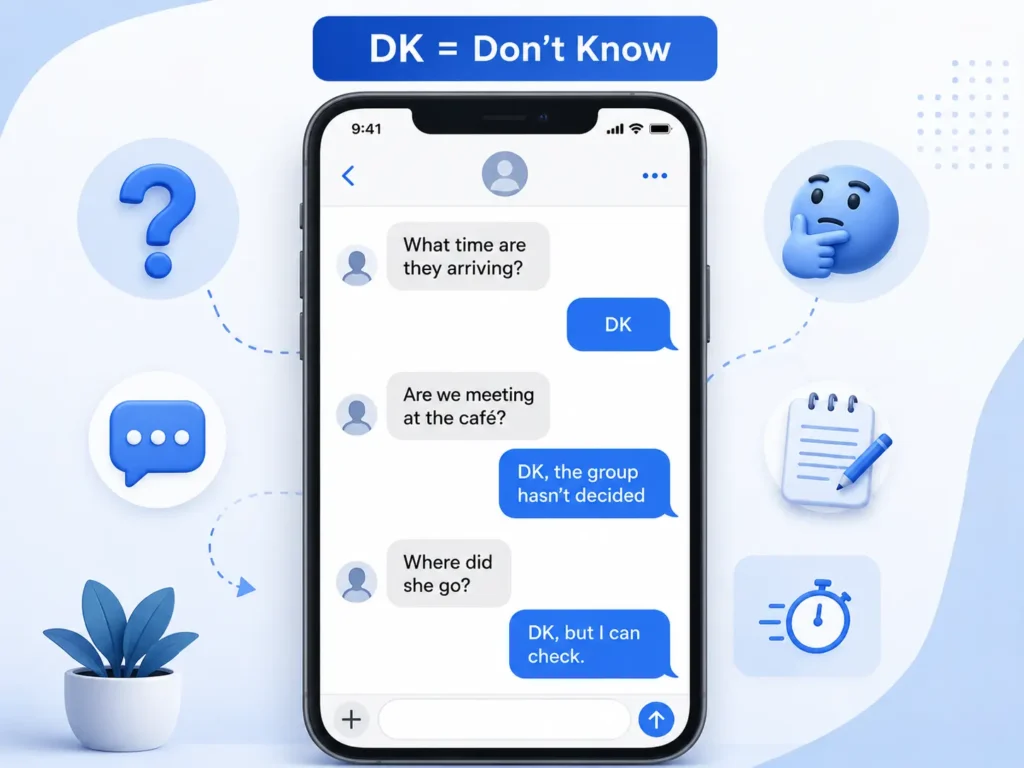
“DK where she went.”
This means:
“Don’t know where she went.”
The message is informal, but the intended idea is easy to understand. People often leave out words in digital conversations because both sides already understand the context.
Why People Use DK Instead of Writing the Full Phrase
People use DK because it is fast and convenient. In group chats, gaming lobbies, or busy conversations, typing two letters takes less effort than writing a full sentence.
DK also matches the quick pace of online communication. A person may use it when they want to answer immediately, even if they have little information to share. It can also signal that the question does not require a detailed response.
However, convenience can affect tone. A very short answer may appear cold when the other person expects help, care, or explanation. For that reason, DK works best when the relationship and situation are already casual.
Is DK an Acronym, Abbreviation, or Slang Term?
DK is best described as an initialism or text abbreviation because each letter represents a separate word: “D” for “Don’t” and “K” for “Know.” People usually pronounce the letters individually rather than saying them as one word.
It also functions as texting slang because it belongs to informal digital language. Like IDK, BRB, and IMO, it helps users communicate quickly. The exact label matters less than understanding how the abbreviation works in a real conversation.
How DK Is Used in Conversations
Answering a Question
The simplest use of DK is answering a direct question.
“Who invited everyone?”
“DK.”
The reply shows that the sender does not have the requested information. It is clear because the previous message asks for an answer.
Showing Uncertainty
DK can also show that someone is unsure rather than completely uninformed.
“Do you think the teacher will cancel class?”
“DK, probably not.”
Here, the person has an opinion but cannot confirm it. Adding “probably not” makes the reply more helpful and less abrupt.
Saying You Have No Information
Sometimes DK tells the other person that no useful information is available.
“Has the delivery arrived?”
“DK, I haven’t checked yet.”
This version explains why the sender does not know. It also gives the conversation a natural next step.
Avoiding a Definite Answer
A person may use DK when they do not want to commit to a decision.
“Are you coming tonight?”
“DK yet.”
The sender may still be deciding. In this case, DK means the answer is uncertain, not necessarily negative. Asking a polite follow-up question can help clarify the situation.
Ending a Conversation Quickly
A short DK can sometimes close the topic.
“Why did he leave?”
“DK.”
This may mean the sender truly lacks information, but it can also show that they do not want to discuss the issue. Tone, timing, and the relationship between the speakers help reveal the intention.
Examples of DK in Text Conversations
DK as a Standalone Reply
A standalone DK is common when the question is simple.
Mia: “What time are they arriving?”
Noah: “DK.”
This response is efficient, but it may sound dry. A friendlier version would be, “DK, but I can ask.”
DK Within a Sentence
DK can appear inside a longer sentence:
“I dk whether she is coming.”
Although many people write “idk” in this structure, some users still type “dk.” The meaning remains “don’t know.” Capitalization usually does not change the definition.
DK When Discussing Plans
People often use DK when plans are uncertain.
“Are we meeting at the café?”
“DK, the group hasn’t decided.”
This reply gives both the answer and the reason. It helps everyone understand that the plan is still open.
DK in School or Work Conversations
In a casual class chat, someone might write:
“DK when the assignment is due. Check the portal.”
In a workplace message, the same abbreviation may sound too informal. A clearer reply would be, “I’m not sure, but I’ll confirm the deadline.” Professional communication usually benefits from complete sentences and a helpful next step.
DK in Friendly and Dating Chats
In friendly conversations, DK often feels harmless:
“Where should we eat?”
“DK lol, you choose.”
In dating conversations, a one-word DK may feel uninterested, especially after a thoughtful question. Adding warmth can prevent confusion:
“DK yet, but I’d like to see you this weekend.”
What Tone Does DK Communicate?
Neutral or Honest
DK can simply communicate an honest lack of knowledge. When the conversation is practical and relaxed, most people will not view it negatively.
Casual and Relaxed
Lowercase “dk” often looks casual. Adding “lol,” an emoji, or a short explanation can make the tone lighter.
Dry or Uninterested
A standalone DK may feel like a dry reply when someone expects detail. It can suggest low effort even when the sender does not intend to be rude.
Annoyed or Dismissive
Capital letters, certain emojis, or repeated short replies can make DK sound annoyed. Compare these forms:
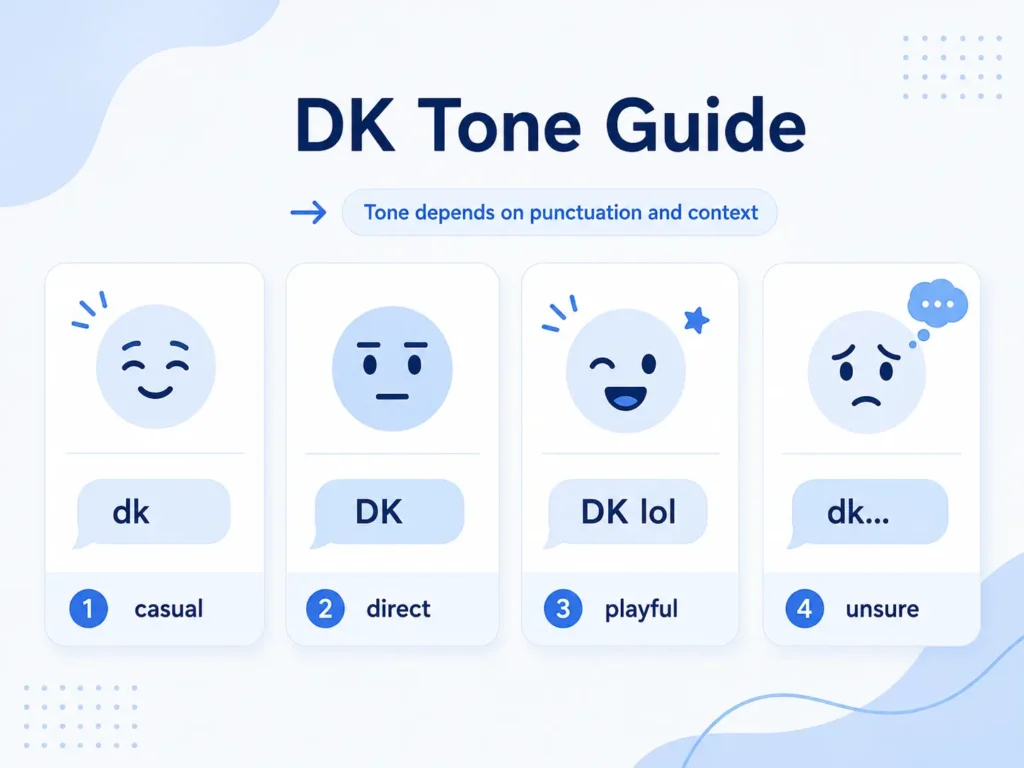
- dk — casual or neutral
- DK — stronger or more direct
- DK lol—lighthearted
- dk… — uncertain or hesitant
- DK 🙄 — potentially annoyed
The words alone do not determine tone. Context, punctuation, timing, and the relationship between speakers matter just as much.
Because digital messages lack facial expressions and voice, the same two letters can produce different impressions. Read the message before DK, notice whether the sender usually writes briefly, and consider the importance of the topic. These clues help you separate an honest answer from impatience, hesitation, humor, or a deliberate attempt to end discussion.
Is DK Rude or Disrespectful?
DK is not automatically rude. In casual conversations, it usually means the sender does not know the answer. Still, a two-letter reply can feel cold when someone expects effort, interest, or support.
When DK Sounds Harmless
DK sounds harmless between friends, classmates, or teammates. It also works when the question is simple:
“Who brought the snacks?”
“dk.”
Nothing here suggests anger. The sender is only answering quickly.
When DK Can Feel Cold or Dismissive
DK may feel dismissive during a serious or emotional discussion. Compare:
“Why has she stopped talking to me?”
“DK.”
“I’m not sure, but maybe you should ask her directly.”
The second reply shows more care.
How Relationship and Context Affect Its Tone
Close friends often understand brief replies without taking offense. Coworkers, customers, and new contacts may interpret the same message differently. A casual question allows a casual answer, while a sensitive topic needs more thoughtful language.
Friendlier Alternatives to a One-Word DK Reply
You can soften DK by adding a reason or offering help:
- “DK, but I can check.”
- “I’m not sure yet.”
- “DK honestly, what do you think?”
- “I don’t know, but I’ll ask.”
- “Not sure. I’ll let you know.”
How to Identify the Correct DK Meaning
The DK Meaning depends on context, so do not interpret the letters alone.
This same context rule applies to abbreviations such as WYFF Meaning, whose intended definition becomes clearer when you examine the platform, topic, and previous messages.
Read the Previous Message
Start with the message before DK. If someone asked a question, “Don’t Know” is usually correct.
Check Whether DK Answers a Question
Replace DK with “Don’t Know.” If the reply still makes sense, you have found the intended meaning.
Consider the Platform and Conversation Topic
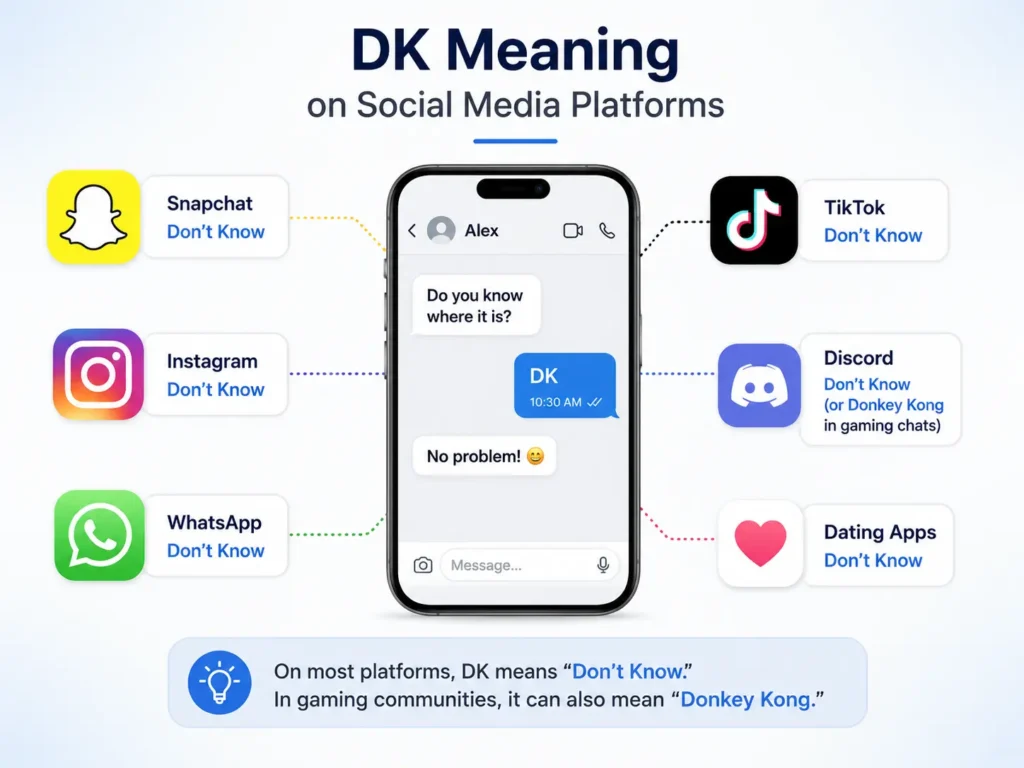
On Snapchat, WhatsApp, or Instagram, DK usually expresses uncertainty. In gaming chats, it may refer to Donkey Kong. In discussions about countries, websites, or shipping, it may point to Denmark.
Notice Capitalization, Punctuation, and Emojis
Capitalization rarely changes the definition, but it affects tone. “dk” feels casual, “DK!” feels forceful, and “dk…” suggests hesitation. Emojis may make the message playful, annoyed, confused, or sarcastic.
DK Meaning on Social Media Platforms
DK Meaning on Snapchat
On Snapchat, DK usually means “Don’t Know” in casual chats.
DK Meaning on Instagram
In Instagram comments and direct messages, DK often answers a question. In gaming content, it may mean Donkey Kong.
DK Meaning on TikTok
TikTok users often use DK for “Don’t Know,” but a Nintendo clip, gaming meme, or character discussion may use it for Donkey Kong.
DK Meaning on WhatsApp and Messenger
DK commonly appears in plans, group conversations, and fast responses. Longer wording works better for important topics.
DK Meaning on Discord and Gaming Platforms
On Discord, DK may mean “Don’t Know,” Donkey Kong, or a game-specific term. Read the channel topic and messages.
DK Meaning on Dating Apps
A short DK may look uninterested on a dating app. Adding context makes the reply warmer and clearer.
DK vs IDK: What Is the Difference?
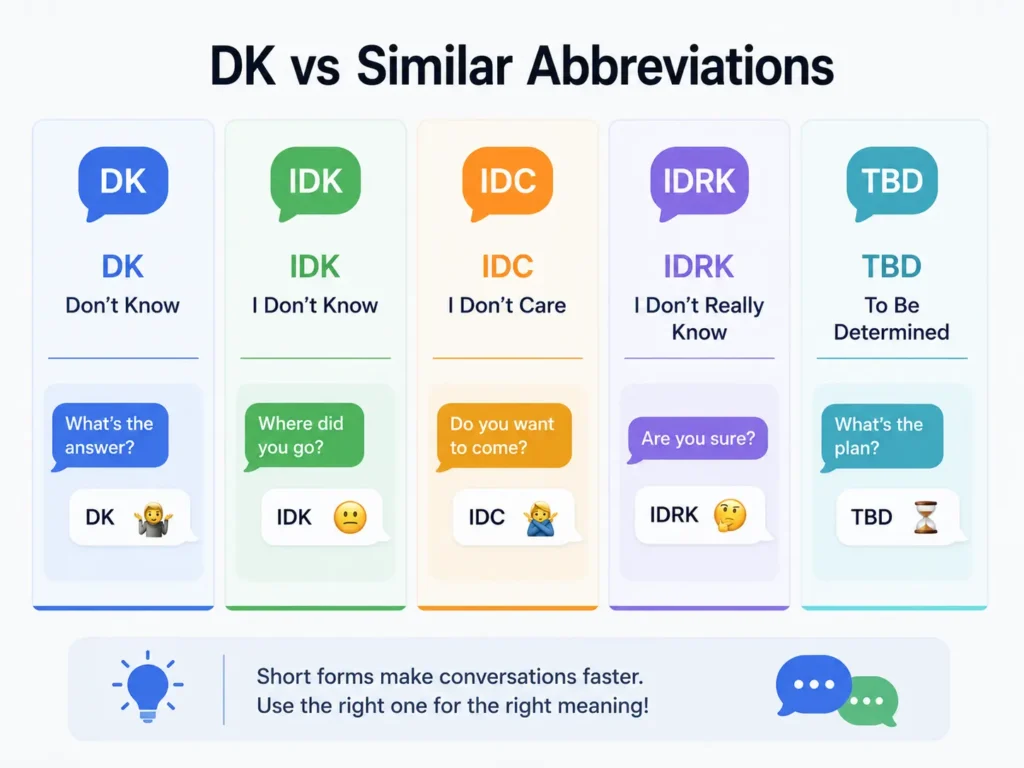
DK means “Don’t Know,” while IDK means “I Don’t Know.” Both express uncertainty, but IDK sounds more complete and personal.
| Term | Full form | Typical use | Tone | Example |
| DK | Don’t Know | Quick replies | Casual or blunt | “DK yet.” |
| IDK | I Don’t Know | Everyday texting | Casual and natural | “IDK where he is.” |
IDK is easier to recognize because it includes “I.” DK feels more clipped and may sound stronger in serious conversations.
DK vs Similar Text Abbreviations
DK vs IDC
DK means you lack information. IDC means “I Don’t Care,” which shows a lack of concern.
DK vs IDRK
IDRK means “I Don’t Really Know.” It sounds slightly softer and less certain than DK.
DK vs NGL
NGL means “Not Gonna Lie.” It introduces an honest opinion instead of expressing uncertainty.
DK vs TBD
TBD means “To Be Decided” or “To Be Determined.” It refers to information that has not been finalized.
DK vs Maybe
“Maybe” suggests possibility, while DK says the sender does not know. “DK, maybe” combines uncertainty with a guess.
Like DK, WFY Meaning can depend on the surrounding conversation, as people may use it for phrases such as “Waiting for You” or other context-based interpretations.
How to Respond When Someone Says DK
Ask a Follow-Up Question
Try, “No problem. Can you check?” or “Who might know?”
Offer More Information
Share useful context. Extra details may help the person answer.
Suggest Finding Out Together
Say, “Let’s check online,” or “I’ll ask someone.” This keeps the exchange productive.
Move the Conversation Forward
When the answer is not essential, say, “That’s okay—I’ll find out,” and continue.
Respect the Person’s Uncertainty
Do not pressure someone to guess. “Let me know when you know” respects their position.
When Should You Use DK?
Use DK in casual conversations with friends, fast group chats, informal social-media messages, gaming chats, and situations where a short answer is acceptable. It works best when everyone understands the abbreviation and the topic does not require detail.
When Should You Avoid Using DK?
Avoid DK in formal emails, customer-service conversations, serious discussions, first introductions, and workplace messages that need clear information. Better alternatives include:
- “I’m not sure.”
- “I don’t have that information yet.”
- “Let me check and get back to you.”
- “I’ll confirm the details.”
Other Meanings of DK
Donkey Kong in Gaming
DK often refers to Donkey Kong, the Nintendo character, in gaming forums and discussions.
Denmark and the .dk Domain
DK is associated with Denmark, while .dk is its country-code internet domain. It may also appear with international addresses or shipping information.
Dark Knight in Entertainment
Fans may use DK as shorthand for “Dark Knight” in film, comic, or character discussions.
Drift King in Car Culture
In car and motorsport culture, DK can mean “Drift King,” a title connected with skilled drifting.
DK as a Name or Initials
DK may represent a person’s initials, username, brand, team, or internal workplace shorthand.
Another abbreviation that changes significantly by context is FM Meaning, which may refer to radio broadcasting, frequency modulation, or an informal expression in digital conversations.
Industry-Specific and Community Meanings
Medical notes, workplace systems, and online communities may use DK differently. Do not assume a specialist meaning without reliable context.
Common Misunderstandings About DK
DK does not usually mean “Don’t Care.” It is related to IDK, but the two are not identical. Capital letters do not automatically change its definition, and DK is not suitable for every conversation. Outside texting, it may refer to gaming, Denmark, entertainment, or initials.
Frequently Asked Questions
What does DK mean in a text message?
It usually means “Don’t Know.”
Is DK considered rude?
Not necessarily, but it can sound blunt in serious conversations.
What does DK mean from a girl or guy?
The definition is normally the same. Tone depends on context, relationship, and writing style.
What does DK mean on Snapchat or TikTok?
It usually means “Don’t Know,” although gaming content may use it for Donkey Kong.
Can DK mean Donkey Kong?
Yes. Gaming discussions often use DK for the Nintendo character.
How should I reply to DK?
Ask a follow-up question, offer help, or move on when the answer is unimportant.
Is DK suitable for professional messages?
Usually not. Complete phrases sound clearer and more respectful.
Final Takeaway
The primary DK Meaning in text, chat, and social media is “Don’t Know.” It supports casual communication, but its short form can sound dry or dismissive. Check the previous message, platform, topic, punctuation, and relationship before interpreting the tone. DK may also refer to Donkey Kong, Denmark, Dark Knight, Drift King, initials, or specialist terms. Context reveals the correct meaning.