
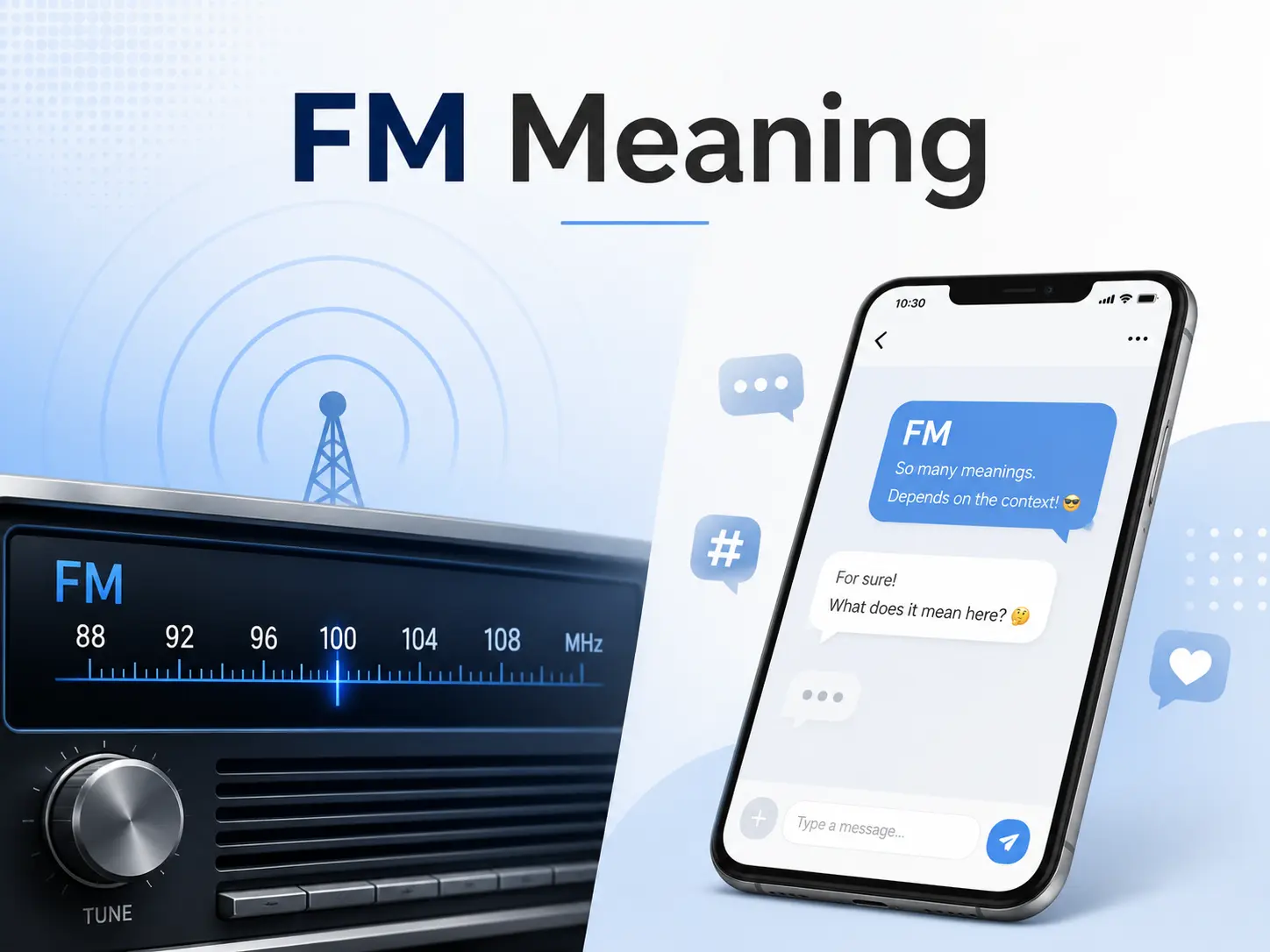
The letters FM appear on car stereos, portable radios, social media posts, business documents, and text messages. Because the abbreviation appears in many places, its meaning can change with the topic.
In radio, FM stands for frequency modulation. It is a method of transmitting sound or data by changing the frequency of a carrier wave. FM broadcasting is popular for music, entertainment, news, and talk programs because it usually provides clear audio with less noticeable static than AM radio.
Outside radio, the FM meaning may be different. In texting, it can mean “for me,” “follow me,” “from me,” or “fine by me.” In business, FM often stands for facilities management. In government reporting, it may mean Foreign Minister, while in chess it means FIDE Master.
This guide explains the primary FM meaning, how FM radio works, what station numbers mean, and how FM compares with AM. It also covers informal and professional uses so you can interpret the abbreviation correctly.
What Does FM Mean?
The most common meaning of FM is frequency modulation. It describes a modulation method in which the frequency of a carrier signal changes according to an audio or information signal.
A transmitter uses these frequency variations to carry music, speech, or data through electromagnetic radio waves. A radio receiver detects the signal, demodulates it, and converts the information back into sound.
FM can also have other meanings:
| Context | FM Meaning |
| Radio | Frequency Modulation |
| Texting | For Me, Follow Me, From Me, or Fine by Me |
| Business | Facilities Management |
| Government | Foreign Minister |
| Chess | FIDE Master |
| Science | Femtometre |
| Music technology | Frequency Modulation synthesis |
The topic usually reveals the correct interpretation. When a discussion includes a station, antenna, transmitter, tuner, frequency range, or signal quality, frequency modulation is almost certainly intended.
What Does FM Mean in Text Messages?
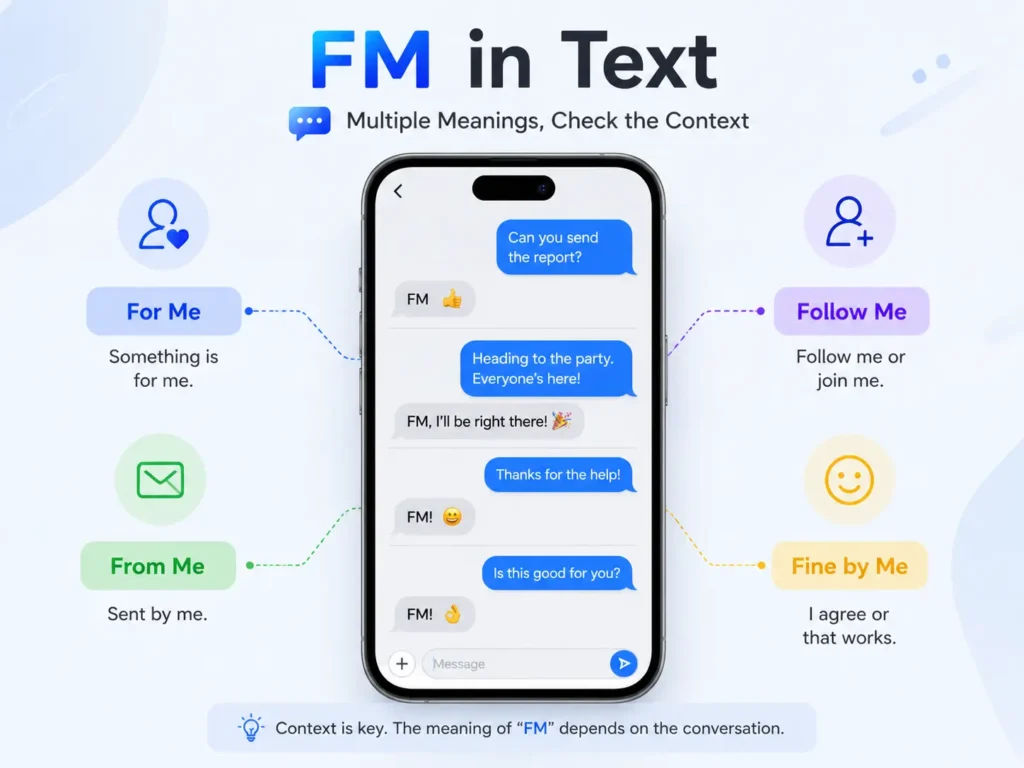
The FM meaning in texting is not as fixed as its radio definition. It may mean “for me,” “follow me,” “from me,” or “fine by me,” depending on the sentence.
Text abbreviations often change meaning depending on grammar and conversation context. You can see the same pattern in our WFY Meaning in Text guide, which explains how one shortcut may refer to waiting or asking about someone’s plans.
“Can you save a seat FM?” likely means “for me.”
“FM for daily updates” probably means “follow me.”
“This package is FM” may mean “from me,” although this use is less common.
“We can leave at nine—FM” may mean “fine by me” because the sender is agreeing.
FM can occasionally represent a flirty or adult phrase. Do not assume that meaning without clear clues. The speakers’ relationship, tone, emojis, and surrounding words matter.
What Does FM Stand For in Radio?
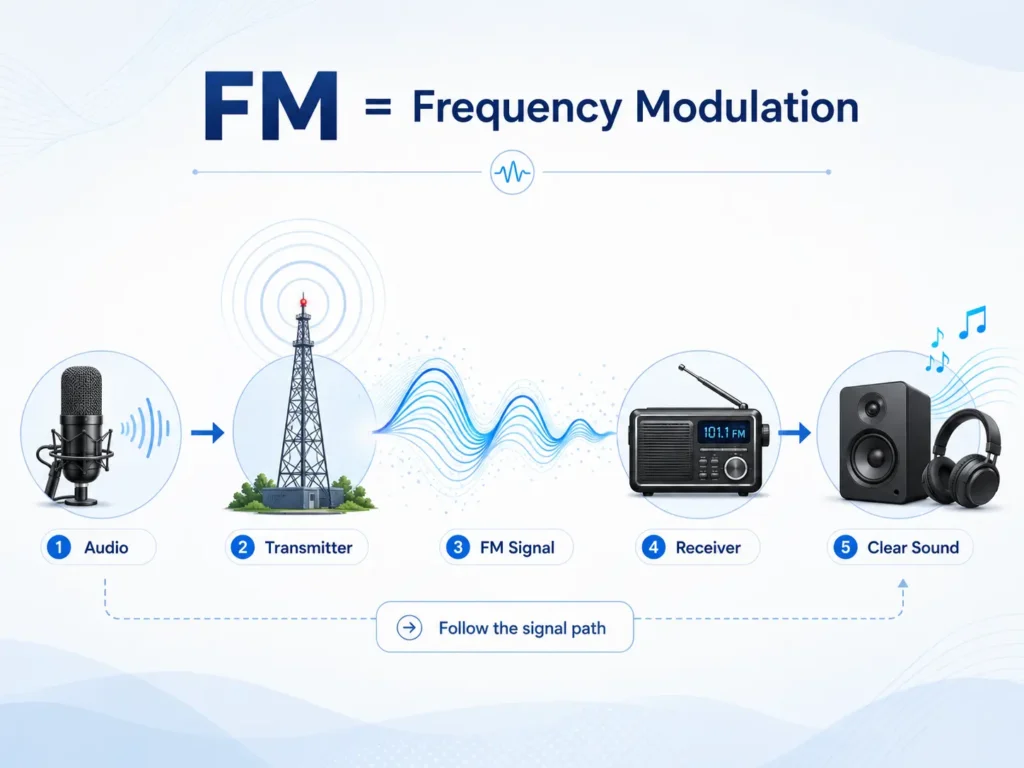
In radio communication, FM stands for frequency modulation. The term combines two ideas.
Frequency is the number of wave cycles completed in one second. It is measured in hertz, or Hz. Larger units include kilohertz, or kHz, and megahertz, or MHz.
Modulation means changing a carrier wave so it can transport information, such as an audio signal or digital data.
FM therefore means changing the frequency of a carrier wave in response to the information being transmitted. It is a transmission method, not simply the name of a radio station.
How Does FM Radio Work?
Sound cannot travel from a studio to distant radio receivers by itself. A broadcasting system must encode the sound onto a radio-frequency carrier wave.
1. A Microphone Captures Sound
A microphone receives speech or music and converts the audio waves into an electrical information signal.
2. A Transmitter Modulates the Carrier Wave
The transmitter combines the audio signal with a high-frequency carrier signal. In FM transmission, the carrier frequency moves slightly higher or lower in response to the sound.
3. An Antenna Broadcasts the Signal
A broadcast antenna sends the modulated signal through the air as electromagnetic radio waves.
4. A Receiver Tunes to the Station
The antenna inside an FM receiver detects radio signals. The tuner selects the frequency assigned to the chosen station.
5. The Receiver Decodes the Audio
The receiver demodulates the FM signal, separates the audio information, and sends the reconstructed sound to the speakers.
A simple analogy is a car traveling on the same road while making small speed changes. The road represents the carrier wave’s path, while the speed changes represent frequency variation. The receiver reads those changes and recreates the sound.
What Do FM Station Numbers Mean?
FM stations use numbers such as 88.5, 96.5, 101.1, or 107.9. These numbers identify the station’s assigned carrier frequency in megahertz.
One megahertz equals one million cycles per second. A station at 101.1 FM therefore uses a carrier frequency near 101.1 million cycles per second.
The number does not represent volume, signal power, or audio quality. It tells the tuner where to find the station within the radio spectrum.
In the United States, standard FM broadcasting operates between 88 and 108 MHz. Channel arrangements may differ in other countries, but the same principle applies.
Nearby stations use different frequencies to reduce interference. If two local stations transmitted on the same channel with overlapping coverage, a receiver might detect both signals, causing distortion or unstable reception.
Signal power, transmitter location, broadcast antenna height, terrain, and nearby buildings can also affect reception quality.
FM vs. AM: What Is the Difference?
FM and AM both use radio waves, but they encode information differently.
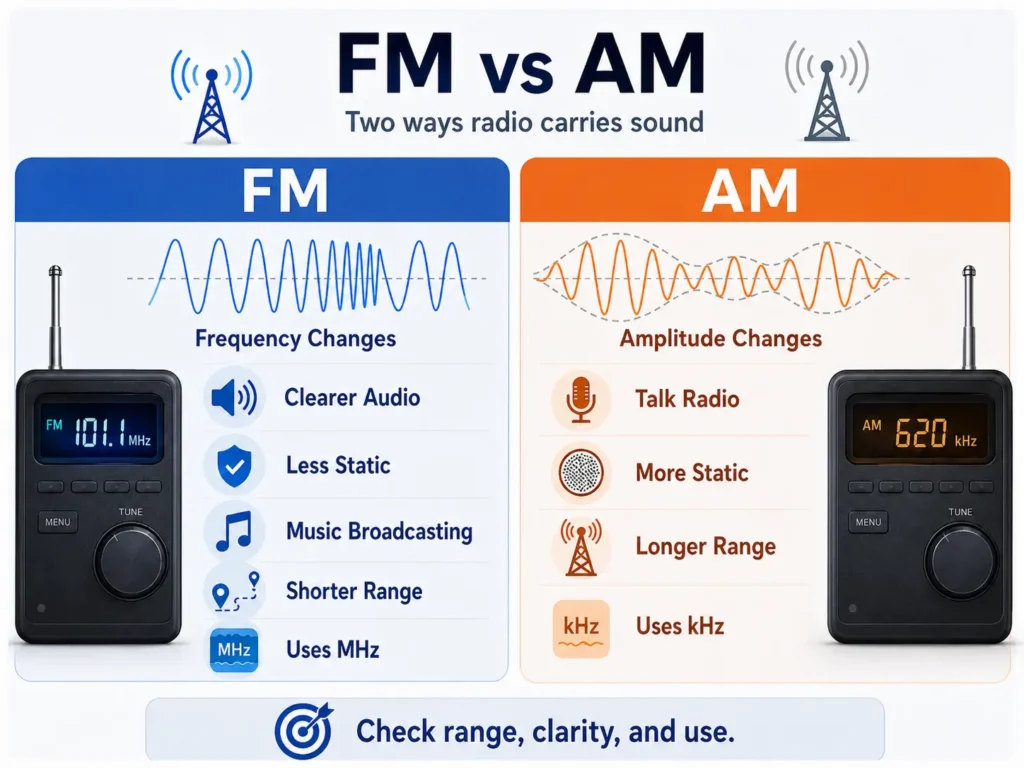
FM stands for frequency modulation and changes the carrier wave’s frequency.
AM stands for amplitude modulation and changes the carrier wave’s amplitude, or strength.
| Feature | FM | AM |
| Full form | Frequency Modulation | Amplitude Modulation |
| Signal feature changed | Frequency | Amplitude |
| Audio quality | Clearer and higher fidelity | Lower fidelity |
| Static | Usually less noticeable | Usually more noticeable |
| Bandwidth | Wider | Narrower |
| Typical programming | Music and local entertainment | News, talk, sports, and information |
| Common unit | MHz | kHz |
| Typical coverage | Local or regional | Often longer-distance |
Why Does FM Usually Sound Clearer?
Electrical storms, motors, power lines, and electronic equipment often affect signal amplitude. AM receivers may reproduce some of this interference as static.
FM receivers focus mainly on frequency variation. This gives FM stronger resistance to radio-frequency interference and often produces a better signal-to-noise ratio.
FM also uses wider bandwidth, allowing more audio detail and supporting clearer music reproduction and stereo broadcasting.
Why Can AM Travel Farther?
AM normally operates at lower frequencies. Its signals can follow the Earth through ground-wave propagation and may reflect from the atmosphere at night through skywave propagation.
FM signals usually rely on line-of-sight transmission. Mountains, tall buildings, and the curvature of the Earth can block or weaken them.
FM therefore suits music, stereo broadcasting, and high-quality local programming. AM remains useful for long-distance news, talk radio, sports, weather information, and emergency broadcasting.
Advantages, Types, and Other Uses of FM
FM radio usually provides clearer audio, less audible static, and better music reproduction than AM. It also supports stereo broadcasting and resists many forms of amplitude-based electrical noise.
However, FM has limits. Its signals usually cover a shorter distance, and hills, buildings, or other obstacles can weaken reception. FM also requires more bandwidth, so broadcasters must manage channel spacing carefully.
Commercial music stations commonly use wideband FM because greater frequency deviation supports higher audio quality. Narrowband FM uses less spectrum and works well for voice services such as business radios, amateur radio, event coordination, and some public safety systems.
Frequency modulation also appears in telemetry, wireless audio equipment, remote communication, and signal processing. In music technology, FM synthesis creates electronic sounds by using one frequency to modify another. This differs from FM broadcasting, but both rely on controlled frequency variation.
FM Meaning on Social Media
On Instagram or TikTok, FM often means “follow me.” Creators may use it in captions, comments, or profile descriptions when inviting users to visit their accounts.
For example:
“FM and check out my latest video.”
On Snapchat and WhatsApp, the FM meaning may shift because messages are more conversational. It can mean “for me” in a request or “fine by me” in a reply.
Social media language changes quickly, and communities may use the same abbreviation differently. Always read the complete sentence instead of relying on one definition.
FM Meaning in Online Chats and Gaming
In gaming chats, FM may mean “follow me” when a player wants teammates to move together.
For example:
“FM to the next checkpoint.”
It could also refer to a game title, feature, mode, team, or server-specific phrase. A sports gaming community might use FM for “Football Manager.”
The correct meaning depends on the game and group vocabulary. When the abbreviation does not fit naturally, ask the sender to explain it.
Different Meanings of FM Depending on Context
FM has several formal meanings outside radio and texting.
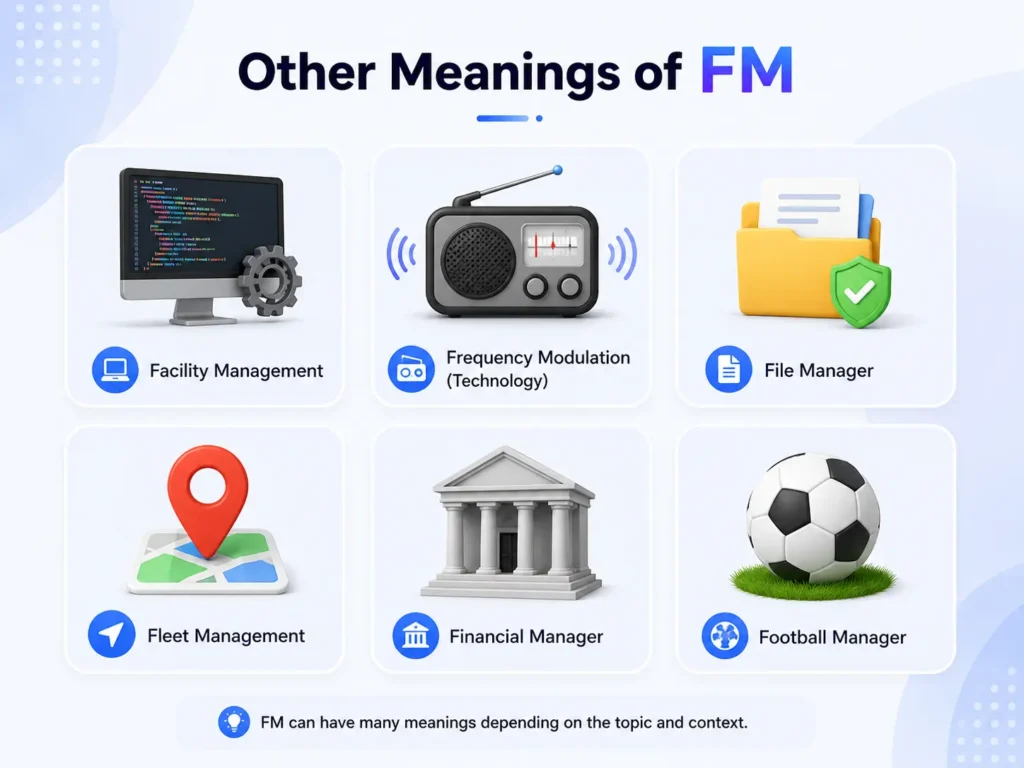
Facilities Management
In business, FM often means facilities management. This field covers building maintenance, workplace services, repairs, safety, cleaning, utilities, and property operations.
Like FM, some uncommon abbreviations cannot be understood from the letters alone. Our IBVS Meaning guide shows how the platform, topic, sentence structure, and surrounding conversation help reveal the correct interpretation.
Foreign Minister
News reports may use FM for Foreign Minister, especially in headlines about international meetings or diplomacy.
FIDE Master
In chess, FM means FIDE Master, an official title awarded under the international chess organization’s rating and achievement system.
Science and Measurement
Lowercase “fm” can represent a femtometre, a very small unit of length. In specialized settings, FM may relate to other measurements, so capitalization and subject matter are important.
Computing and Music
Older data-storage systems used frequency modulation encoding. Modified frequency modulation, or MFM, later improved storage efficiency.
In music production, FM may refer to FM synthesis, which creates sounds through interactions between different frequencies.
To find the correct interpretation, check the topic, platform, sender, and nearby words. Replace FM with each possible phrase and choose the one that makes grammatical and logical sense.
Is FM Formal or Informal?
FM can be formal or informal.
It is formal when it means frequency modulation, facilities management, Foreign Minister, or FIDE Master. In these settings, writers normally use uppercase letters.
It is informal when it shortens phrases such as “for me” or “follow me.” Lowercase “fm” may appear in casual chat, but it should not be confused with scientific notation.
FM is usually an initialism because people pronounce it as “eff-em.” An acronym is spoken as a word, while an initialism is spoken letter by letter.
Origin and Evolution of FM Radio
American electrical engineer Edwin Howard Armstrong helped develop practical wideband FM during the early twentieth century. Radio systems at the time often suffered from static and electrical interference, especially when using amplitude modulation.
Armstrong’s work showed that transmitting information through frequency changes could improve noise resistance and sound clarity. FM broadcasting later expanded as more stations, home receivers, and car radios became available.
Its wider audio bandwidth and stereo capability made FM attractive for music stations. Although streaming and digital radio now offer more choices, analog FM remains useful for local broadcasting, portable radios, and emergency communication.
Related Radio and Texting Abbreviations
Several abbreviations may appear near FM:
- AM: Amplitude modulation
- RF: Radio frequency
- MHz: Megahertz
- Hz: Hertz
- SNR: Signal-to-noise ratio
- DM: Direct message
- PM: Private message
- F4F: Follow for follow
- LMK: Let me know
These terms can reveal whether a conversation concerns radio technology or online communication.
Some texting shortcuts look very similar but communicate completely different ideas. Read our WYFF Meaning guide to understand how spelling, letter order, and context affect the intended message.
Frequently Asked Questions
What is the full form of FM?
The primary full form of FM is frequency modulation.
What does FM mean in a text?
It can mean “for me,” “follow me,” “from me,” or “fine by me.” Context decides the correct meaning.
What does FM mean on Instagram or TikTok?
It often means “follow me,” especially when it appears in captions, profile descriptions, or creator calls to action.
Does FM radio need the internet?
No. A traditional FM receiver picks up radio waves from a broadcast transmitter without requiring an internet connection.
Is FM radio analog or digital?
Traditional FM broadcasting is analog, although some modern systems combine radio broadcasting with digital technology.
Why does FM sound clearer than AM?
FM resists many types of amplitude-based radio-frequency interference and supports wider audio bandwidth.
Is FM still used today?
Yes. FM remains common in local radio, music broadcasting, portable receivers, two-way communication, and emergency systems.
Final Thoughts
The most common FM meaning is frequency modulation, a method that carries information by changing a carrier wave’s frequency. It supports clear audio, reduced static, and reliable local broadcasting.
In texts and social media, FM has no universal definition. It may mean “for me,” “follow me,” “from me,” or “fine by me.” In professional contexts, it can refer to facilities management, Foreign Minister, FIDE Master, scientific measurement, computing, or music synthesis.
The best way to understand FM is to examine the full context. The topic, platform, sender, capitalization, and surrounding words usually reveal the intended meaning.