
If you keep seeing NGL in texts, TikTok comments, Instagram captions, or online chats, the meaning is usually simple. NGL stands for “not gonna lie.” People use it when they want to share an honest opinion, admit something, soften criticism, or add emphasis.
The NGL meaning can feel slightly different depending on the sentence. “NGL, I loved that movie” sounds positive, while “That was disappointing, ngl” expresses criticism. In both cases, the abbreviation signals that the speaker is being direct about what they think.
NGL is common in informal digital communication because it is short, easy to type, and fits naturally into casual conversation. This guide explains what NGL means in texting, social media, online chats, and other common situations.
What Does NGL Mean?
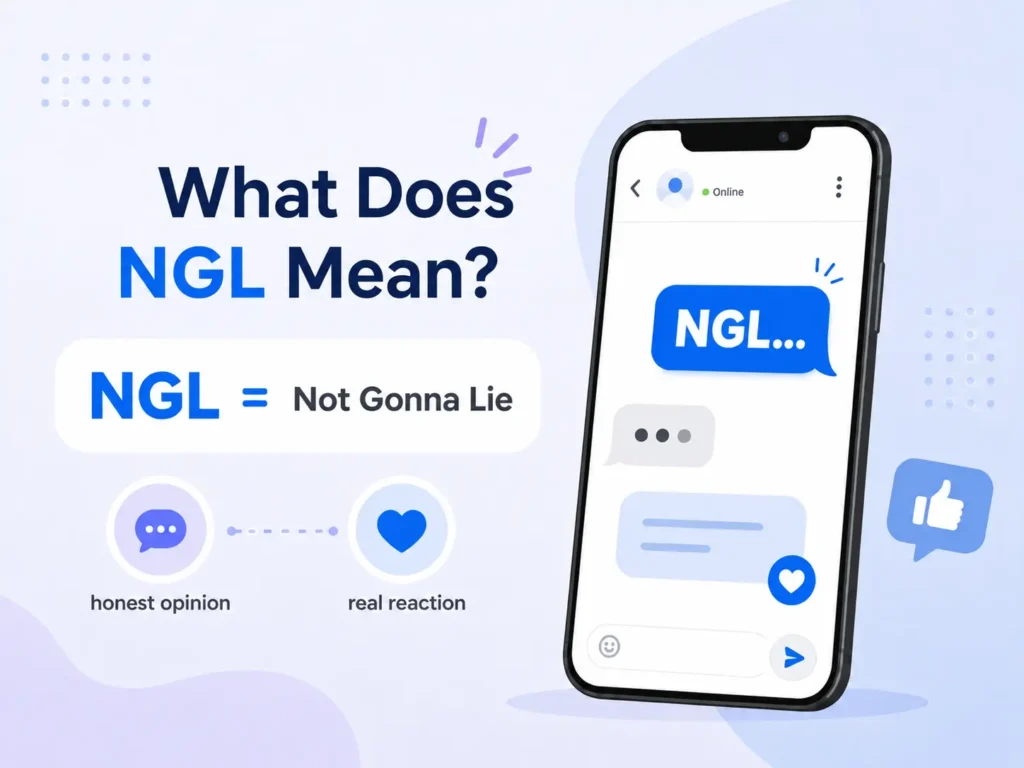
NGL usually means “not gonna lie.” It is an informal abbreviation used to introduce an honest thought, reaction, confession, or opinion.
For example:
“NGL, that restaurant was better than I expected.”
The speaker is saying that they genuinely enjoyed the restaurant, perhaps more than they thought they would.
Another example is:
“I was nervous before the interview, ngl.”
Here, the person is admitting a feeling they may not have mentioned otherwise.
Cambridge Dictionary describes NGL as an informal abbreviation connected with admitting something or expressing an opinion. That fits the way people commonly use the expression in texts and online conversations.
Simple Definition of NGL
The simplest definition is:
NGL = Not Gonna Lie
“Gonna” is an informal form of “going to,” so the full phrase can also be understood as “not going to lie.”
People do not normally use NGL as a literal promise that they never lie. Instead, it works as a conversational signal that the statement reflects the speaker’s honest reaction.
For instance:
“NGL, I want to go home.”
This means something close to:
“Honestly, I want to go home.”
That link between NGL, honesty, and personal opinion is the key to understanding the expression.
Is NGL an Acronym or an Abbreviation?
NGL is best described as an initialism or abbreviation because each letter represents a separate word:
- N — Not
- G — Gonna
- L — Lie
People often call terms like NGL “acronyms” in everyday conversation, but an acronym is usually pronounced as a word. NGL is normally pronounced letter by letter: “N-G-L.”
In casual discussions about texting slang, however, terms such as acronym, abbreviation, and shorthand are often used loosely.
What Does NGL Mean in Text Messages?
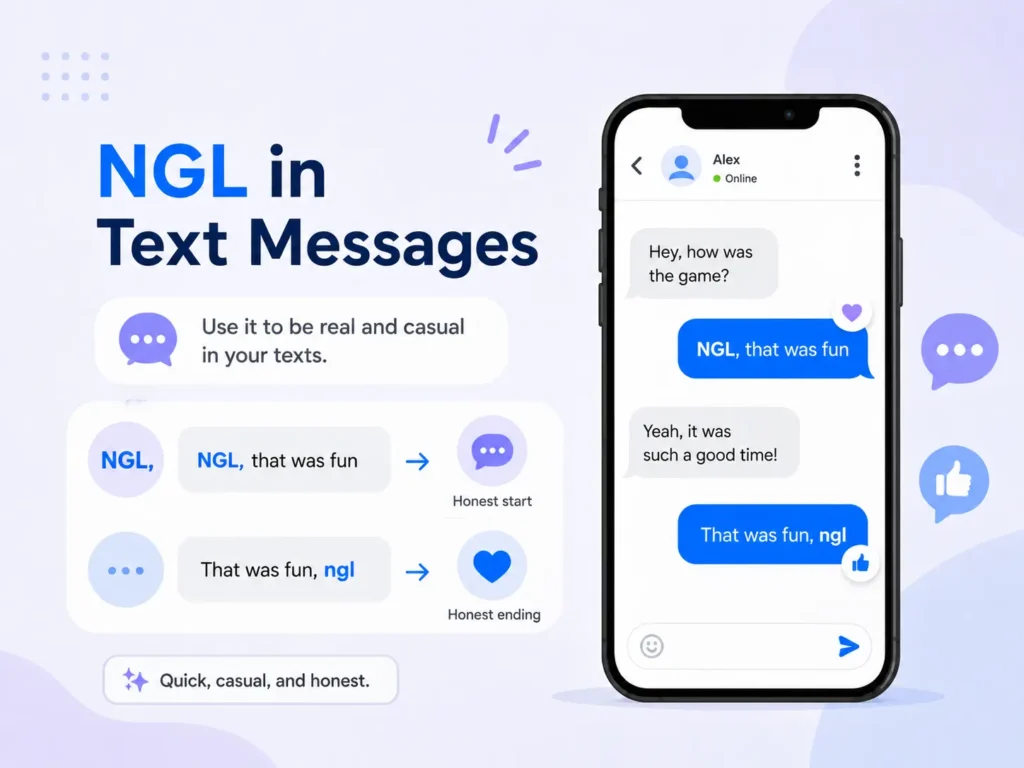
In text messages, the NGL meaning is almost always “not gonna lie.” People use it to make a message sound more honest, personal, or direct.
It can introduce an opinion:
“NGL, I think the black shoes look better.”
It can introduce an admission:
“NGL, I forgot to reply.”
It can also emphasize a reaction:
“That test was hard, ngl.”
The words around NGL tell you whether the message is positive, negative, serious, or playful.
NGL at the Beginning of a Text
When NGL appears at the beginning, it prepares the reader for what comes next.
“NGL, your presentation was really good.”
The sender is giving a compliment and signaling that they mean it sincerely.
“NGL, I didn’t understand the ending.”
Here, the abbreviation introduces an honest admission.
At the beginning of a message, NGL often works like “honestly,” “to be honest,” or “if I’m being honest.”
NGL at the End of a Text
NGL can also appear at the end of a sentence.
“I miss those days, ngl.”
In this position, NGL reinforces the feeling that the person has already expressed.
“That update made the app worse, NGL.”
The speaker is emphasizing a critical opinion.
The meaning does not change much based on sentence position. At the beginning, NGL introduces the thought. At the end, it often adds emphasis after the thought has already been stated.
Common Texting Examples
Here are a few common ways NGL appears in messages:
“NGL, I’m tired today.”
The speaker is admitting how they feel.
“You were right, ngl.”
The sender openly admits that the other person was correct.
“NGL, that outfit looks great.”
The phrase introduces a sincere compliment.
“That meeting was too long, ngl.”
The sender gives a blunt but honest opinion.
These examples show why context matters. NGL does not make a sentence automatically positive or negative. It simply signals that the speaker is being candid.
NGL Meaning on Social Media
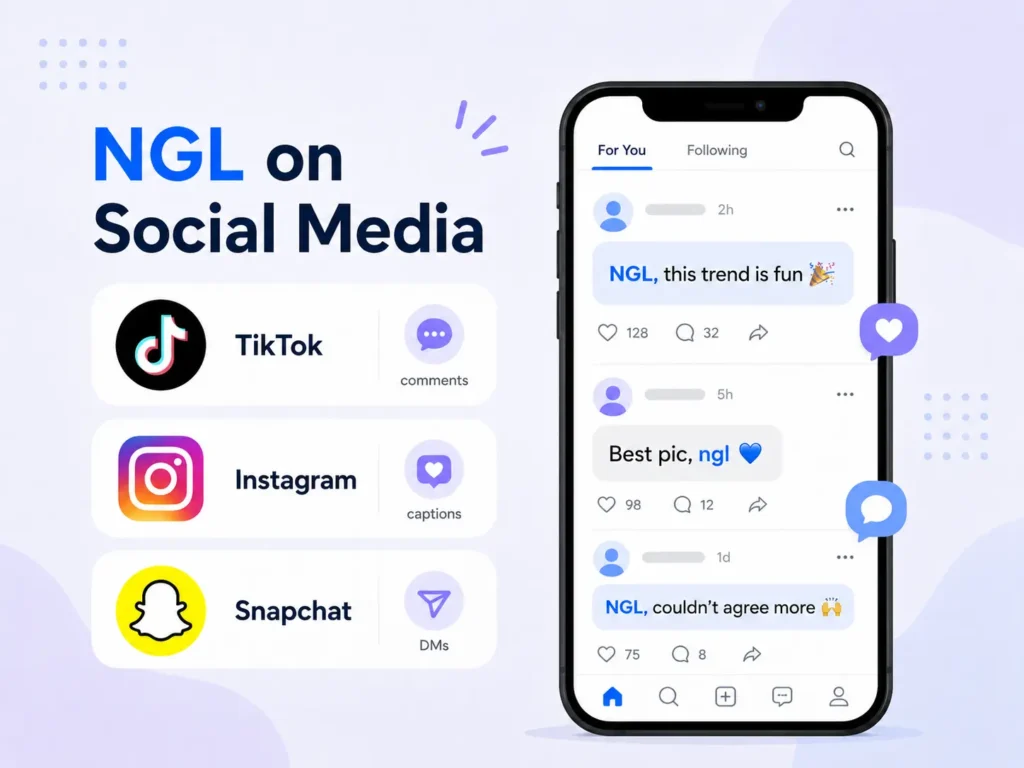
The NGL meaning stays mostly the same on social media. On TikTok, Instagram, Snapchat, and other platforms, NGL usually means “not gonna lie.”
Users add it to captions, comments, replies, and direct messages when sharing a reaction or opinion.
On TikTok:
“NGL, this trend is actually funny.”
On Instagram:
“NGL, this is my favorite photo from the trip.”
On Snapchat:
“You were right about that, ngl.”
In each example, NGL adds a conversational tone and suggests that the person is giving a genuine reaction.
The lowercase form ngl is also common. Capitalization usually does not change the meaning. Uppercase may look more noticeable, while lowercase can feel more casual.
NGL Meaning in Online Chats and Gaming
NGL also appears in group chats, gaming communities, and other online spaces. It works the same way it does in texting: it introduces honesty, emphasis, or a candid reaction.
For example:
“NGL, that was a great match.”
A player might use this after a competitive game to give sincere praise.
Or:
“That strategy didn’t work, ngl.”
Here, NGL emphasizes criticism without changing the basic meaning of the sentence.
Because online chats move quickly, short forms such as NGL, TBH, FR, IMO, IDK, and LOL help people communicate efficiently. These expressions are part of modern internet slang and digital communication.
Another common shorthand is BC Meaning, where BC usually means “because” in texts, chats, comments, and other casual online conversations.
Different Uses of NGL Depending on Context
Although NGL usually stands for “not gonna lie,” the intention behind it can change depending on context. A person may use it to share an honest opinion, make a confession, soften criticism, give a compliment, or add humor.
NGL for an Honest Opinion
“NGL, I think the first design looks better.”
Here, NGL tells the reader that the speaker is giving their real opinion.
NGL for an Admission
NGL can also introduce something personal or slightly embarrassing.
“NGL, I watched the entire series in one weekend.”
The phrase makes the admission feel casual rather than overly serious.
NGL for Compliments
NGL can make praise sound more sincere.
“NGL, you did an amazing job.”
The speaker uses the abbreviation to emphasize that the compliment reflects their genuine opinion.
NGL for Criticism
People also use NGL before giving negative feedback.
“NGL, the food was disappointing.”
The phrase may make criticism feel more conversational, but it does not automatically make the message polite. A harsh comment can still sound rude even when NGL appears before it.
NGL for Humor or Sarcasm
NGL sometimes appears in jokes or sarcastic comments.
“NGL, getting out of bed was my biggest achievement today.”
The person is probably exaggerating for humor.
Because sarcasm can be difficult to detect in writing, look at emojis, punctuation, previous messages, and the wider conversation before deciding how the sender intended the statement.
Is NGL Positive or Negative?
NGL itself is neutral. It can appear in positive, negative, or humorous messages.
Positive: “NGL, that song is amazing.”
Negative: “That movie was boring, ngl.”
Humorous: “NGL, I came for the snacks.”
The surrounding words determine the tone. This is why understanding the NGL meaning requires more than simply knowing what the letters stand for.
NGL vs Similar Texting Abbreviations
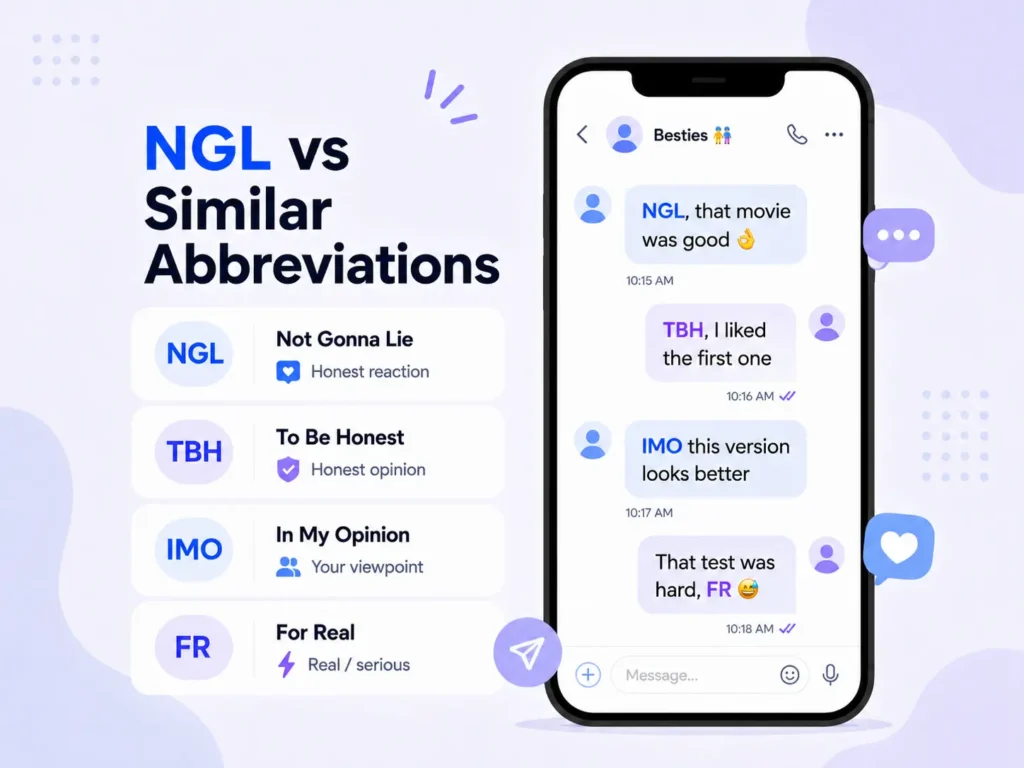
Several internet abbreviations have meanings similar to NGL, especially when people share opinions or emphasize honesty.
NGL vs TBH
TBH means “to be honest.” It is one of the closest alternatives to NGL.
“NGL, I liked the first movie better.”
“TBH, I liked the first movie better.”
Both sentences communicate an honest opinion. NGL often feels slightly more casual and conversational.
NGL vs IMO
IMO means “in my opinion.”
IMO simply tells readers that a statement represents the speaker’s viewpoint:
“IMO, this version looks better.”
NGL adds a stronger sense of candidness:
“NGL, this version looks better.”
NGL vs IMHO
IMHO usually means “in my humble opinion.” It can make an opinion sound softer or more modest.
NGL focuses more on honesty than humility.
NGL vs FR and FRFR
FR means “for real,” while FRFR means “for real, for real.”
People use these expressions to emphasize seriousness, truth, or agreement.
For example:
“That game was difficult, FR.”
NGL would instead frame the statement as an honest reaction:
“NGL, that game was difficult.”
| Abbreviation | Meaning | Main Use |
| NGL | Not Gonna Lie | Honest opinion or admission |
| TBH | To Be Honest | Honest statement |
| IMO | In My Opinion | Personal viewpoint |
| IMHO | In My Humble Opinion | Softer personal opinion |
| FR | For Real | Seriousness or agreement |
| FRFR | For Real, For Real | Strong emphasis |
Is NGL Formal or Informal?
NGL is informal language. It works naturally in texts, social media comments, group chats, gaming conversations, and messages between friends.
For another abbreviation that appears in both messages and traditional writing, see PS Meaning to understand what PS stands for and how its use changes by context.
For example:
“NGL, I’m excited for the weekend.”
This sounds normal in casual conversation.
However, NGL is usually not the best choice for formal writing, academic assignments, business proposals, job applications, or professional emails.
Instead of writing:
“NGL, I disagree with this plan.”
You could write:
“I have some concerns about this plan.”
In workplace communication, clarity matters more than using popular slang. Some coworkers may understand NGL immediately, while others may not.
Origin and Evolution of NGL
The phrase “not gonna lie” existed in spoken English before people shortened it to NGL online. Like many texting abbreviations, NGL became useful because it allowed people to express a familiar phrase with only three letters.
There is no single widely established creator of the slang term. Crowdsourced sources such as Urban Dictionary show that NGL was being recorded online by the late 2000s, including entries from 2009.
As texting, instant messaging, and social media became more common, shortened expressions became part of everyday digital communication. NGL developed alongside terms such as TBH, LOL, IDK, and IMO.
Its popularity also reflects the communication habits associated with younger internet users, including Gen Z, although the expression is not limited to one generation.
Today, NGL appears across text messages, TikTok, Instagram, Snapchat, comments, memes, gaming chats, and other online platforms.
NGL Slang vs the NGL App
The NGL meaning can sometimes cause confusion because NGL is also the name of an anonymous messaging app.
If someone writes:
“NGL, that was hilarious.”
NGL clearly means “not gonna lie.”
But if someone says:
“Send me a message on NGL.”
They may be talking about the app.
Look for context words such as app, link, anonymous message, question, or send. These clues usually make the intended meaning clear.
In ordinary texting or social media conversation, “not gonna lie” remains the most likely meaning.
Popular Texting Acronyms Related to NGL
Understanding related slang can make online conversations easier to follow.
If you often see short replies in messages, you may also want to learn the SG Meaning, which commonly refers to “Sounds Good” in casual texting.
TBH — To Be Honest
TBH introduces an honest opinion.
“TBH, I liked the original better.”
IMO — In My Opinion
IMO marks something as a personal viewpoint.
“IMO, the blue one looks best.”
IDK — I Don’t Know
IDK expresses uncertainty.
“IDK what time they are coming.”
TBF — To Be Fair
TBF introduces another perspective.
“TBF, they didn’t have much time.”
LOL — Laughing Out Loud
LOL usually signals laughter or amusement.
“That video was hilarious LOL.”
These internet acronyms serve different purposes, but they share the same informal style found in texting and social media slang.
Final Thoughts on NGL Meaning
The NGL meaning is usually “not gonna lie.” People use it to introduce an honest opinion, confession, compliment, criticism, reaction, or joke.
You may see NGL at the beginning or end of a sentence, and both uppercase NGL and lowercase ngl are common. The abbreviation itself is neither positive nor negative. Context, tone, emojis, and word choice determine how the message should be understood.
If you are unsure what NGL means in a casual conversation, replace it with “honestly” or “to be honest.” In most cases, the sentence will immediately make sense.
Frequently Asked Questions About NGL Meaning
What does NGL mean in texting?
NGL usually means “not gonna lie.” People use it when sharing an honest opinion, admission, compliment, or reaction.
What does NGL stand for?
NGL stands for “not gonna lie,” an informal version of “not going to lie.”
What does NGL mean on social media?
On social media, NGL normally means “not gonna lie.” It appears in captions, comments, replies, DMs, and casual discussions.
What does NGL mean on TikTok?
On TikTok, NGL usually introduces an honest reaction or opinion, such as “NGL, this trend is actually fun.”
What does NGL mean on Snapchat?
On Snapchat, NGL commonly means “not gonna lie.” In some contexts, however, it may refer to the NGL anonymous messaging app.
Is NGL the same as TBH?
They are similar. NGL means “not gonna lie,” while TBH means “to be honest.” Both can introduce candid opinions.
Is NGL rude?
NGL itself is not rude, but the statement that follows it can sound blunt or critical.
Can NGL be sarcastic?
Yes. NGL can be used humorously or sarcastically, so context and tone matter.
Is NGL appropriate at work?
It may be fine in casual chats with coworkers, but formal emails, reports, and professional documents usually need clearer language.
Why do people put NGL at the end of a sentence?
Putting NGL at the end often reinforces the opinion that came before it, as in “That was difficult, ngl.”