
If you see IDK in a text message, TikTok comment, Instagram caption, group chat, or online conversation, the meaning is usually simple. IDK stands for “I don’t know.” People use this short expression when they lack information, feel uncertain, hesitate about a decision, or simply do not know how to answer.
The IDK meaning can also depend on tone and context. A message such as “IDK, maybe” sounds uncertain, while a short “IDK.” may sometimes feel more serious or dismissive. Punctuation, capitalization, emojis, and the surrounding conversation can all affect how the message sounds.
IDK is common in texting, social media, gaming chats, and other forms of digital communication. Understanding how it works in different situations can help you interpret messages more accurately and avoid confusing uncertainty with indifference.
What Does IDK Mean?
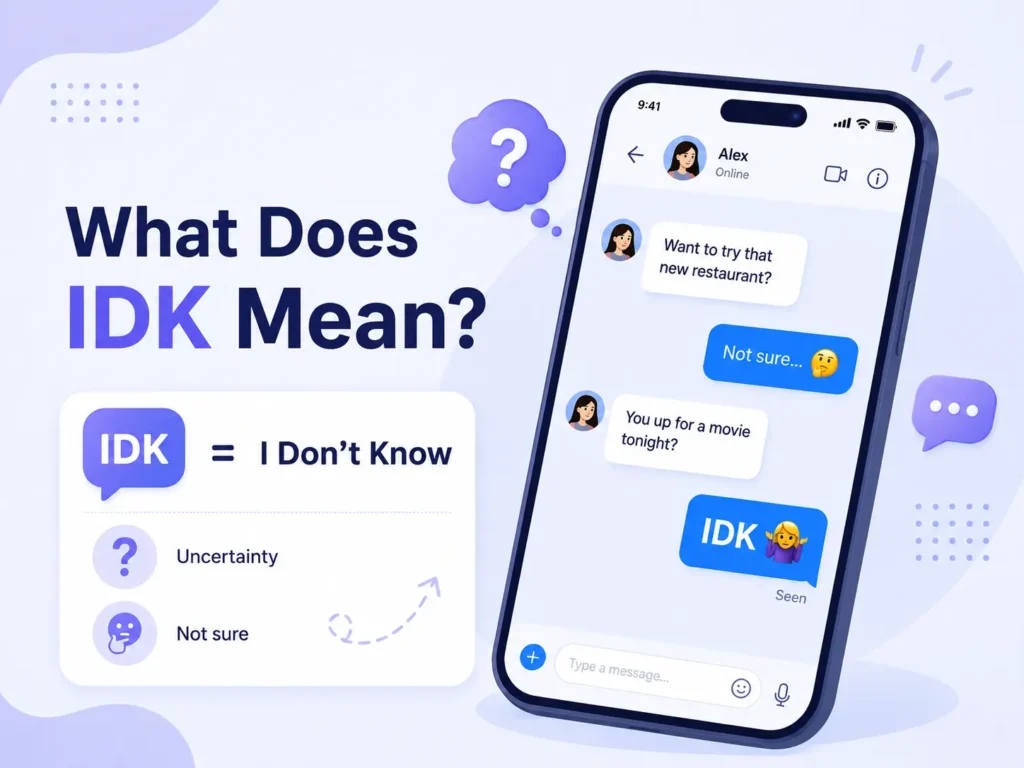
IDK means “I don’t know.” It is an informal abbreviation commonly used when someone does not have an answer or feels unsure.
For example:
“What time does the movie start?”
“IDK, maybe around 8.”
The person does not know the exact time.
IDK can also express hesitation:
“IDK if I want to go.”
Here, the speaker may have enough information to make a decision but has not decided yet.
The IDK meaning therefore stays connected to uncertainty, but the reason for that uncertainty can change. Someone may lack information, feel confused, doubt a decision, or have no clear preference.
Simple Definition of IDK
The simplest definition is:
IDK = I Don’t Know
It is a popular example of internet slang and short-form communication. Instead of typing the complete phrase, people can respond with three letters.
For example:
“Where is Ava?”
“IDK.”
In this case, the answer is direct. The sender simply does not know where Ava is.
Is IDK an Acronym, Initialism, or Abbreviation?
IDK is technically an initialism because people usually pronounce the letters separately: I-D-K.
Each letter represents a word:
- I — I
- D — Don’t
- K — Know
People also commonly call IDK an abbreviation or texting acronym. In casual discussions about internet terminology, these labels are often used interchangeably.
IDK Meaning at a Glance
| IDK Use | Meaning or Tone | Example |
| Direct answer | Lack of knowledge | “IDK where he went.” |
| Uncertainty | Not sure | “IDK if I can come.” |
| Hesitation | Doubt | “IDK, maybe.” |
| Indifference | No strong preference | “IDK, you choose.” |
The words around IDK help determine which tone the sender intends.
What Does IDK Mean in Text Messages?
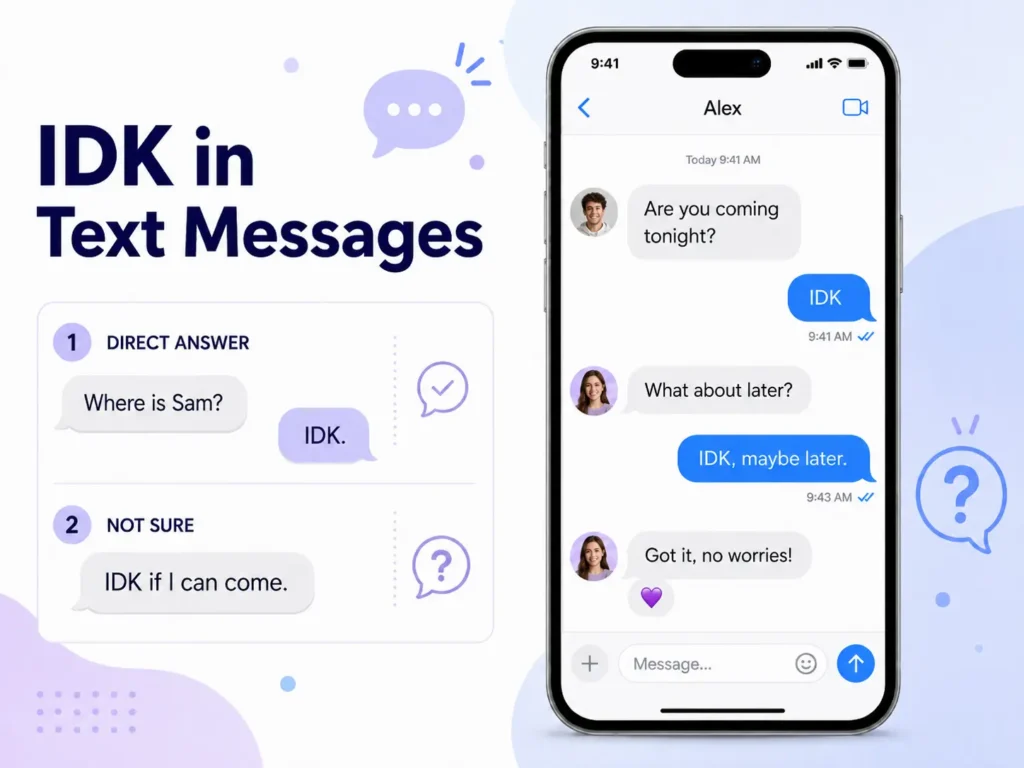
In text messages, IDK usually means “I don’t know.” It can work as a complete reply or appear inside a longer sentence.
For example:
“Who is coming tonight?”
“IDK.”
Or:
“IDK if Mia is coming tonight.”
Both messages express uncertainty, but the second gives more information.
IDK as a Direct Answer
People often use IDK when they cannot answer a question.
Friend 1: “Where did Sam go?”
Friend 2: “IDK.”
This is one of the most common uses.
However, a very short response may sometimes sound uninterested depending on the situation. If the conversation is serious, adding more detail can make the reply sound more helpful:
“IDK, but I can ask him.”
IDK When Someone Is Unsure
IDK can also mean “I’m not sure.”
For example:
“IDK if that’s a good idea.”
The speaker is not saying they have no knowledge at all. Instead, they are expressing doubt.
Another example is:
“IDK whether I should buy it.”
Here, IDK shows hesitation about making a decision.
Common IDK Texting Examples
Different messages can give IDK slightly different tones:
“IDK what to wear.”
The person is uncertain.
“IDK, ask Alex.”
The sender does not know and suggests another person.
“IDK if I can make it tonight.”
The person is unsure about their plans.
“idk lol, that was weird.”
The sender may sound confused but playful.
“IDK, whatever you want.”
The person may have no strong preference.
These examples show that the IDK meaning is simple, but message context affects how it feels.
Another short reply you may see in casual messages is SG Meaning, where SG commonly means “Sounds Good” when someone agrees with a plan or suggestion.
IDK Meaning on Social Media
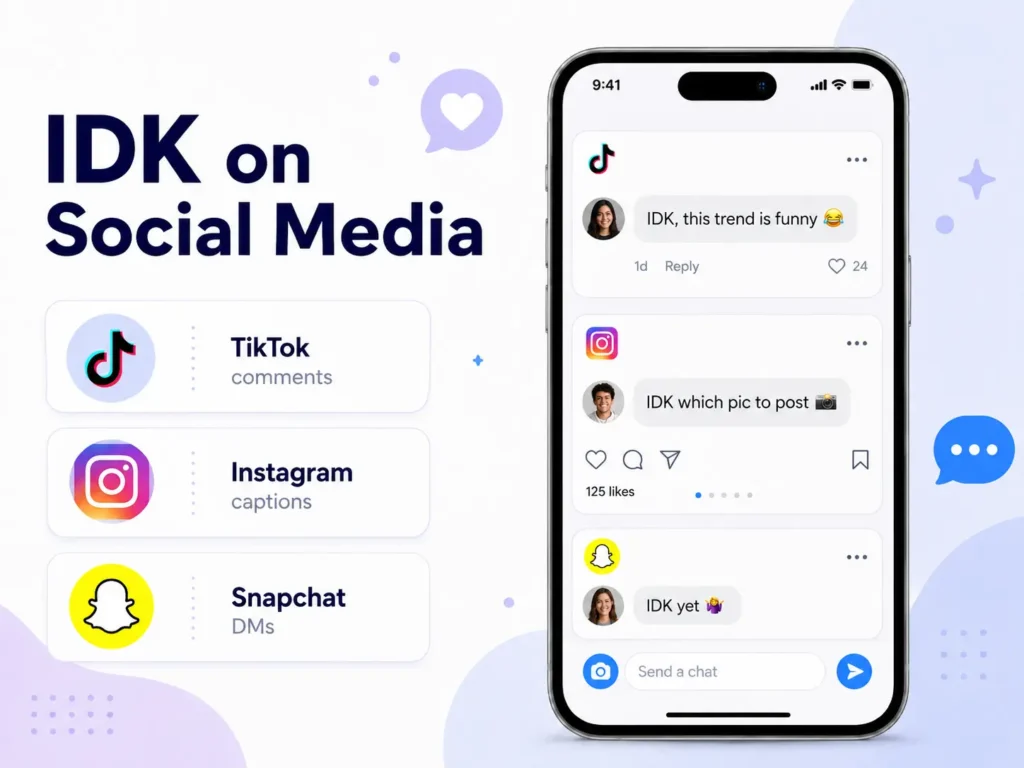
On social media, IDK still means “I don’t know.” People use it in captions, comments, replies, Stories, and direct messages to express uncertainty, confusion, hesitation, or humor.
IDK on TikTok
On TikTok, you may see comments such as:
“IDK why this video is so funny.”
The user is not necessarily asking for an explanation. The phrase simply makes the comment sound casual and conversational.
Another example is:
“IDK if I like this trend yet.”
Here, IDK expresses hesitation.
IDK on Instagram
Instagram users may write:
“IDK which photo to post.”
This shows uncertainty about a choice.
Someone might also say:
“IDK how we got this lucky.”
In this case, the expression may communicate surprise or emotion rather than a literal request for information.
IDK on Snapchat
Because Snapchat conversations are usually informal, IDK often appears in quick replies.
“Are you going out tonight?”
“IDK yet.”
Texting abbreviations such as IDK, IDC, IKR, TBH, and IMO are common in this kind of casual digital communication.
IDK in Comments and DMs
The same abbreviation can sound different depending on the words around it:
“IDK what everyone likes about this song.”
This expresses an opinion.
“IDK what to say 😭.”
This may show surprise, confusion, or emotion.
“IDK, maybe later.”
This suggests hesitation.
Emojis and punctuation can make these meanings easier to interpret.
IDK Meaning in Online Chats and Gaming
The IDK meaning remains the same in group chats, gaming conversations, forums, and online communities. People use it when they need a fast way to communicate uncertainty.
You may also come across BC Meaning in online chats, where BC usually works as a shortened form of “because” in casual digital communication.
In a group chat:
“What time are we meeting?”
“IDK, maybe 7?”
In a gaming conversation:
“Where did the other team go?”
“IDK, maybe left side.”
In a forum:
“IDK if this update actually improved anything.”
In each example, IDK keeps the message short while still communicating doubt or lack of information.
Different Uses and Tones of IDK Depending on Context
Although IDK always comes from “I don’t know,” it does not always communicate exactly the same feeling.
IDK for Genuine Uncertainty
Sometimes the sender simply does not know the answer:
“IDK what time the store closes.”
IDK for Hesitation
IDK can show doubt about a decision:
“IDK if I should go.”
IDK for Confusion
It may also show that someone does not understand something:
“IDK what you mean.”
IDK for Indifference
In some conversations, IDK can suggest that the person has no strong preference:
“IDK, you choose.”
The phrase still means “I don’t know,” but tone and context help reveal whether the sender feels uncertain, confused, hesitant, or simply unconcerned about the choice.
IDK When Someone Does Not Want to Answer
Sometimes, a person may use IDK because they do not want to give a clear answer.
For example:
“Do you like him?”
“IDK.”
The person may genuinely feel unsure, or they may be avoiding the question. The surrounding conversation usually gives the best clue.
IDK Used Humorously or Sarcastically
IDK can also appear in jokes or playful comments.
“IDK why I thought staying up until 3 a.m. was a good idea.”
The speaker probably understands what happened but uses IDK to make the message sound humorous.
Punctuation and emojis can also change the tone:
- “IDK 😭” may show frustration or emotion.
- “IDK 😂” may sound playful.
- “IDK 🤷” often suggests uncertainty or indifference.
- “IDK.” may feel more serious or final.
- “idk lol” usually sounds casual and lighthearted.
Capitalization does not change the basic definition. Lowercase idk often feels more relaxed, while uppercase IDK can add emphasis.
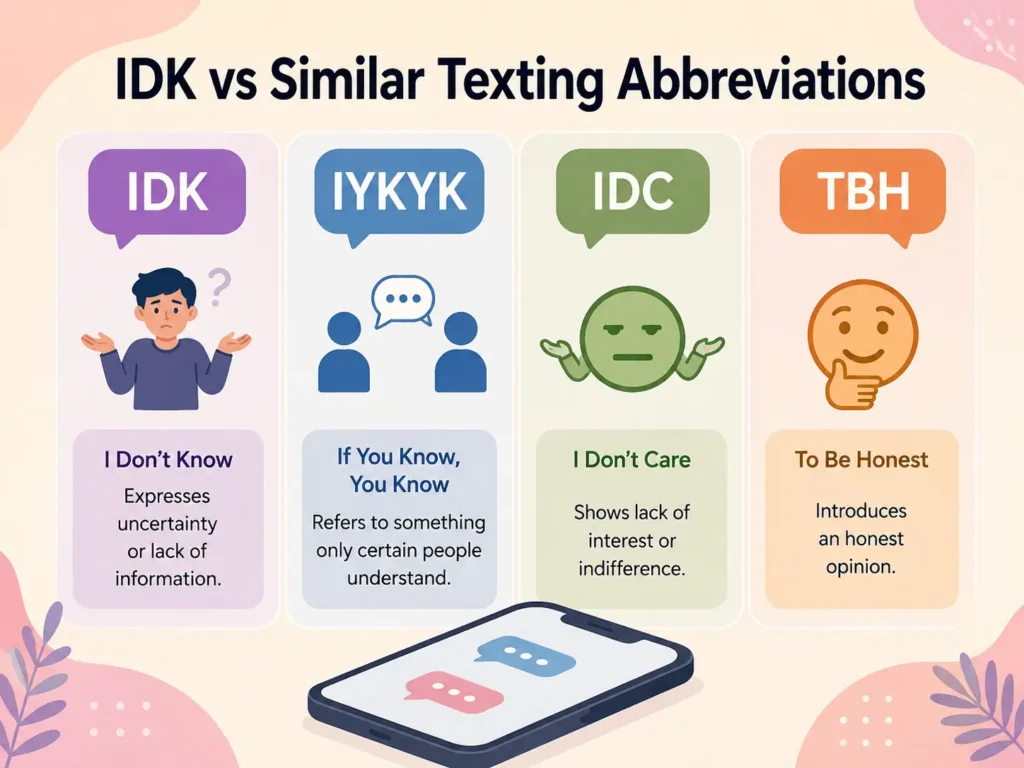
IDK vs Similar Texting Abbreviations
Several texting abbreviations appear in similar conversations, but they have different meanings.
IDK vs IDC
IDK means “I don’t know,” while IDC means “I don’t care.”
Compare:
“IDK where we should eat.”
The person does not know.
“IDC where we eat.”
The person has no preference.
This difference is important because an IDK reply may express uncertainty, while IDC expresses indifference.
IDK vs IDT
IDT means “I don’t think.”
For example:
“IDT he’s coming tonight.”
The speaker is expressing doubt or an opinion rather than saying they have no knowledge.
IDK vs IIRC
IIRC means “if I recall correctly.” People use it when they remember something but are not completely certain.
“IIRC, the meeting starts at 9.”
IDK expresses greater uncertainty because the speaker does not know the answer.
IDK vs IMO
IMO means “in my opinion.”
It introduces a personal viewpoint:
“IMO, the first design looks better.”
IDK instead signals uncertainty or lack of information.
IDK vs TBH and IKR
TBH means “to be honest.” It often introduces a sincere opinion.
IKR means “I know, right?” and usually expresses agreement.
| Abbreviation | Meaning | Main Purpose |
| IDK | I Don’t Know | Uncertainty |
| IDC | I Don’t Care | Indifference |
| IDT | I Don’t Think | Doubt |
| IIRC | If I Recall Correctly | Uncertain memory |
| IMO | In My Opinion | Personal viewpoint |
| IKR | I Know, Right? | Agreement |
Learning these differences helps prevent misunderstandings in text messages and online communication.
Is IDK Formal or Informal?
IDK is mainly informal language. It fits naturally in texts, social media comments, gaming chats, and conversations with friends.
Using IDK With Friends
With friends, IDK usually sounds normal:
“IDK what we should watch tonight.”
The shortened expression keeps the conversation quick and casual.
Using IDK at School or Work
IDK may also appear in informal messages between classmates or coworkers.
For example:
“IDK if the meeting room is free.”
However, clearer wording often works better in professional communication.
Instead of:
“IDK.”
You could write:
“I’m not sure, but I’ll check.”
This sounds more helpful and professional.
When to Avoid IDK
Avoid IDK in formal situations such as:
- academic writing
- job applications
- business reports
- formal emails
- professional documents
Better alternatives include:
- “I’m not sure.”
- “I don’t have that information.”
- “I’ll need to check.”
- “I’m uncertain about that.”
Origin and Evolution of IDK
IDK developed from the everyday phrase “I don’t know.” As internet and SMS culture grew, people began shortening common expressions to save time and typing effort.
Short forms became especially useful in text messaging and online chats, where quick communication mattered. Over time, IDK became part of common internet slang alongside abbreviations such as LOL, BTW, IMO, and TBH.
As social media, gaming communities, and online communication expanded, IDK became familiar across many digital spaces.
The abbreviation remains popular because it is simple. Three letters can quickly express uncertainty, hesitation, or lack of knowledge.
Popular Texting Acronyms Related to IDK
Other common abbreviations include:
- IDC — I Don’t Care
- IKR — I Know, Right?
- IMO — In My Opinion
- TBH — To Be Honest
- IDT — I Don’t Think
- IIRC — If I Recall Correctly
- BTW — By the Way
- NGL — Not Gonna Lie
If you want to understand another common expression used for honest reactions, check the NGL Meaning, which usually stands for “Not Gonna Lie.”
These expressions belong to the same casual texting culture, but each communicates a different idea.
How Should You Reply When Someone Says IDK?
The best response depends on the conversation.
If the person genuinely does not know, you can say:
“No problem, I’ll check.”
If they seem uncertain:
“Take your time and let me know.”
If you need a clear answer:
“Can you find out and get back to me?”
If the reply sounds dismissive, avoid immediately assuming the person is being rude. A short IDK can sometimes reflect uncertainty rather than attitude.
Final Thoughts on IDK Meaning
The IDK meaning is usually “I don’t know.” People use it in text messages, social media, online chats, gaming conversations, and other forms of digital communication when they feel uncertain or lack information.
IDK can also express hesitation, confusion, or indifference depending on context. Punctuation, capitalization, emojis, and surrounding words can influence how the message sounds.
In casual communication, IDK is quick and widely understood. In formal or professional writing, complete phrases such as “I’m not sure” or “I’ll need to check” are usually clearer.
Frequently Asked Questions About IDK Meaning
What does IDK mean in texting?
IDK means “I don’t know.” It usually expresses uncertainty, hesitation, or lack of information.
What does IDK stand for?
IDK stands for “I don’t know.”
What does IDK mean on social media?
On social media, IDK usually means “I don’t know.” It may appear in comments, captions, DMs, and replies.
What does IDK mean on TikTok?
On TikTok, IDK commonly expresses uncertainty, confusion, hesitation, or a casual reaction.
What does IDK mean on Snapchat?
On Snapchat, IDK usually means “I don’t know” in informal conversations.
Is IDK rude?
IDK is not automatically rude. However, a short reply such as “IDK.” can sometimes sound dismissive depending on tone and context.
What does “idk lol” mean?
It usually means “I don’t know” with a playful or lighthearted tone.
What does IDKKK mean?
IDKKK is an exaggerated version of IDK. The extra letters can add emotion, frustration, excitement, or playful uncertainty.
What is the difference between IDK and IDC?
IDK means “I don’t know,” while IDC means “I don’t care.” IDK expresses uncertainty; IDC expresses indifference.
Is IDK appropriate in professional messages?
It may be acceptable in casual workplace chats, but formal communication usually benefits from clearer wording such as “I’m not sure” or “I’ll check.”
Can IDK mean “I don’t care”?
Not literally. However, an IDK response can sometimes sound indifferent depending on the tone.
How should you respond when someone says IDK?
You can ask a follow-up question, offer to find the information, or give the person time to decide.