
Seeing “IKYFL” in a message can feel confusing. You may wonder whether the sender is joking, accusing someone of lying, or reacting to surprising news. The answer depends on the conversation, your relationship, and the tone created by punctuation or emojis.
The most common IKYFL meaning is “I know you’re fucking lying.” People use this internet acronym to express disbelief, shock, suspicion, or surprise. It may sound aggressive literally, but many users type it playfully when news feels unbelievable.
This guide explains the abbreviation, its tone, and its context. It also helps you distinguish a humorous reaction from a serious accusation.
Quick Answer: What Does IKYFL Mean?
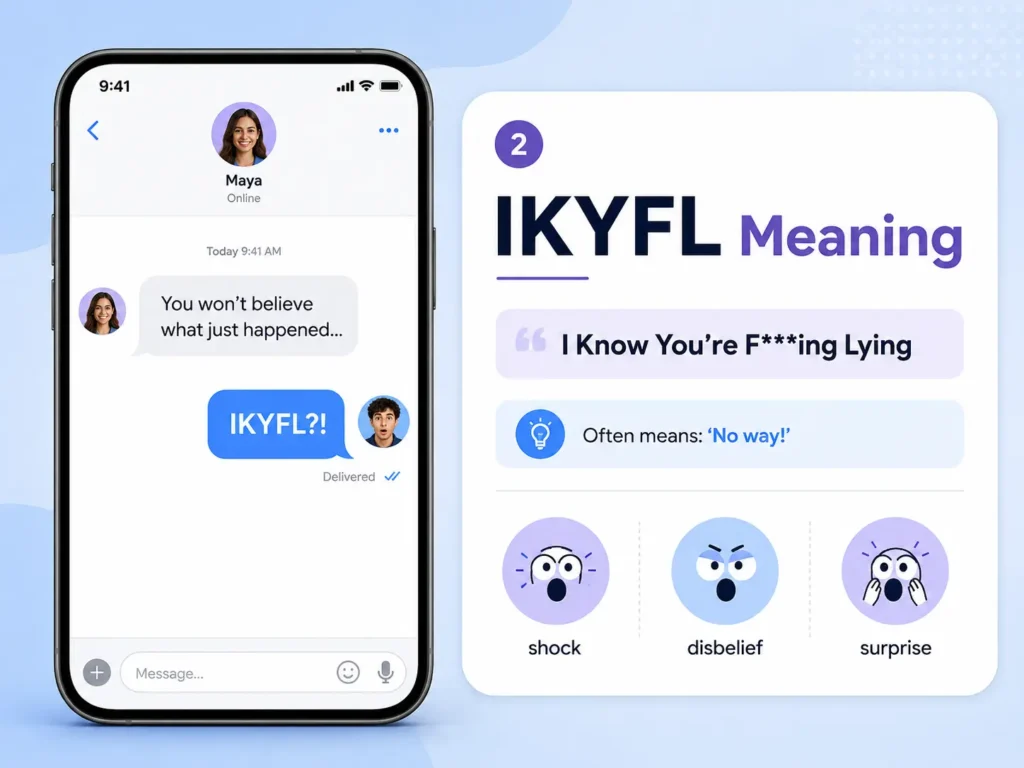
IKYFL usually stands for “I know you’re f***ing lying.” It is informal texting slang used when someone finds a statement shocking, unbelievable, suspicious, or difficult to accept.
In many casual conversations, it means something softer, such as:
- “No way.”
- “You must be joking.”
- “I cannot believe you.”
- “Are you serious?”
- “That cannot be true.”
The phrase includes implied profanity, although it appears as an acronym. It works best in relaxed chats with friends, siblings, partners, or people who understand your style.
IKYFL stands for “I Know You or You’re F***ing Lying.”
The dominant IKYFL meaning comes from a spoken expression that challenges an unbelievable statement. Some read it as “I know you’re fucking lying,” while others use “I know you’re fing lying.” Both communicate the same idea.
The phrase does not always mean the sender has proof of dishonesty. It often acts as an emotional response after surprising gossip, unexpected good news, or an unbelievable online claim.
For example:
Ava: “I won two tickets to the concert.”
Mia: “IKYFL! When did that happen?”
Mia is probably not accusing Ava of deception. She is showing excitement and disbelief.
Simple Meaning Without the Profanity
A clean interpretation is “I know you are not serious” or “I do not believe what I just heard.” This version captures the emotional intent without repeating the strong language.
The original phrase contains profanity, so initials do not make it suitable for every audience. A teacher, manager, customer, or unfamiliar person may consider it rude or unprofessional.
Is IKYFL a Literal Accusation or Just a Reaction?
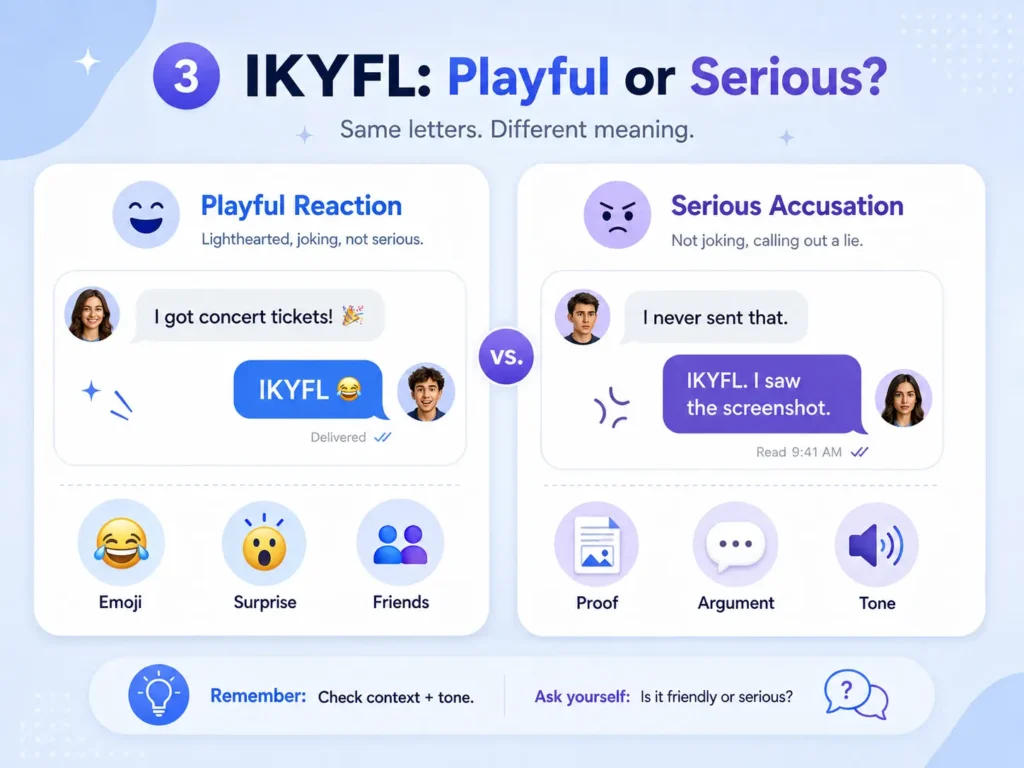
It can be either. In a friendly conversation, the acronym usually expresses playful disbelief. In an argument, it may become a direct accusation of lying.
Compare these examples:
Friend: “My parents bought me a car.”
Reply: “IKYFL 😂”
The laughing emoji makes the reaction feel playful and excited.
Partner: “I never sent that message.”
Reply: “IKYFL. I saw the screenshot.”
Here, the period and supporting evidence make the response serious and confrontational.
The surrounding message matters more than the abbreviation alone. Never assume the sender is joking without checking the context.
What Does IKYFL Mean in Text Messages?
In text messages, IKYFL works as a strong reaction. It is more emotional than “Really?” or “Are you serious?” The sender shows that the information feels shocking, suspicious, or difficult to believe.
Unlike IKYFL, which communicates strong disbelief, HM Meaning usually relates to thinking, hesitation, curiosity, or uncertainty in a conversation.
Expressing Shock or Disbelief
People commonly use the acronym after unexpected news. The information may be positive, negative, funny, or dramatic.
Nora: “Our final exam has been cancelled.”
Zara: “IKYFL! Please tell me this is real.”
The reply shows surprise and hope. It does not necessarily suggest that Nora is dishonest.
Questioning Whether Someone Is Telling the Truth
Sometimes the phrase has a literal meaning. The sender may believe that another person is hiding facts, changing a story, or making a false claim.
Jay: “I was home all evening.”
Sam: “IKYFL. You were in the video.”
This use feels serious because Sam gives a reason for doubting Jay. Tone matters greatly during arguments, relationship conflicts, and trust discussions.
Reacting to Gossip or Surprising News
IKYFL often appears when people share gossip, celebrity news, school drama, workplace updates, or relationship stories.
Lina: “Tara and Noah are dating again.”
Reem: “IKYFL! After everything that happened?”
The expression adds drama and matches the conversation’s emotional energy. Here, it often means “That news is unbelievable.”
Using IKYFL as Playful Exaggeration
Friends may use the abbreviation even when they believe the information. They exaggerate their disbelief to make the conversation more entertaining.
Omar: “I finished the whole project before midnight.”
Hassan: “IKYFL 😂 You never finish early.”
The response teases Omar instead of attacking his honesty. Shared humor makes the meaning easier to recognize.
How to Identify the Correct IKYFL Meaning
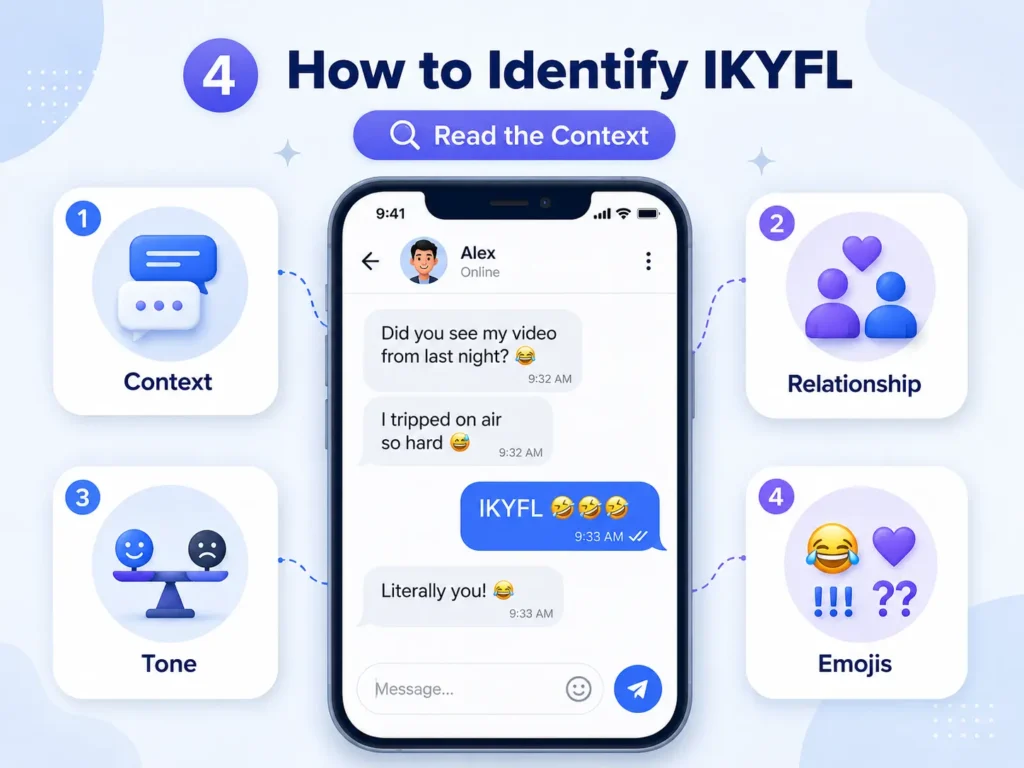
Acronyms can lose important emotional details because readers cannot hear the sender’s voice. Use the following clues before deciding what a message means.
Read the Message That Came Before It
The previous message usually provides the strongest clue. Surprising good news often leads to playful disbelief, while a disputed claim may trigger a serious accusation.
If the conversation concerns proof, broken trust, or conflicting stories, the phrase may sound confrontational. After exciting gossip or an unexpected announcement, it probably expresses surprise.
Consider Your Relationship With the Sender
Close friends often use strong slang without intending harm. They already understand each other’s humor, habits, and boundaries.
The message may feel offensive from a stranger, coworker, manager, or new acquaintance. Your relationship helps determine whether it sounds teasing, casual, disrespectful, or hostile.
Check Whether the Conversation Is Serious or Playful
Look at the subject. Birthdays, jokes, memes, or harmless gossip usually create a playful setting. Cheating, money, workplace conduct, or broken promises create a serious one.
Do not judge the phrase in isolation. Read several messages around it before responding.
Notice Capitalization, Punctuation, and Emojis
Small visual details can change the emotional tone:
| Version | Likely tone |
| ikyfl 😂 | Playful disbelief |
| IKYFL?! | Strong shock |
| ikyfl 🙄 | Annoyance or skepticism |
| IKYFL. | Serious or confrontational |
Capital letters can add intensity. Question marks suggest surprise, while a final period may make the statement feel firm. Emojis can soften the reaction, but they do not always remove its offensive edge.
Replace IKYFL With “No Way” or “You’re Lying”
A useful test is to replace the acronym with two possible phrases. First try “No way.” Then try “You’re lying.”
The option that fits the conversation naturally is probably closest to the intended meaning. This simple method helps separate playful disbelief from a direct accusation and prevents unnecessary misunderstandings.
What Tone Does IKYFL Communicate?
The phrase can communicate several emotions, so tone depends on context rather than the letters alone.
Playful or Amused Disbelief
With laughing emojis, exclamation marks, or friendly teasing, it often sounds humorous. The sender is impressed, entertained, or pleasantly shocked.
Dramatic Surprise
People also use it to make an ordinary reaction feel stronger. In this case, the acronym means “I cannot believe that happened.”
Sarcasm or Suspicion
An eye-roll emoji, a doubtful question, or a reference to inconsistent details can make the message sarcastic. The sender may question the story without starting a direct argument.
Annoyance or Confrontation
During conflict, IKYFL can sound harsh. It may accuse someone of dishonesty and increase tension. In sensitive conversations, clearer and less aggressive language is usually safer.
Understanding the IKYFL meaning requires more than its full form. The best interpretation comes from context, relationship, punctuation, emojis, and evidence.
Examples of IKYFL in Real Conversations
Real examples make the IKYFL meaning easier to understand.
Reacting to Surprising News
Aisha: “I got accepted into my first-choice university.”
Sara: “IKYFL! That is amazing!”
Sara believes Aisha. Her response communicates happy disbelief rather than an accusation.
Responding to Gossip or “Tea”
Maya: “Leo quit the team after arguing with the coach.”
Nina: “IKYFL. What happened?”
Here, the phrase works like “No way” and invites more details.
Teasing a Close Friend
Bilal: “I woke up at six and went running.”
Hamza: “IKYFL 😂 You hate mornings.”
The laughing emoji and shared history make the message playful.
Using IKYFL in Dating or Relationship Chats
Rina: “I never saw your earlier message.”
Adam: “IKYFL. It says read.”
This example sounds more serious because Adam challenges a claim.
Responding to an Unbelievable Claim
Noah: “I can finish the assignment in ten minutes.”
Eli: “IKYFL. It has twenty questions.”
The response shows skepticism, but it may still be friendly.
Using IKYFL as a Serious Accusation
During arguments, the acronym can directly accuse someone of dishonesty. Use clear language instead when the issue involves trust, money, safety, or relationships.
IKYFL Meaning on Social Media Platforms
The basic definition stays the same across platforms, but the format and audience can change its effect.
IKYFL in Texting and WhatsApp Chats
In private chats, people use it as a quick reaction to surprising information. Close relationships often make the tone easier to interpret.
For a more casual and friendly conversation starter, you can also explore HRY Meaning, a common abbreviation people use to ask “How are you?” in messages.
IKYFL on TikTok and Instagram
On TikTok or Instagram, it may appear under dramatic stories, celebrity updates, transformations, announcements, or unbelievable claims. Comments often use it for exaggerated surprise.
IKYFL on Snapchat
Snapchat users may place it over a photo, video, or screenshot. The visual content usually explains whether the reaction is funny or serious.
IKYFL on X, Discord, and Comment Sections
On public posts, strangers may read the acronym more harshly than friends would. Without shared context, playful slang can look confrontational.
Captions, Memes, and Reaction Posts
Creators sometimes use IKYFL in captions or memes to dramatize disbelief. This usage usually reflects a reaction rather than a literal accusation.
Is IKYFL Rude or Offensive?
IKYFL can be rude because its full form contains profanity and challenges someone’s honesty.
When It Sounds Funny
Among close friends, laughing emojis, jokes, or exciting news can make it sound lighthearted.
When It Sounds Aggressive
It may feel disrespectful during an argument, when sent to a stranger, or when used after someone shares a serious experience.
Why the Relationship Matters
Friends who understand each other’s humor may accept the phrase. Teachers, customers, managers, and unfamiliar people may not.
When You Should Avoid It
Avoid IKYFL in formal emails, sensitive discussions, professional messages, customer communication, and situations where the recipient may feel attacked.
Can You Use IKYFL at Work or School?
IKYFL is unsuitable for professional communication because it includes hidden profanity and may sound accusatory.
Do not send it to a boss, client, teacher, supervisor, or customer. Even when you intend humor, the reader may interpret it as disrespect.
Use cleaner phrases instead:
- “Are you serious?”
- “That surprises me.”
- “Could you clarify that?”
- “I may have misunderstood.”
- “Can you confirm the details?”
These alternatives express disbelief while keeping a respectful tone.
How to Use IKYFL Correctly
Use the acronym with people who understand your humor. Match it to the situation and check whether strong slang is appropriate.
Avoid using it during grief, conflict, health concerns, financial problems, or other sensitive conversations. Do not accuse someone of lying without evidence.
Overusing the phrase can also make your reactions feel exaggerated or repetitive. Choose it when strong surprise genuinely fits.
How to Reply When Someone Says IKYFL
Your best reply depends on whether the sender sounds playful, doubtful, or angry.
When You Are Telling the Truth
Try:
- “I’m completely serious.”
- “I promise I’m not lying.”
- “It really happened.”
- “I can show you the message.”
Funny and Playful Replies
Try:
- “I knew you wouldn’t believe me.”
- “No lies detected.”
- “I have receipts!”
- “Surprise, it is true.”
Replies That Provide Proof
When the issue matters, share a screenshot, link, date, or clear explanation. Proof can prevent a harmless misunderstanding from becoming an argument.
When It Sounds Confrontational
Stay calm and ask, “What makes you think I’m lying?” A direct question encourages clarification without matching the sender’s aggression.
Cleaner and Softer Alternatives to IKYFL
You can communicate disbelief without profanity by saying “No way,” “Are you serious?” “You must be joking.” “I don’t believe it.” “That can’t be true,” or “You’re kidding, right?”
These options work better with wider audiences and reduce the risk of sounding hostile.
IKYFL vs. Similar Slang Terms
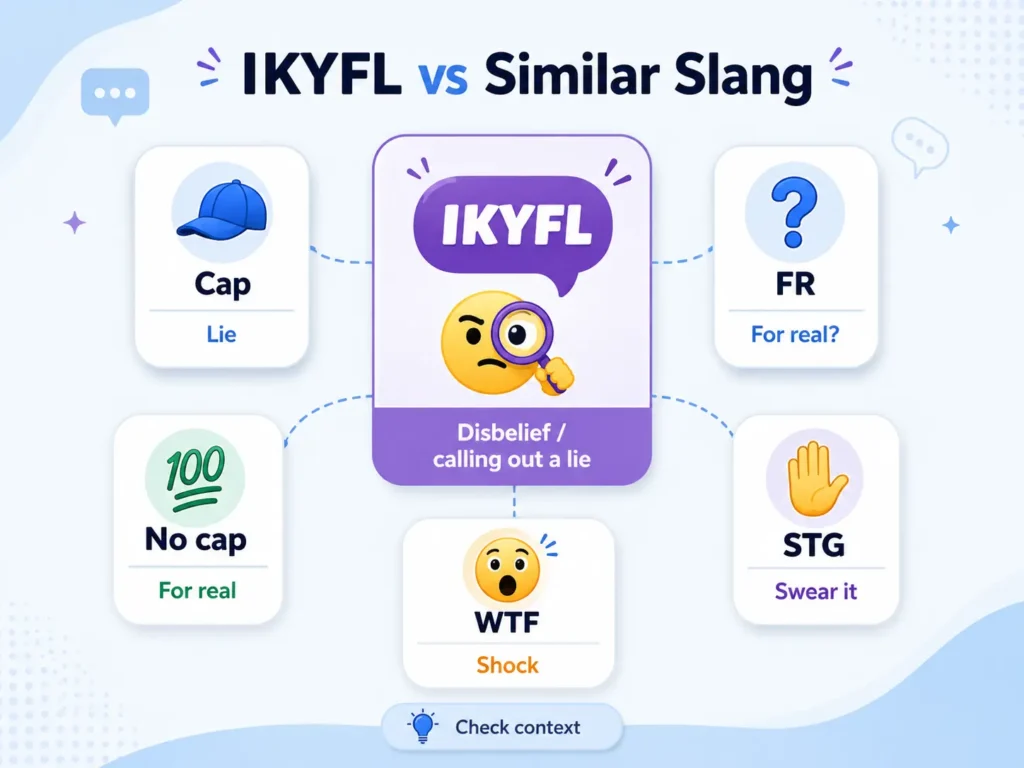
| Term | Meaning | Main purpose |
| IKYFL | I know you’re f***ing lying | Strong disbelief or accusation |
| Cap | A lie or false claim | Calls something untrue |
| No cap | No lie, honestly | Emphasizes truth |
| FR | For real | Requests or shows confirmation |
| STG | Swear to God | Strongly insists something is true |
| WTF | What the f*** | Expresses shock or confusion |
IKYL may be used as a shorter form of “I know you’re lying,” but interpretations vary. Check the surrounding message instead of assuming.
IKYFL vs. IYKYK
IKYFL expresses disbelief or suspicion. IYKYK means “if you know, you know” and refers to shared knowledge or an inside experience.
People confuse them because both begin with “I” and contain similar letters. Their meanings and uses are completely different.
Common Mistakes and Other Meanings
Do not assume the “L” means love or laughing. Do not treat every use as a serious accusation, and do not assume an emoji automatically makes the phrase friendly.
Other short expressions can also have different interpretations, so understanding YM Meaning can help you avoid confusion when reading slang in texts and social-media comments.
The dominant IKYFL meaning in internet slang relates to lying and disbelief. Rare, user-created expansions may appear online, but context and reliable usage matter. Some media projects or games may also use IKYFL as a name; that does not change its conversational definition.
The acronym likely developed from a spoken expression and spread through texting, memes, and social platforms. Exact first-use claims are difficult to verify, so avoid presenting an unsupported origin date as fact.
Frequently Asked Questions About IKYFL Meaning
What does IKYFL stand for in texting?
It usually stands for “I know you’re f***ing lying.”
Is IKYFL always serious?
No. It often expresses playful shock, although it can become a genuine accusation.
Is IKYFL rude?
It can be because it contains implied profanity and questions someone’s honesty.
What does IKYFL mean from a girl or guy?
The meaning does not depend on gender. Context, relationship, and tone determine the intention.
What does IKYFL mean on TikTok?
It usually reacts to shocking, dramatic, or unbelievable content.
Can you use IKYFL professionally?
No. Choose respectful wording in work, school, or customer communication.
How should you reply?
Confirm the truth, explain the situation, share proof, or ask why the sender doubts you.
What is a clean alternative?
Use “No way,” “Are you serious?” or “You must be joking.”
Final Takeaway
IKYFL usually means “I know you’re f***ing lying.” It can show playful disbelief, dramatic surprise, suspicion, or a serious accusation. Read the previous message, relationship, punctuation, and emojis before deciding what it means. Because the phrase contains implied profanity, reserve it for informal conversations with people who understand your tone.