
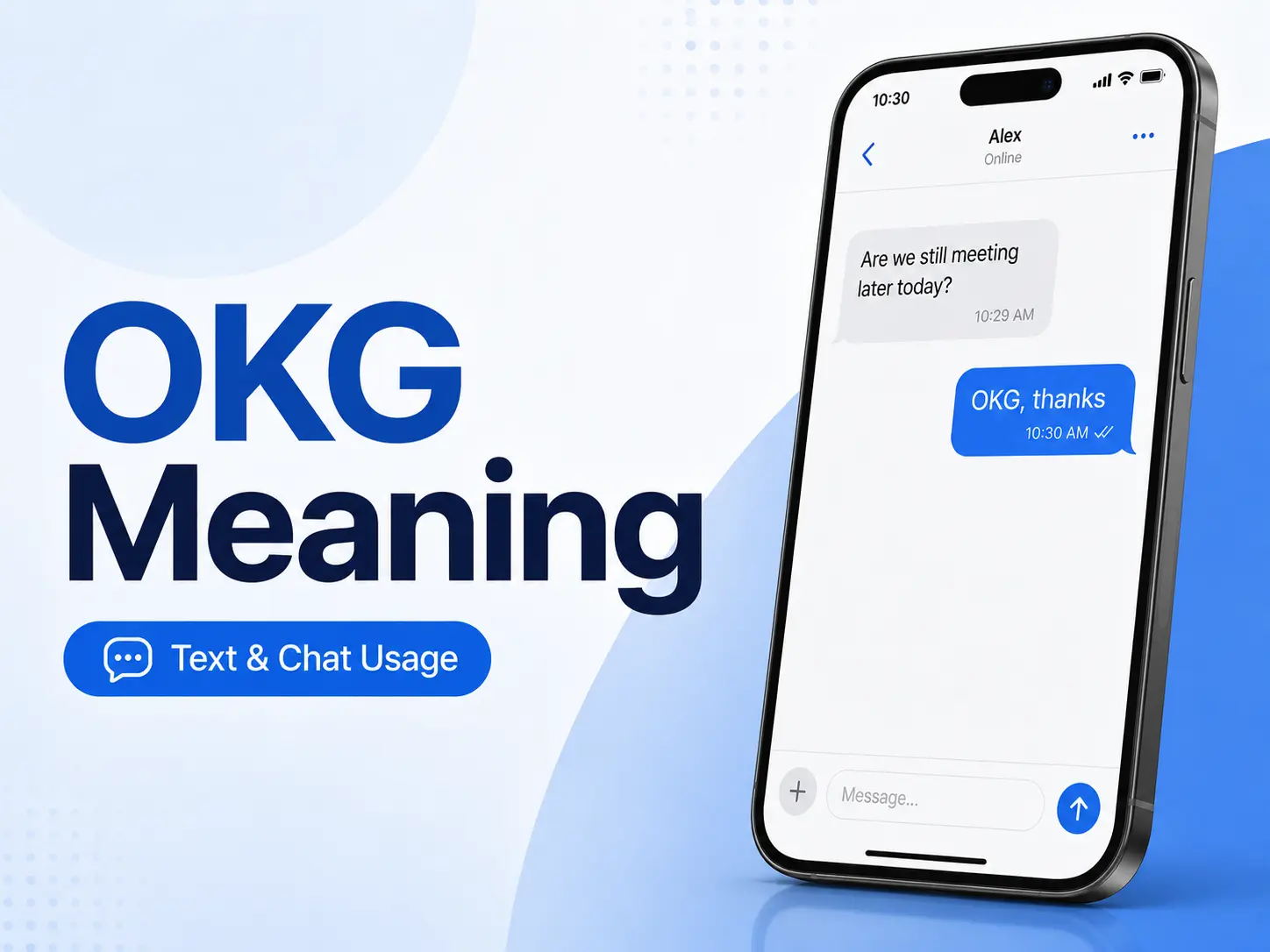
If someone sends you “OKG” in a message, it can feel confusing because it looks close to “OK” but has an extra letter at the end. You may wonder if it means “okay good,” “oh okay,” “okay,” or something completely different.
The OKG meaning depends on the conversation. Unlike popular texting abbreviations such as LOL, OMG, IDK, or TBH, OKG does not have one fixed meaning that everyone uses the same way. In most casual chats, OKG works like a short acknowledgment. It may mean “OK,” “okay good,” “oh okay,” “got it,” or “sounds good.”
For example, if someone says, “I sent the notes to your email,” and the other person replies, “OKG, thanks,” the meaning is probably “okay, good” or “got it.” The sender is simply confirming that they received the message.
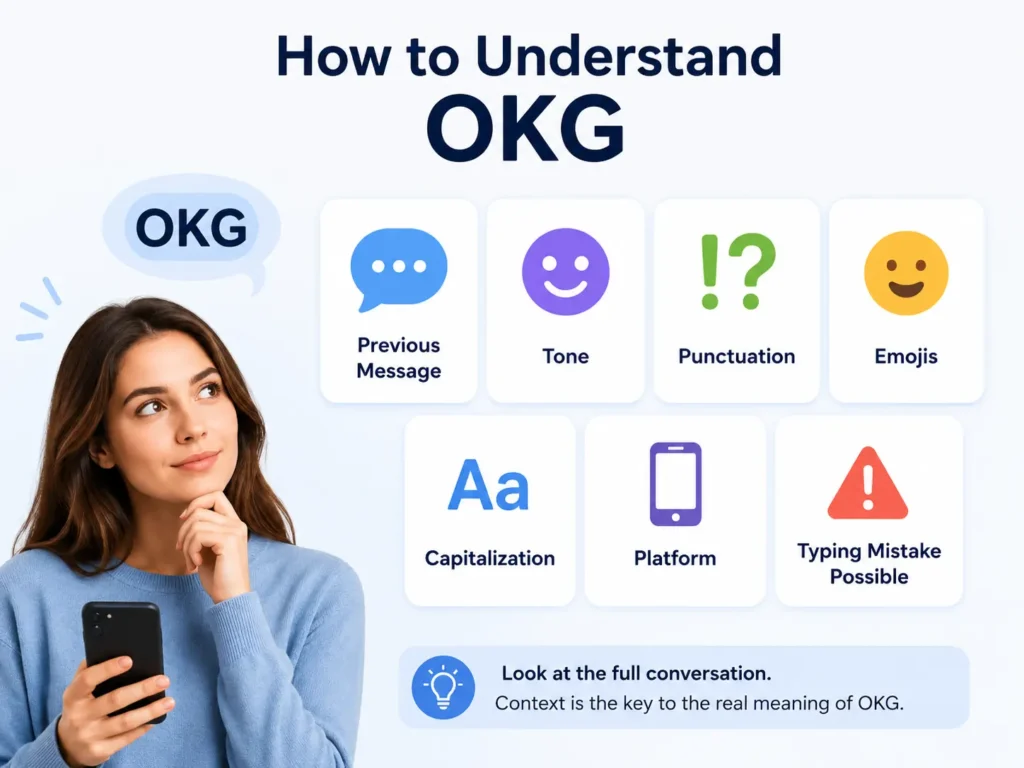
However, OKG can also be a typo, autocorrect mistake, or personal texting habit. That is why context matters. The previous message, tone, punctuation, emojis, capitalization, platform, and relationship with the sender can all help you understand what OKG means.
This guide explains OKG meaning in text messages, social media, online chats, gaming conversations, and dating apps. You will also learn how OKG compares with similar texting abbreviations and when you should avoid using it.
What Does OKG Mean?
OKG most often means “OK,” “okay good,” or “oh okay” in casual texting. It is usually used as a quick response to show that someone understands, agrees, or accepts what was said.
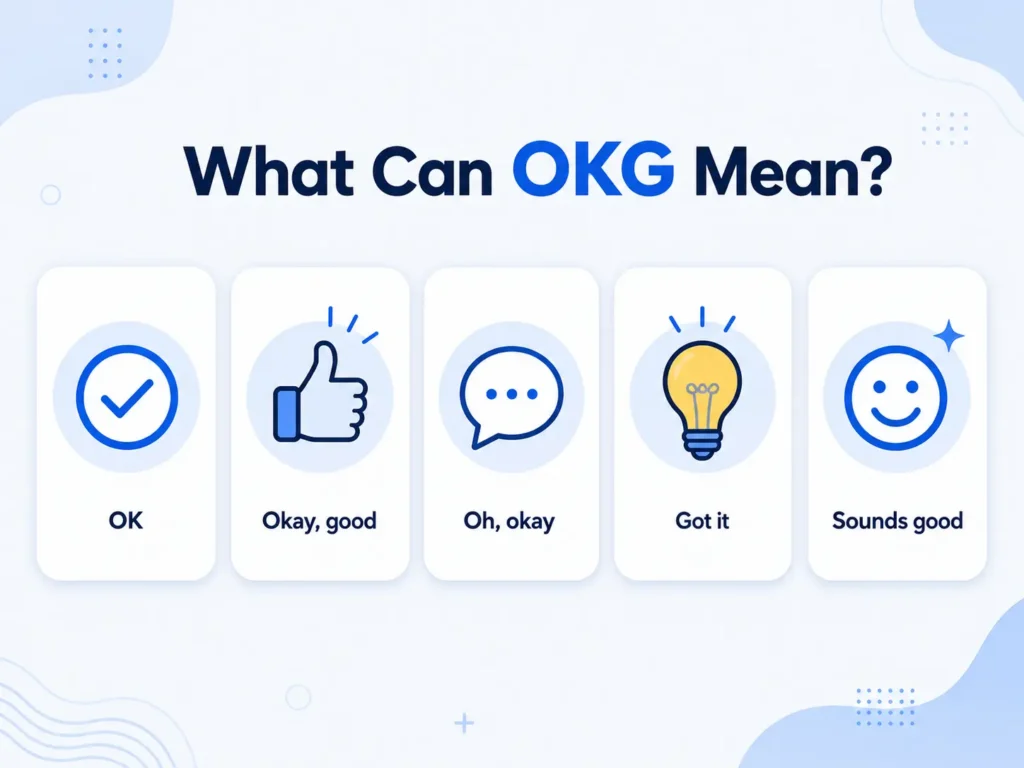
People may use OKG to mean:
Okay
Okay, good
Oh, okay
Got it
Sounds good
Understood
The exact meaning depends on the sentence. If someone gives you information and you reply “OKG,” it usually means you received the message. If someone tells you good news and you reply “OKG!” it may mean “okay, good!” with a more positive tone.
Example:
Person 1: I booked the tickets for tomorrow.
Person 2: OKG, see you then.
Here, OKG likely means “okay, good.” The sender is confirming the plan and continuing the conversation naturally.
Still, OKG is not a standard abbreviation with one official definition. Some people may type it by accident while trying to write OK. Others may use it as a personal shortcut. In a friend group, OKG may become a common habit even if people outside the group do not recognize it.
The safest way to understand OKG is to replace it with “OK” or “okay good.” If the sentence still makes sense, that is probably the intended meaning.
What Does OKG Mean in Text Messages?
In text messages, OKG usually works as a short acknowledgment or confirmation. It helps the sender respond quickly without writing a full sentence.
For example:
Person 1: I emailed you the file.
Person 2: OKG, I’ll check it.
In this example, OKG means “okay” or “got it.” The response is short, clear, and practical.
OKG can also confirm a plan:
Person 1: Let’s meet outside the café at 5.
Person 2: OKG, see you there.
Here, OKG means the sender accepts the plan. The phrase “see you there” makes the reply sound cooperative and clear.
Sometimes OKG can sound dry or distant, especially if it appears alone after an emotional message.
Example:
Person 1: I was upset because you ignored my message.
Person 2: OKG.
The sender may only mean “okay,” but the short response may feel cold because it does not answer the emotion in the first message. This does not mean OKG is always rude. It means the tone depends on the situation.
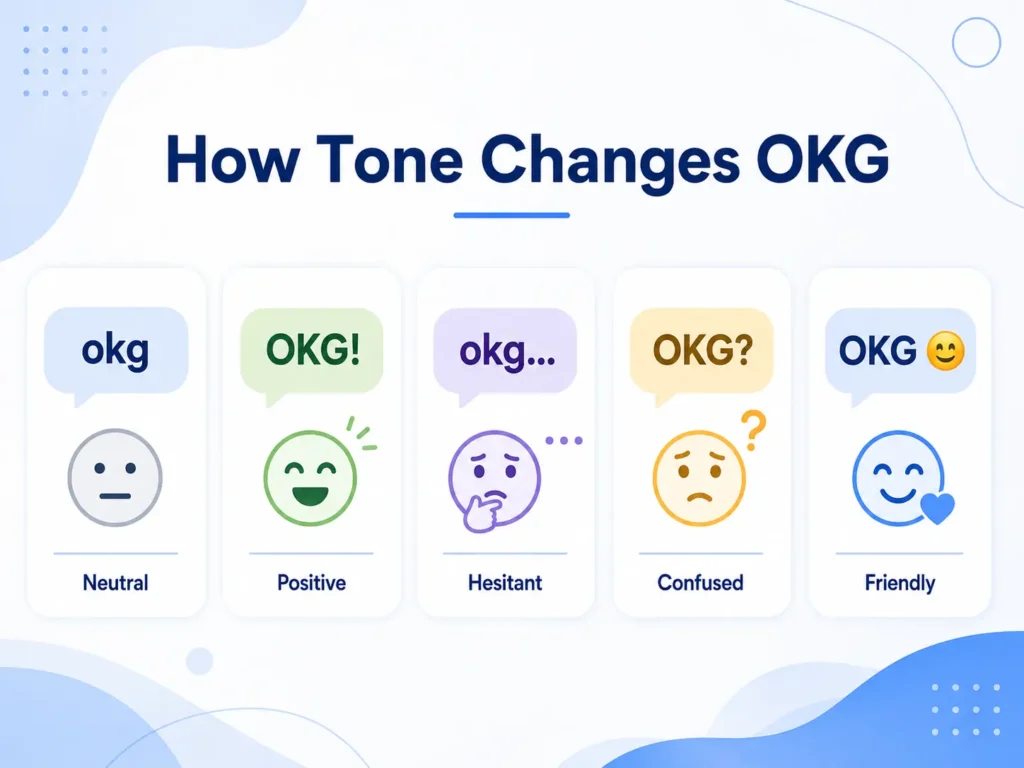
Punctuation and emojis can also change the meaning:
okg = casual or neutral
OKG! = positive or energetic
okg… = unsure, hesitant, or annoyed
OKG? = confused or asking for confirmation
OKG 😊 = friendly
OKG 🙄 = sarcastic or irritated
Because texting does not include voice tone, these small details matter. Always read the full message before deciding whether OKG sounds friendly, dry, sarcastic, or neutral.
OKG Meaning on Social Media
On social media, OKG usually has the same basic meaning: “OK,” “okay good,” or “got it.” You may see it in comments, captions, replies, story responses, and direct messages.
On Snapchat, OKG may appear in quick private replies, streak chats, or casual plan confirmations.
Example:
“I’ll send the pictures tonight.”
“OKG.”
This reply probably means “okay” or “got it.” Since Snapchat conversations are often fast, short replies like OKG can feel normal.
On TikTok, OKG may appear in comments or replies. Depending on the video, it can sound casual, funny, or sarcastic.
Example:
“You really watched the whole season in one day?”
“OKG 😂”
The laughing emoji makes the response playful.
On Instagram, OKG may appear in DMs, story replies, or comment threads.
Example:
“I tagged you in the post.”
“OKG, I saw it.”
Here, OKG confirms that the person noticed the tag.
On WhatsApp, iMessage, and Messenger, OKG is often used in everyday conversations with friends, family, classmates, or coworkers. It may confirm plans, acknowledge updates, or respond to simple instructions.
Example:
“The address is in the group chat.”
“OKG, thanks.”
Because social media language is flexible, OKG may not mean the same thing to every person. Some users may understand it immediately, while others may see it as a typo. If the meaning is unclear, it is fine to ask, “Do you mean okay?”
OKG Meaning in Online Chats and Gaming
In online chats and gaming conversations, OKG usually means “OK,” “got it,” or “okay good.” Fast conversations on Discord, gaming servers, livestream chats, and group messages often include short replies, so OKG can fit naturally.
Example:
Player 1: Join the voice channel after this round.
Player 2: OKG.
Here, OKG means the player understands the instruction.
In a gaming chat, OKG may also confirm a strategy:
Player 1: Wait before pushing.
Player 2: OKG, I’ll stay back.
This response shows agreement and helps the team communicate quickly.
In Discord communities, OKG may become part of a group’s personal slang. If many people in the server use it, the meaning may be clear within that group even if it is not widely recognized elsewhere.
On dating apps, OKG can be harder to read because short replies often feel more important. If someone says, “Want to meet for coffee this weekend?” and the reply is “OKG, Saturday works,” the message sounds positive because it includes a clear plan.
But if someone says, “I had a really good time talking to you,” and the reply is only “OKG,” it may feel dry. The abbreviation alone does not prove romantic interest, annoyance, or disinterest. The full message, response timing, emojis, and whether the person continues the conversation matter more.
Different Meanings of OKG Depending on Context
The most common OKG meaning is connected to “OK,” “okay good,” or “oh okay.” However, the exact meaning can change depending on the sentence, tone, platform, punctuation, and sender’s texting habit.
Context is especially important with less common slang. You can also read our OFCC Meaningguide to see how tone, spelling, and the surrounding message help clarify an unfamiliar abbreviation.
In a simple conversation, OKG usually means acknowledgment.
Example:
Person 1: I sent you the homework file.
Person 2: OKG, I’ll check it.
Here, OKG means “got it” or “okay.”
In a positive conversation, OKG may mean “okay, good.”
Example:
Person 1: The tickets are booked.
Person 2: OKG! That’s perfect.
The exclamation mark makes the reply sound more excited.
In a confused or surprised conversation, OKG may mean “oh okay.”
Example:
Person 1: We are not meeting today. The plan changed.
Person 2: OKG, I didn’t know.
Here, the sender is accepting new information.
OKG can also be a typing mistake. Someone may have meant to type OK but added G by accident because of fast typing, autocorrect, predictive text, or swipe typing. If the sender usually writes OK and suddenly sends OKG once, it may simply be a typo.
In rare cases, OKG may refer to a brand, group, organization, project, or community-specific acronym. This is more likely in professional documents or group names, not normal casual texting.
OKG vs Similar Texting Abbreviations
OKG is similar to several short texting replies, but each one has a slightly different tone.
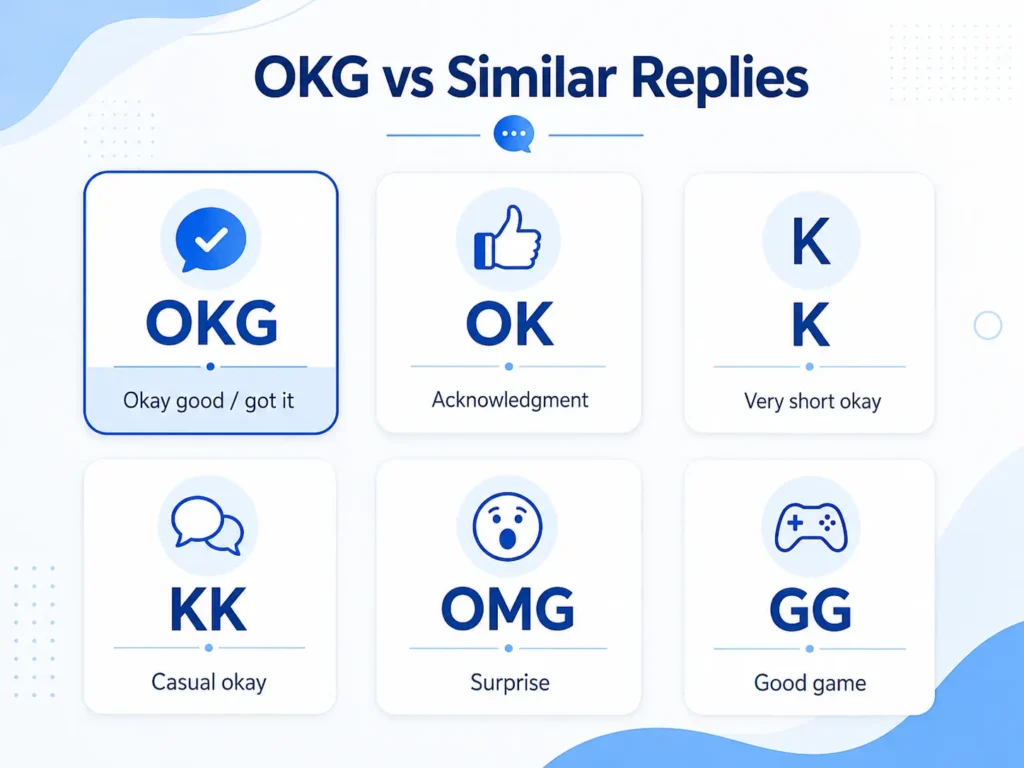
OK is the clearest and most common form. It means agreement, acceptance, or acknowledgment. If clarity matters, OK is safer than OKG.
Short replies can look similar but communicate different ideas. For example, IK Meaning explains how “IK” is commonly used to mean “I know” in text messages and online conversations.
K is a very short version of okay. Some people use it normally, but others may read it as dry, cold, or dismissive.
KK usually means okay or okay, okay. It often sounds more casual and friendly than K.
Okay is the full word. It is clearer than OKG and works in both casual and many professional conversations.
Sounds good is a stronger and clearer way to accept a plan. For example, “Sounds good, see you there” is easier to understand than “OKG.”
OMG is different from OKG. OMG means “oh my God” or “oh my gosh” and shows surprise, shock, or excitement. OKG usually shows acknowledgment.
GG is also different. In gaming, GG usually means “good game.” OKG usually means okay, got it, or okay good.
The main difference is that OKG is less established than these terms. It may make sense in a specific chat, but not everyone will recognize it immediately.
Is OKG Formal or Informal?
OKG is informal. It belongs to casual texting, social media, direct messages, and online chats. You can use it with friends, family members, classmates, gaming friends, or people who understand your texting style.
OKG may be fine in:
Text messages
WhatsApp chats
Snapchat replies
Instagram DMs
TikTok comments
Messenger conversations
Discord chats
Gaming messages
Casual group chats
Relaxed dating-app conversations
However, OKG should be avoided in formal communication. It may look like a typo or unclear abbreviation in business emails, academic writing, job applications, customer support messages, legal documents, medical instructions, or official workplace reports.
In formal writing, use clearer phrases such as:
Okay, thank you.
Understood.
That sounds good.
I confirm.
I have received the information.
Certainly.
For example:
Informal: OKG, I’ll do it.
Formal: Understood. I will complete it today.
The formal version is clearer and more professional.
Origin and Evolution of OKG
OKG does not have a clear official origin. It appears to come from casual texting habits around the word OK. Since people often type quickly in chats, new short forms can appear naturally.
Some users may create OKG as a personal shortcut for “okay good.” Others may use it as a quick version of “oh okay.” In some cases, it may not be intentional at all and may simply be a typo.
Modern internet slang often grows this way. People shorten words, add letters, repeat sounds, or create small variations that become familiar within a friend group or online community. A term does not need to be in a formal dictionary to be understood in a specific conversation.
Still, OKG is not as widely recognized as LOL, OMG, IDK, TBH, or BTW. That is why context is so important. If you use OKG with someone who has never seen it before, they may ask what it means.
Popular Texting Acronyms Related to OKG
Several texting acronyms appear in the same type of casual conversations as OKG.
OK means okay or understood.
KK means okay in a relaxed way.
OMG means oh my God or oh my gosh.
LOL means laughing out loud.
IDK means I don’t know.
TBH means to be honest.
NGL means not gonna lie.
BTW means by the way.
LMK means let me know.
TY means thank you.
YW means you’re welcome.
FR means for real.
FS means for sure.
GG means good game, especially in gaming chats.
Some online expressions represent reactions rather than standard acronyms. For example, TSK Meaning explains how “tsk” can show mild disapproval, annoyance, disappointment, or playful judgment.
These abbreviations are common in text messages, social media, online communities, and casual digital conversations. Knowing them can help you understand short replies more easily.
Final Thoughts
The OKG meaning in text is usually “OK,” “okay good,” or “oh okay.” It often works as a short acknowledgment, confirmation, or casual reply.
However, OKG is not a fixed slang term with one universal definition. It may be a personal shortcut, a typing mistake, an autocorrect issue, or a phrase used inside a specific friend group or online community.
To understand OKG correctly, read the previous message and look at the tone, punctuation, emojis, capitalization, platform, and relationship between the users. If “OK,” “okay good,” or “oh okay” fits naturally, that is probably the intended meaning.
Use OKG in casual chats only. For professional or serious messages, choose clearer wording such as “Okay,” “Understood,” or “That sounds good.”
Frequently Asked Questions
What does OKG mean in texting?
OKG usually means “OK,” “okay good,” or “oh okay.” It often shows acknowledgment, agreement, or confirmation.
Does OKG mean “okay good”?
Yes, it can mean “okay good” when that phrase fits the conversation. However, it does not always have one fixed full form.
Is OKG a real slang term?
OKG may be used as informal text slang, but it is not as widely recognized as common abbreviations like LOL or OMG.
Is OKG a typo?
Sometimes, yes. A person may accidentally type OKG while trying to write OK.
What does OKG mean on Snapchat?
On Snapchat, OKG usually works as a quick “OK,” “got it,” or “okay good.”
What does OKG mean on TikTok?
On TikTok, OKG may appear as a casual, funny, or sarcastic reply depending on the video or comment thread.
What does OKG mean from a girl?
It usually means acknowledgment, agreement, or a casual response. The full conversation matters more than gender.
What does OKG mean from a guy?
It usually means the same thing: OK, got it, or okay good. Gender does not change the basic meaning.
Is OKG rude?
OKG is not rude by itself, but it may sound dry in an emotional conversation if no other words are added.
How should I reply to OKG?
You can reply with “Great,” “Thanks,” “Perfect,” “Sounds good,” or continue with the next useful detail.
Can I use OKG professionally?
It is better not to use OKG in professional messages. Use “Understood,” “Okay, thank you,” or “That sounds good” instead.