
Have you ever received a message that says “IK” and wondered what the person really means? At first, it looks simple, but short texting abbreviations can be easy to misunderstand. A reply like “IK” may sound friendly in one conversation and rude in another.
In most cases, IK means “I know.” People use it in text messages, social media comments, online chats, and direct messages when they already understand something or are aware of the information.
For example:
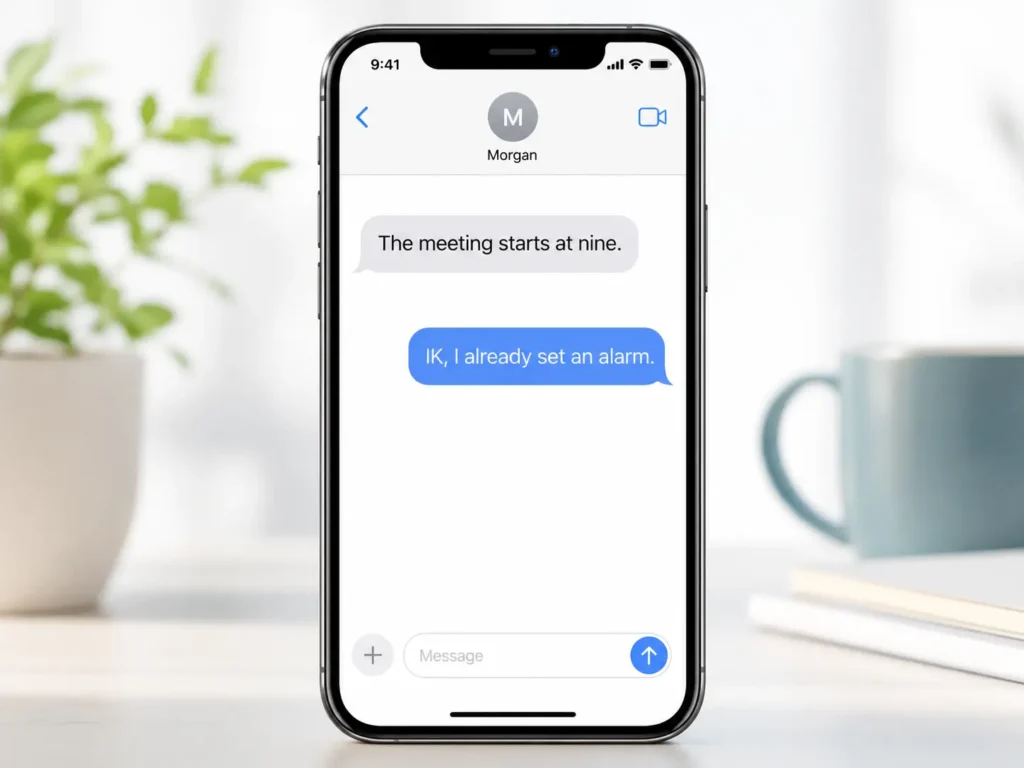
Person A: “The meeting starts at nine.”
Person B: “IK, I already set an alarm.”
Here, IK simply means the person already knows the meeting time.
However, tone matters a lot. “IK!” can sound excited. “IK 😂” can sound playful. “IK.” may feel short or dismissive. “Yeah, IK” can sound neutral or slightly annoyed depending on the situation.
That is why understanding the IK meaning is not only about replacing two letters with “I know.” You also need to read the full message, check the punctuation, notice the emojis, and think about your relationship with the sender.
What Does IK Mean?
IK means “I know.” It is a common texting abbreviation used to show that someone already knows, understands, or agrees with something.
It is informal, so people mostly use it in casual conversations with friends, classmates, family members, partners, familiar coworkers, and people they talk to online.
Example:
Friend: “The store closes at six.”
You: “IK, I’m going there now.”
In this example, IK is a simple confirmation. The person is not asking a question. They are saying they already have the information.
IK can also appear inside a longer sentence.
Examples:
“IK you are busy, but can you call me later?”
“IK it looks hard, but we can finish it.”
“IK what you mean.”
In all these examples, IK replaces the full phrase “I know.”
People use IK because it is fast, simple, and casual. Like LOL, IDK, OMG, and IKR, it fits the quick style of digital communication.
What Does IK Mean in Text Messages?
In text messages, IK usually means “I know,” but the purpose can change depending on the message.
IK as a Simple Acknowledgment
The most common use of IK is to confirm that the sender already knows something.
Example:
Person A: “The class starts at ten.”
Person B: “IK, I’m getting ready.”
This sounds neutral and practical. The sender is only confirming awareness.
IK Showing Agreement
IK can also show agreement, especially when someone shares an opinion or reaction.
Example:
Person A: “That movie was amazing.”
Person B: “IK! The ending was so good.”
Here, IK means more than “I already know.” It shows that the sender agrees strongly.
IK Showing Shared Understanding
Sometimes people use IK to show that they understand a feeling or situation.
Example:
Person A: “This week has been so stressful.”
Person B: “IK, everyone seems tired.”
This makes the reply feel relatable and supportive.
IK Showing Support
IK can sound caring when it is followed by helpful or emotional words.
Example:
Person A: “I’m nervous about tomorrow.”
Person B: “IK, but you’ll do great.”
The abbreviation starts the reply, but the second part makes the message supportive.
IK Showing Annoyance
A short “IK” may sound annoyed when someone repeats advice or reminders.
Example:
Person A: “Don’t forget to submit the form.”
Person B: “IK.”
The period and short reply can feel cold. Still, the sender may simply be busy or answering quickly. Do not assume they are angry without checking the full conversation.
IK Meaning on Social Media

The basic IK meaning stays the same on most platforms. It usually means “I know.” However, the tone can change based on the platform, comment style, emojis, and context.
IK Meaning on Snapchat
On Snapchat, IK often appears in quick chats, captions, and replies to snaps. Because Snapchat conversations are usually casual, IK may sound playful or relaxed.
Example:
“That filter makes everyone look funny.”
“IK 😂”
The laughing emoji makes the reply friendly and amused.
IK Meaning on TikTok
On TikTok, people often use IK in comments to show agreement with a video or another comment.
Example:
Comment: “This song is impossible to stop playing.”
Reply: “IK!”
Here, IK means “I completely agree.”
IK Meaning on Instagram
On Instagram, IK can appear in direct messages, story replies, captions, and comments. It may respond to compliments, opinions, trends, or shared experiences.
Example:
“You always take good pictures.”
“IK 😌”
This reply may sound confident, playful, or flirty depending on the relationship.
IK Meaning on WhatsApp and Messenger
On WhatsApp and Messenger, IK is common in private chats and group conversations. It may confirm information, respond to reminders, or show agreement.
Example:
“We are meeting at the main gate.”
“IK, I’m almost there.”
This is a simple confirmation.
IK Meaning in Online Chats and Gaming
In online chats, Discord servers, and gaming platforms, IK is often used as a quick response. Players may use it to confirm that they understand a rule, warning, update, or strategy.
Example:
Player 1: “The enemy team is moving left.”
Player 2: “IK, I can see them.”
In gaming, fast communication matters. IK helps players respond quickly without typing a long sentence.
In Discord chats, IK can also appear when someone already understands a community rule or topic.
Example:
“Don’t post spoilers here.”
“IK, I won’t.”
In dating apps, IK may sound neutral, confident, teasing, or flirty depending on the message.
Example:
“You know you’re cute, right?”
“IK 😉”
Here, the emoji makes the response playful. But if someone writes only “IK.” after a serious message, it may feel dismissive.
Different Meanings of IK Depending on Context
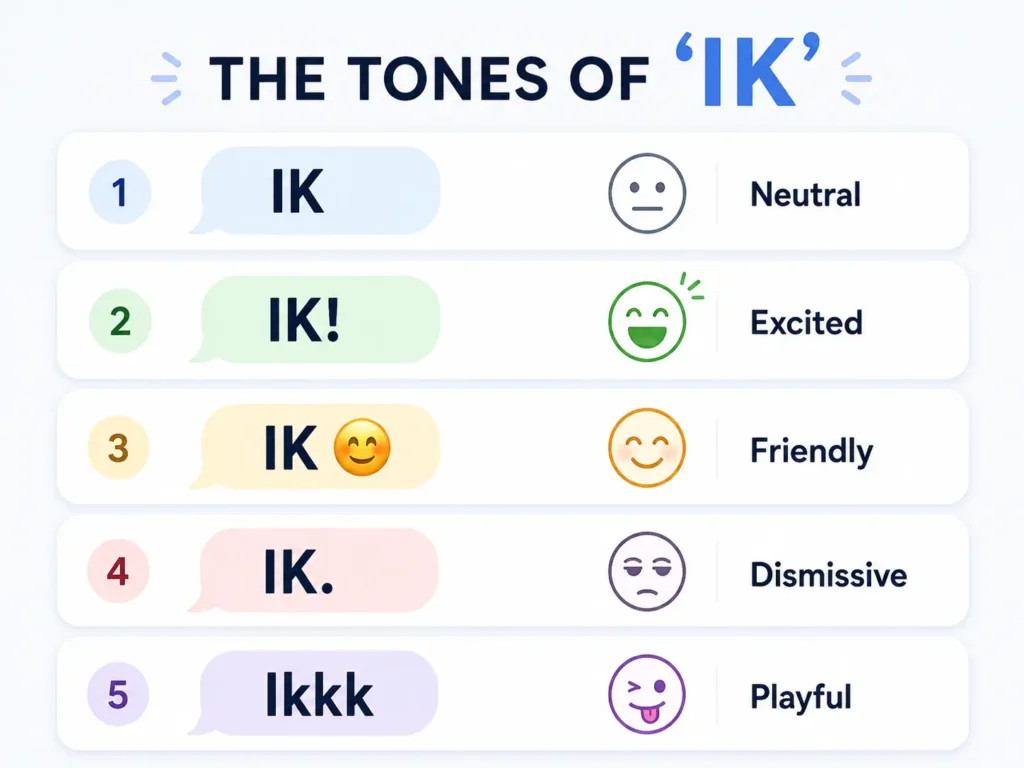
IK usually means “I know,” but the emotional meaning changes with context.
It can mean simple awareness:
“The train leaves at seven.”
“IK, I checked the schedule.”
It can show strong agreement:
“That restaurant is expensive.”
“IK! The prices shocked me.”
It can sound supportive:
“I’m worried about the test.”
“IK, but you studied hard.”
It can feel sarcastic:
“You really love that song.”
“IK, I’ve only played it twenty times.”
It can sound dismissive:
“Please remember to call me.”
“IK.”
The simple rule is this: IK means “I know,” but tone depends on the full sentence, punctuation, emojis, previous message, and relationship between the sender and receiver.
IK vs Similar Texting Abbreviations
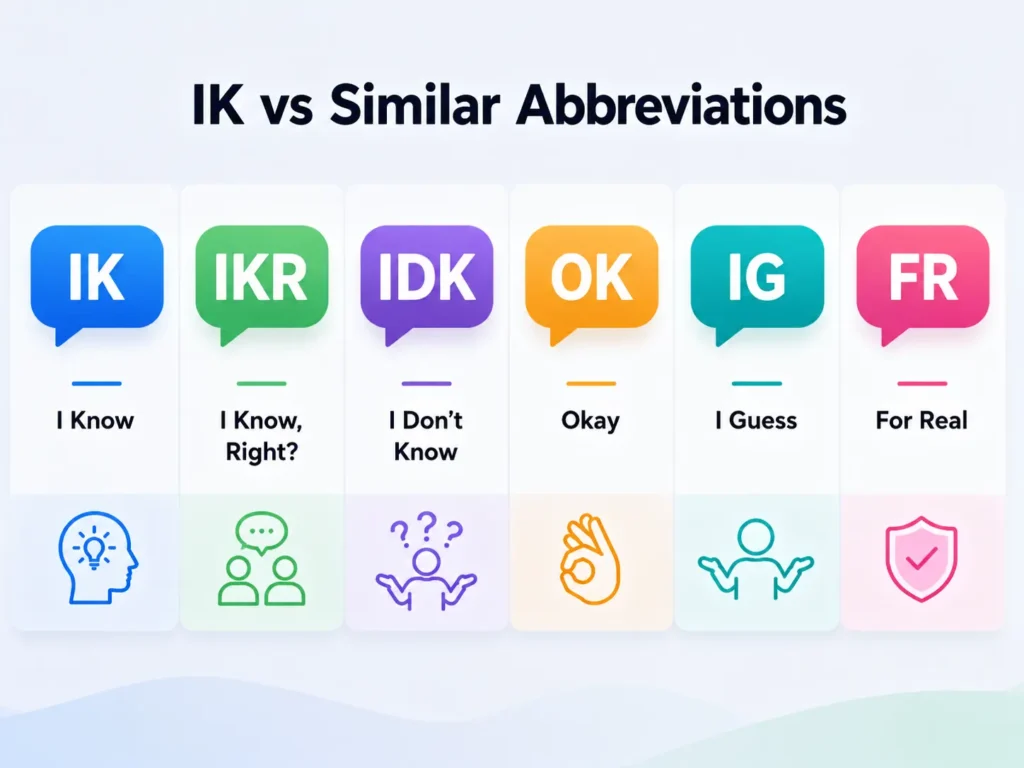
IK is often confused with other short texting abbreviations because many of them look similar or appear in the same type of conversations. However, each one has a different meaning and purpose.
Short responses can look similar while expressing very different emotions. For example, OFCC usually works as an expressive version of “of course,” while IK means “I know.” Read our [OFCC Meaning] article to understand how its spelling, tone, and context affect a conversation.
IK vs IKR
IK means “I know.” It shows that someone already knows or understands something.
IKR means “I know, right?” It is usually used to show strong agreement.
Example:
Person A: “That ending was crazy.”
Person B: “IKR!”
Here, IKR sounds more emotional and excited than IK. If the person wrote “IK,” it would simply mean they already know or agree.
IK vs IDK
IDK means “I don’t know.” It is the opposite of IK.
Example:
“IK” = I know
“IDK” = I don’t know
If someone says “IK,” they are showing awareness. If someone says “IDK,” they are showing uncertainty.
IK vs OK
OK means “okay.” It usually shows acceptance, agreement, or understanding.
Example:
“IK, I saw the message.”
“OK, I will be there.”
IK tells someone you already know something. OK shows that you accept or understand what was said.
IK vs IG
IG can mean “I guess” in texting. It shows uncertainty or weak agreement.
Example:
“IK, that makes sense.”
“IG, we can try it.”
IK sounds more certain, while IG sounds less confident.
IK vs FR
FR means “for real.” People use it to show sincerity, surprise, or strong agreement.
Example:
“That really happened?”
“FR.”
IK means “I know,” while FR means the sender is being serious or confirming something strongly.
Is IK Formal or Informal?
IK is informal. It is best for casual text messages, group chats, social media comments, Discord conversations, gaming chats, and friendly DMs.
You can use IK with:
Friends
Classmates
Siblings
Partners
Close coworkers
Online friends
Example:
“The movie starts at eight.”
“IK, I already bought the tickets.”
This sounds natural in a casual conversation.
However, IK is not the best choice for formal communication. Avoid it in client emails, job applications, school assignments, business reports, customer-service replies, or messages to senior managers.
Instead of writing:
“IK about the deadline.”
A better formal version is:
“I understand the deadline.”
You can also write:
“I am aware of that.”
“Thank you for confirming.”
“Yes, I have received the information.”
These phrases sound clearer and more respectful in professional situations.
Is IK Rude or Polite?
IK is not automatically rude. Its tone depends on how it is written.
IK sounds polite when it includes extra words, appreciation, or friendly punctuation.
Examples:
“IK, thank you!”
“IK, I appreciate the reminder.”
“IK 😊”
“IK, I’ll take care of it.”
These examples sound friendly because they do not end the conversation coldly.
IK may sound rude or dismissive when it is too short, especially after advice, concern, or a reminder.
Example:
Person A: “Please call me when you get home.”
Person B: “IK.”
This reply may feel cold because it gives no reassurance. A better reply would be:
“IK, I’ll call you when I arrive.”
The meaning is still “I know,” but the tone is much warmer.
How to Use IK Naturally
Use IK when you want to confirm that you already know something.
Example:
“The train leaves at seven.”
“IK, I checked the schedule.”
You can also use it to agree with someone.
Example:
“That restaurant is expensive.”
“IK! The prices surprised me.”
You can use it to show support.
Example:
“This week has been stressful.”
“IK, but you are doing your best.”
If you want your message to sound clear, add a few extra words after IK. Short replies are easy to misunderstand, especially in serious conversations.
Good examples include:
“IK, thanks for reminding me.”
“IK! I’m excited too.”
“IK what you mean.”
“IK, but I still wanted to check.”
Avoid using only “IK” too often. Repeated short replies may make you seem uninterested, even if you do not mean it that way.
How to Reply When Someone Says IK
Your reply should match the tone of the conversation.
If someone uses IK to confirm information, you can say:
“Okay, just checking.”
“Great.”
“Sounds good.”
If they use IK to agree with you, you can reply:
“Exactly.”
“Right?”
“Glad you agree.”
If they sound excited, continue the conversation with the same energy.
Example:
Person A: “That concert is going to be amazing.”
Person B: “IK! I can’t wait.”
Person A: “Same! Which song are you most excited for?”
If they sound dismissive, stay calm. You can say:
“I was only trying to help.”
“No problem, I just wanted to make sure.”
“Okay, I understand.”
If the tone is unclear, ask directly instead of assuming.
Example:
“Did you mean you already knew, or are you upset?”
Other Meanings of IK
In most English text messages, IK means “I know.” However, IK can have other meanings in specific contexts.
It may refer to someone’s initials, an organization, a project, or a technical abbreviation.
In gaming, IK may sometimes mean “instant kill” or refer to a game-related term. In academic or cultural discussions, IK may mean “Indigenous knowledge.” In Dutch or Afrikaans, “ik” means “I.”
Still, in normal texting and social media, IK almost always means “I know.” If “I know” does not fit the sentence, then you should look for another meaning based on the topic.
Context becomes even more important when an abbreviation appears in a technical discussion. For example, GB commonly means “gigabyte” when people discuss computers, phones, storage, or mobile data. Learn more in our complete [GB Meaning] guide.
Origin and Evolution of IK
IK became popular because texting, instant messaging, online forums, and social media made short forms common. People wanted faster ways to write everyday phrases, so “I know” became IK.
It works like other internet slang terms such as LOL, OMG, IDK, IKR, and FR. These abbreviations save time and fit the quick style of digital communication.
Over time, people started using punctuation, capitalization, emojis, and repeated letters to change the tone.
Examples:
“IK” sounds neutral.
“IK!” sounds excited.
“IK 😂” sounds playful.
“IK 🙄” sounds annoyed or sarcastic.
“Ikkk” may sound casual or dramatic.
The meaning stays close to “I know,” but the emotion changes.
Popular Texting Acronyms Related to IK
Here are some common texting acronyms related to IK:
IKR means “I know, right?”
IDK means “I don’t know.”
OK means “okay.”
IG means “I guess.”
FR means “for real.”
LOL means “laughing out loud.”
OMG means “oh my God.”
TBH means “to be honest.”
Learning these terms can help you understand online chats, comments, captions, and social media replies more easily.
Some popular chat expressions represent sounds rather than complete phrases. One example is TSK, which people use to show disappointment, annoyance, or disapproval. Our [TSK Meaning] guide explains its different tones with practical conversation examples.
Final Thoughts
The IK meaning is simple: IK usually stands for “I know.” People use it in text messages, chats, DMs, comments, gaming conversations, and social media posts to show awareness, agreement, understanding, or confirmation.
However, the tone can change. IK can sound friendly, excited, supportive, sarcastic, dismissive, or rude depending on punctuation, emojis, extra words, platform, and relationship.
The best way to understand IK is to replace it with “I know” and then read the full sentence. If the message still makes sense, you have probably found the correct meaning.
Frequently Asked Questions
What does IK mean in texting?
IK means “I know.” It shows that someone already understands or is aware of something.
Does IK always mean “I know”?
In most English text conversations, yes. In gaming, academic, technical, or multilingual contexts, it may have another meaning.
Is IK rude?
Not always. IK can sound rude if it is used alone after advice or a reminder, but friendly words or emojis can soften it.
What does IK mean from a girl?
It usually means “I know.” Her tone depends on the message, punctuation, emojis, and your relationship.
What does IK mean from a guy?
It normally means “I know.” It can sound neutral, friendly, flirty, sarcastic, or dismissive depending on context.
What does IK mean on Snapchat?
On Snapchat, IK usually means “I know” and is often used in quick, casual replies.
What does IK mean on TikTok?
On TikTok, IK often appears in comments to show agreement or shared understanding.
What is the difference between IK and IKR?
IK means “I know.” IKR means “I know, right?” and usually shows stronger agreement.
What is the difference between IK and IDK?
IK means “I know,” while IDK means “I don’t know.”
Can I use IK in professional messages?
It is better to avoid IK in formal messages. Use “I know,” “I understand,” or “I am aware of that” instead.