
You may see the word GB almost every day without thinking much about it. A phone may have 128 GB of storage, a laptop may come with a 512 GB SSD, and a mobile data plan may offer 20 GB per month. These numbers look simple, but many people still feel confused about what GB actually means.
The GB meaning is important because it helps you understand storage capacity, mobile data, file size, internet usage, cloud storage, downloads, apps, photos, videos, and device performance. When you know what a gigabyte is, it becomes easier to choose the right phone, laptop, tablet, data plan, or cloud storage package.
In simple terms, GB usually means gigabyte. A gigabyte is a unit used to measure digital data. It tells you how much information a device can store or how much data you can use online. For example, a photo, video, app, game, document, or downloaded file all use some amount of digital storage. When these files become large, they are usually measured in gigabytes instead of megabytes or kilobytes.
This guide explains GB in simple language. You will learn what GB stands for, how it is used in storage and mobile data, how much 1 GB can hold, and how it compares with MB, TB, Gb, and GiB.
What Does GB Mean?
GB stands for gigabyte. A gigabyte is a measurement unit for digital information. It is commonly used for phone storage, computer storage, mobile data, cloud storage, USB drives, SSDs, downloads, app sizes, game sizes, and file sizes.
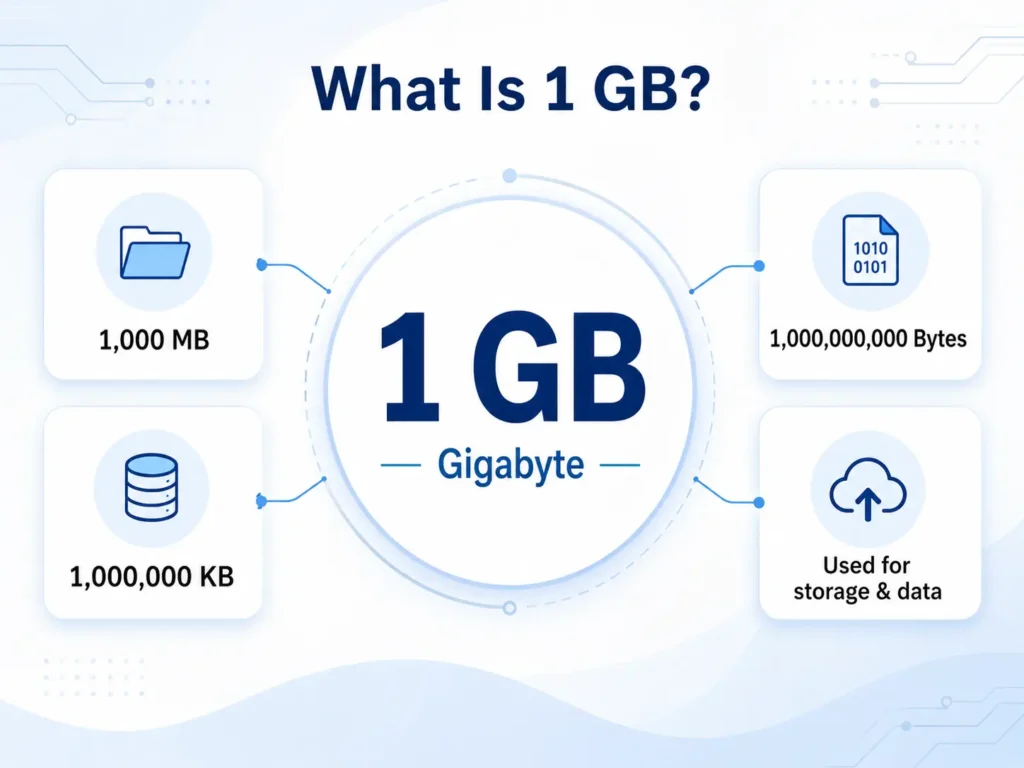
In the decimal system, 1 GB equals 1,000 megabytes. It also equals 1,000,000 kilobytes and 1,000,000,000 bytes. You do not need to remember every number for everyday use, but it helps to understand the basic idea: GB is larger than MB and much larger than KB.
For example:
A small text file may use only a few KB.
A photo may use a few MB.
A video may use several hundred MB or many GB.
A large game may require 50 GB or more.
A phone may offer 64 GB, 128 GB, 256 GB, or 512 GB of storage.
So, when you see GB, think of it as a way to measure how much digital content can be stored, downloaded, transferred, or used.
What Does GB Mean in Digital Storage?
The GB meaning in digital storage refers to the amount of space available for keeping apps, photos, videos, documents, games, and other files on a device.This is the meaning most people notice when buying a phone, laptop, tablet, memory card, USB drive, or external hard drive.
Storage capacity includes things like:
Apps
Photos
Videos
Documents
Music files
Games
Downloads
System files
Offline movies
Cached app data
For example, if a phone has 128 GB of storage, that means the phone has space for apps, photos, videos, messages, documents, and other files. However, you usually do not get the full 128 GB as free space. Part of the storage is already used by the operating system, preinstalled apps, system files, updates, and formatting.
This is why a new phone may show less available space than the number printed on the box. That does not usually mean the device is faulty. It simply means some storage is reserved before you start saving your own files.
More usually GB means more storage capacity, but it does not always mean better speed. A 256 GB phone can store more than a 128 GB phone, but performance also depends on RAM, processor, storage technology, software optimization, and free space.
GB Meaning for Mobile Data and Internet Usage
GB Meaning can also describe mobile data or internet usage. This is different from device storage.
Mobile data measures how much information your phone sends and receives through a cellular network. When you browse websites, stream music, watch videos, use social media, send media messages, download files, use maps, or join video calls, you are using internet data.
For example, if your mobile plan gives you 20 GB per month, that means you can transfer up to 20 GB of data through your cellular connection during that billing period. After that, your provider may slow your speed, charge extra, or stop data access depending on your plan.
This is where many people get confused. Phone storage and mobile data both use GB, but they are not the same thing.
Phone storage means saved space on your device.
Mobile data means information used while online.
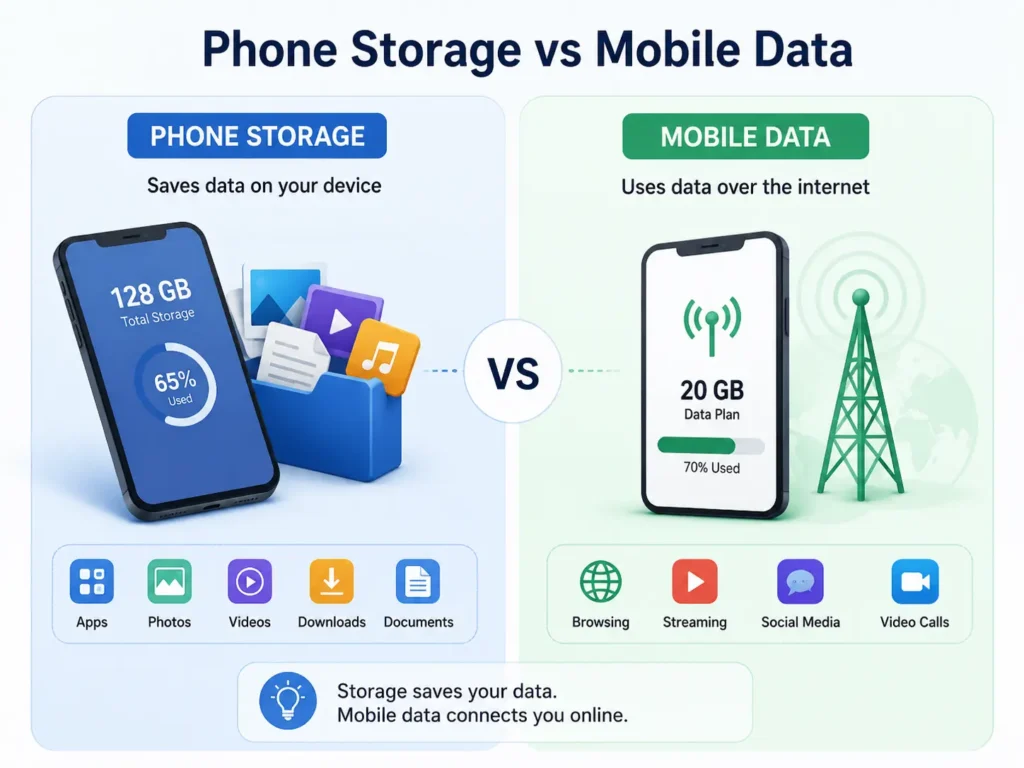
For example, downloading a 2 GB video uses mobile data during the download. After the download is complete, the same video also takes up storage space on your phone. If you delete the video later, you free storage space, but you do not get back the mobile data you already used.
Wi-Fi is also important here. If you use Wi-Fi, your activity usually does not count against your cellular data plan. However, your device may switch to mobile data if Wi-Fi becomes weak, depending on your settings.
GB Meaning on Phones, Laptops, and Cloud Storage
The GB meaning changes slightly depending on where you see it.
On a phone, GB can refer to internal storage or mobile data. A 128 GB phone refers to storage capacity, while a 10 GB monthly plan refers to cellular data usage. Phone storage is used by photos, apps, videos, messages, games, downloads, and system files.
On a laptop, GB usually refers to storage or memory. A laptop may have 512 GB of SSD storage for files and programs. It may also have 8 GB or 16 GB of RAM. Storage and RAM are different. Storage keeps files permanently, while RAM helps the computer run tasks while it is turned on.
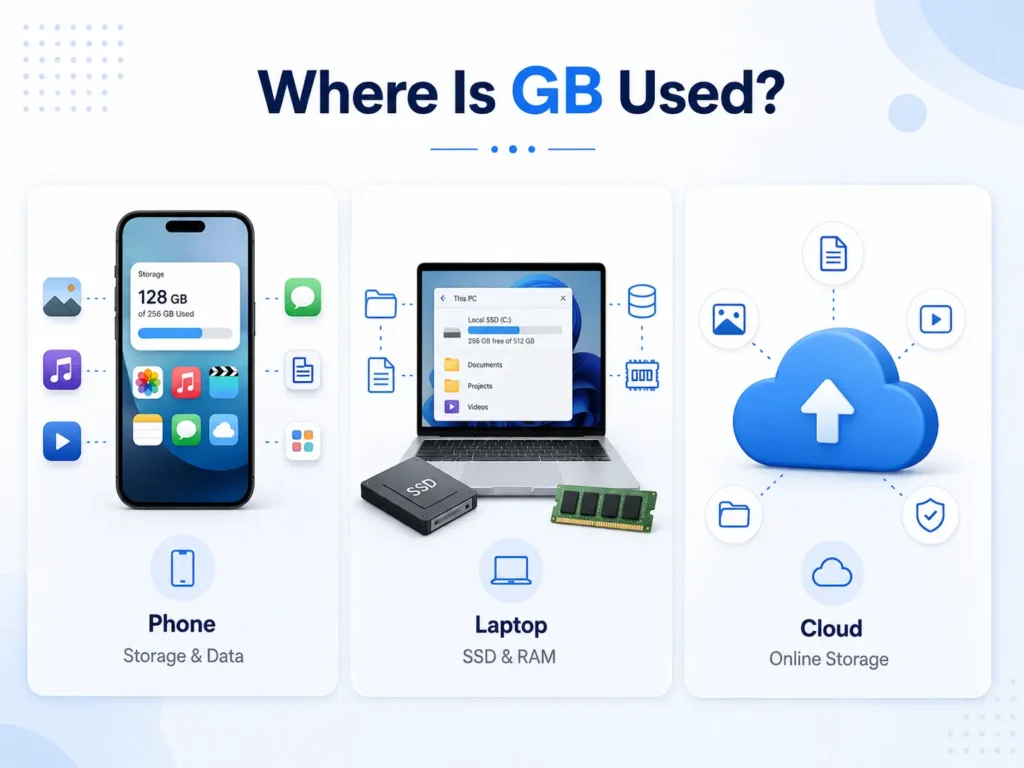
In cloud storage, GB means online space for saving files. Services such as cloud backup, photo storage, document storage, and shared work folders may offer plans like 50 GB, 100 GB, 200 GB, or 1 TB. Cloud storage is useful for backups, videos, photos, documents, and files you want to access from multiple devices.
In apps and games, GB shows file size. Some apps may use only a few MB, while large games, video editors, and creative tools may use several GB. Over time, apps can also grow because of updates, downloaded content, and cached files.
How Much Data Does 1 GB Hold?
One GB can hold a lot or very little depending on the type of content. File size changes based on quality, format, compression, resolution, bitrate, duration, and app settings.
Understanding the GB meaning also helps you estimate how many photos, songs, documents, apps, or videos you can save or download.
For photos, 1 GB may hold roughly 200 to 500 standard smartphone photos. High-resolution photos, RAW images, live photos, or edited images may take much more space.
For music, 1 GB may hold around 200 to 250 compressed songs. Lossless audio and high-quality files use more space than standard MP3 or AAC files.
For documents, 1 GB can hold thousands of simple text documents. PDFs, presentations, and spreadsheets may use more space if they include images, charts, or videos.
For video, 1 GB disappears faster. A low-quality video may last longer, but HD, Full HD, and 4K videos use much more storage and mobile data. A short 4K video can become very large quickly.
For apps, there is no fixed number. Small apps may use only a few MB, while large games can use many GB. Some games may require 20 GB, 50 GB, or even more after updates.
This is why GB should always be understood by context. One gigabyte may feel large for documents but small for modern games, HD videos, and cloud backups.
GB vs Similar Data Units
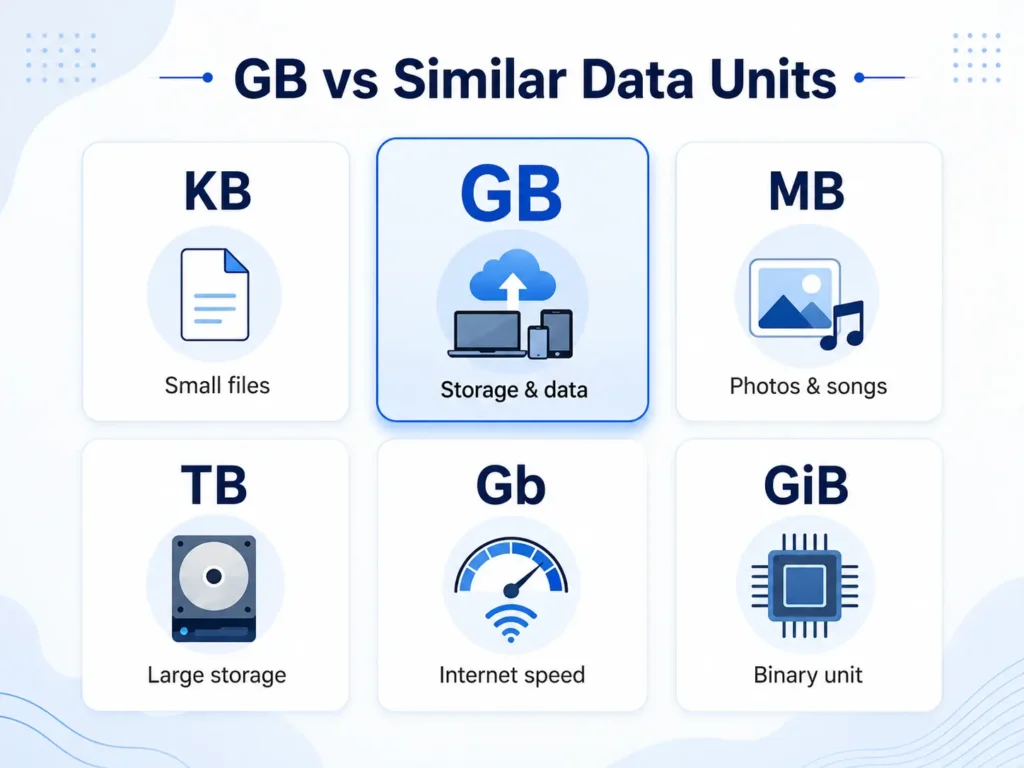
GB is part of a larger group of digital measurement units. To understand the GB meaning clearly, it helps to compare it with MB, KB, TB, Gb, and GiB.
GB vs MB
MB stands for megabyte. A megabyte is smaller than a gigabyte. In the decimal system, 1 GB equals 1,000 MB.
MB is commonly used for photos, songs, small apps, PDFs, and documents. GB is used for larger files, phone storage, laptop storage, videos, games, cloud plans, and mobile data allowances.
For example, a single photo may be 3 MB, but a long HD video may be several GB.
GB vs TB
TB stands for terabyte. A terabyte is larger than a gigabyte. In the decimal system, 1 TB equals 1,000 GB.
TB is usually used for large hard drives, external storage, gaming PCs, video editing projects, backups, and professional media libraries. If GB is useful for everyday phones and apps, TB is useful for very large storage needs.
GB vs Gb
GB and Gb look similar, but they do not mean the same thing.
GB means gigabyte. The uppercase B stands for byte. Gigabytes are used for storage capacity, file size, mobile data, downloads, and cloud storage.
Gb means gigabit. The lowercase b stands for bit. Gigabits are often used for internet speed, network speed, and data transfer rates.
The basic rule is simple: 1 byte equals 8 bits. That means 1 GB equals 8 Gb.
This is why internet speed may be shown in Mbps or Gbps, while file size is usually shown in MB or GB.
GB vs GiB
GiB stands for gibibyte. It is a binary measurement used in more technical computing contexts. One GiB equals 1,073,741,824 bytes, while one GB equals 1,000,000,000 bytes.
For everyday users, this difference mainly explains why a device may show less usable storage than the advertised number. A 500 GB drive may not show exactly 500 GB of available space because of measurement differences, formatting, system files, and preinstalled software.
Is GB a Formal or Informal Term?
GB is a formal technology abbreviation. It is not slang. You can use it in product descriptions, mobile plans, computer specifications, storage guides, software settings, and technical articles.
GB is a formal technology abbreviation, unlike informal texting terms such as ONM Meaning, which can change depending on the tone and context of a conversation.
However, people also use GB casually in daily conversation. Someone may say, “My phone has 128 GB,” or “I only have 2 GB of data left.” In both cases, the meaning is still gigabyte.
So, GB is formal in technical writing but also common in everyday language. The only important thing is context. If the topic is phones, laptops, cloud storage, apps, videos, files, or mobile data, GB almost always means gigabyte.
Origin and Evolution of GB
The term gigabyte comes from two parts: “giga” and “byte.” Giga means one billion in the decimal measurement system. A byte is a basic unit of digital information.
In the early days of computing, storage sizes were much smaller. People talked more about bytes, kilobytes, and megabytes. As computers, phones, cameras, games, and videos became more advanced, file sizes became larger. Because of that, gigabytes became a common part of everyday technology language.
Today, GB appears almost everywhere. You see it when buying a smartphone, checking laptop storage, choosing a mobile data plan, downloading an app, recording video, backing up photos, or comparing cloud storage plans.
The meaning has not changed, but its everyday importance has grown. A few years ago, 8 GB or 16 GB of phone storage may have seemed enough for many users. Now, many people choose 128 GB, 256 GB, or more because apps, videos, photos, and games use much more space.
Popular Digital Terms Related to GB
Digital abbreviations can be confusing because not every term has a technical meaning. For example, our OOP Meaning guide explains how OOP is used in text messages, comments, and social media.
To understand the GB meaning more clearly, it is useful to learn how gigabytes relate to other digital terms such as KB, MB, TB, RAM, SSD, and mobile data.
Byte: A small unit of digital data.
KB: Kilobyte. Used for very small files, such as basic text files.
MB: Megabyte. Used for photos, songs, PDFs, and smaller apps.
GB: Gigabyte. Used for phone storage, mobile data, videos, apps, games, and downloads.
TB: Terabyte. Used for large hard drives, backups, gaming storage, and media libraries.
RAM: Temporary memory that helps a device run apps and tasks.
SSD: A fast storage drive used in laptops and computers.
Cloud storage: Online storage used for photos, videos, documents, backups, and shared files.
Mobile data: Internet data used through a cellular network.
File size: The amount of space a file uses.
Download: A file transferred from the internet to your device.
Streaming: Watching or listening online without permanently saving the full file.
These terms often appear together because they all describe how digital information is stored, moved, or used.
Final Thoughts
The GB meaning is usually gigabyte. A gigabyte is a unit used to measure digital data. It can describe phone storage, laptop storage, cloud storage, file sizes, app sizes, downloads, mobile data, and internet usage.
Understanding context is important when reading abbreviations online. You can also explore MF Meaning to learn how tone, platform, and surrounding words affect the meaning of informal slang.
The most important thing to remember is that GB can refer to storage or data usage depending on the context. Storage GB tells you how much space your device or cloud account has. Mobile data GB tells you how much online data you can use through a cellular plan.
One GB can hold many documents, hundreds of photos, or many songs, but it may not hold much HD video or large game content. That is why you should choose storage or data plans based on your real habits.
If you mostly send messages, browse websites, and store a few photos, you may not need a very large amount of GB. If you record videos, play games, download movies, use cloud backups, or stream often, you will need more.
Frequently Asked Questions
What does GB stand for?
GB stands for gigabyte. It is a unit used to measure digital data, storage capacity, file size, downloads, and mobile data usage.
How many MB are in 1 GB?
In the decimal system, 1 GB equals 1,000 MB. This is the common measurement used for storage products and mobile data plans.
Is GB bigger than MB?
Yes. GB is bigger than MB. A gigabyte contains 1,000 megabytes in decimal measurement.
Is TB bigger than GB?
Yes. TB is bigger than GB. One terabyte equals 1,000 gigabytes.
What does GB mean on a phone?
On a phone, GB may mean storage capacity or mobile data. A 128 GB phone refers to storage, while a 10 GB plan refers to cellular data.
Is phone storage the same as mobile data?
No. Phone storage saves files on your device. Mobile data measures the internet data you use through a cellular network.
How much can 1 GB hold?
One GB may hold hundreds of standard photos, around 200 to 250 compressed songs, thousands of simple documents, or a limited amount of video. The exact amount depends on file size and quality.
How long does 1 GB of mobile data last?
It depends on your activity. Messaging and browsing use less data, while HD video streaming, video calls, app updates, and large downloads use much more.
What is the difference between GB and Gb?
GB means gigabyte, and Gb means gigabit. Gigabytes measure storage and data amount. Gigabits are often used for internet speed.
Why does my device show less storage than advertised?
Your device may show less storage because the operating system, formatting, system files, preinstalled apps, and updates use part of the advertised space.
Does Wi-Fi use mobile data GB?
Usually, Wi-Fi does not use your cellular data allowance. However, some devices may switch to mobile data if Wi-Fi becomes weak.
Is 128 GB enough for a phone?
For many users, 128 GB is enough for everyday apps, photos, messages, and moderate video use. Heavy gamers, creators, or people who record many videos may need 256 GB or more.