
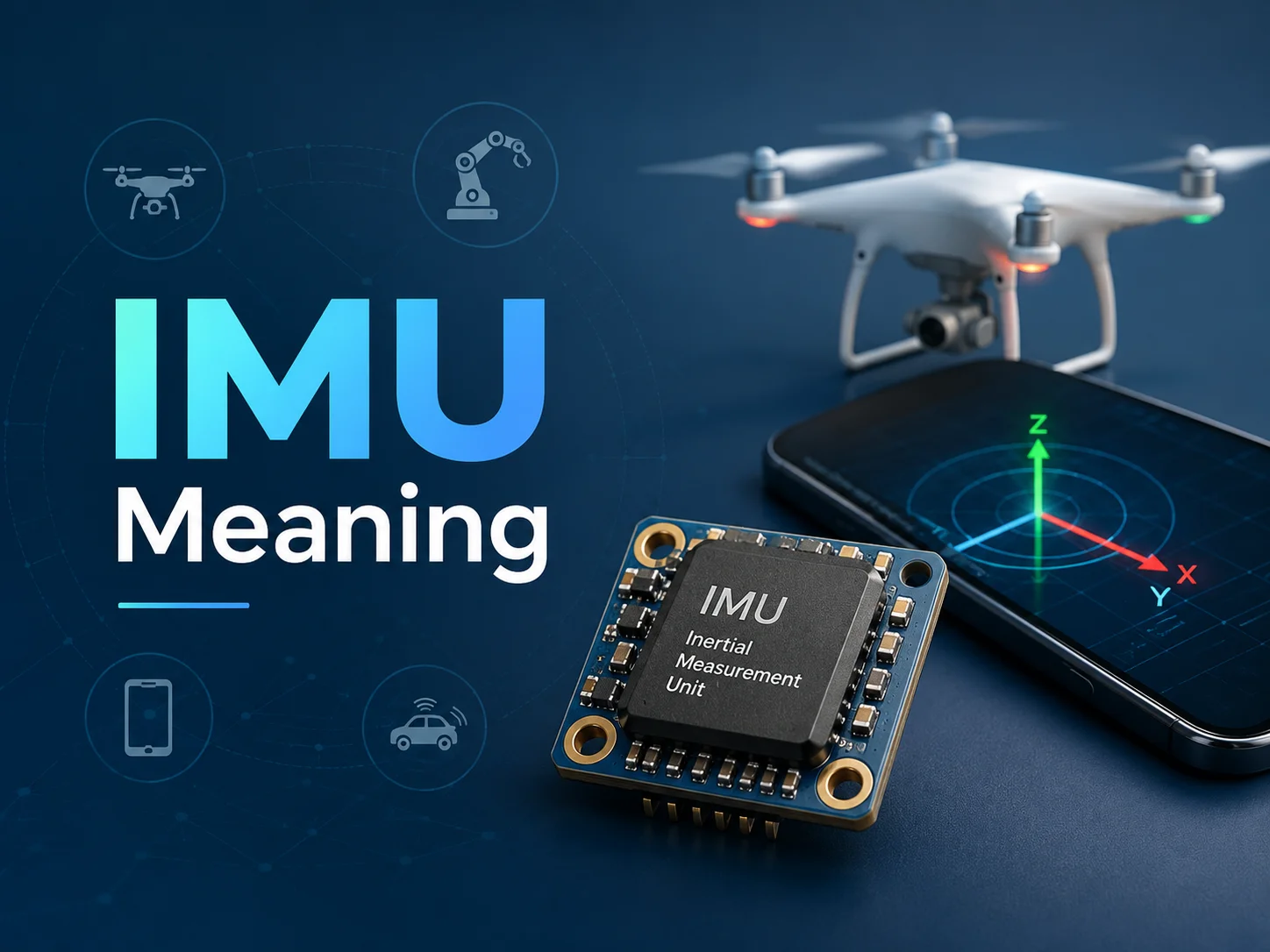
Have you ever wondered how your phone knows when you rotate the screen, how a drone stays balanced in the air, or how a fitness tracker counts your steps? One important technology behind these features is called an IMU.
The IMU meaning is simple when you break it down. IMU stands for Inertial Measurement Unit. It is a motion-sensing device that helps electronic systems understand movement, rotation, direction, heading, and orientation.
IMUs are used in many modern technologies, including smartphones, smartwatches, drones, robots, autonomous vehicles, aircraft, satellites, gaming controllers, virtual reality headsets, and fitness trackers. These devices need real-time motion data so they can respond quickly and accurately.
For example, a drone needs to know if it is tilting, turning, climbing, or falling. A smartphone needs to know when you turn it sideways. A robot needs to track movement through a room. An IMU helps provide this information.
This guide explains what an IMU is, how an Inertial Measurement Unit works, what sensors it uses, what it measures, and why it matters in modern technology.
What Does IMU Mean?
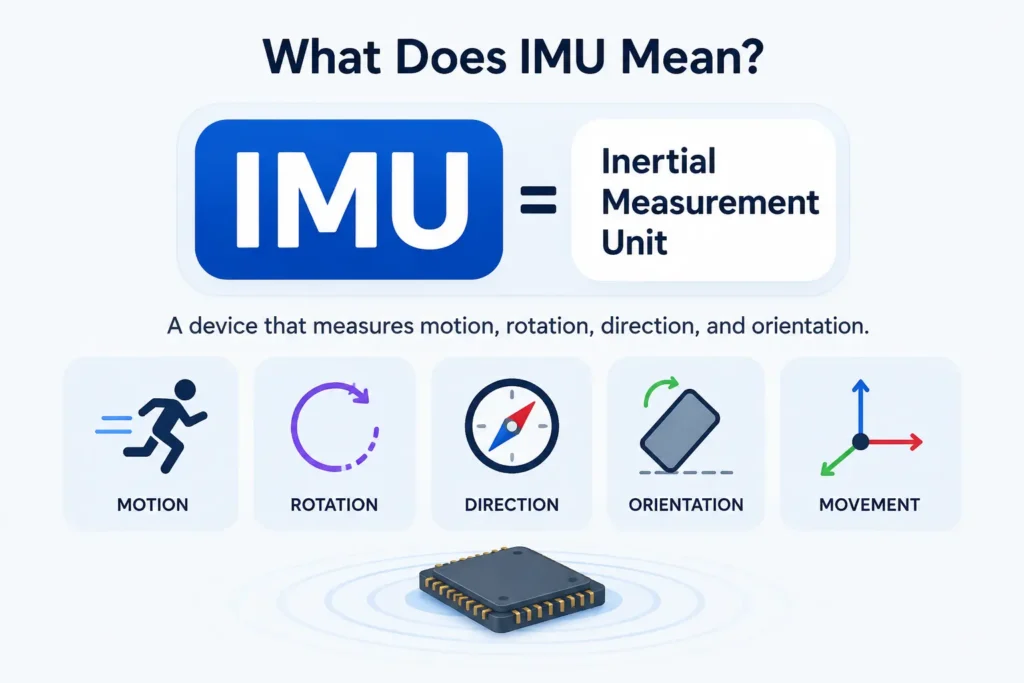
IMU means Inertial Measurement Unit. It is an electronic device that measures motion and orientation. In simple words, an IMU helps a machine understand how it is moving.
An IMU can detect acceleration, rotation, tilt, direction, heading, orientation, and motion changes. These measurements help electronic systems know whether they are moving forward, turning, falling, shaking, or staying still.
Most IMUs use a combination of sensors. The most common sensors are an accelerometer and a gyroscope. Some IMUs also include a magnetometer, which works like a digital compass. Together, these sensors help the device create a more complete picture of movement.
A simple way to understand an IMU is to compare it to the balance system in your body. Your inner ear helps you sense balance, movement, and direction. In a similar way, an IMU helps a device sense motion and position.
For example, a smartphone uses an IMU to rotate the screen. A drone uses an IMU to stay stable during flight. A robot uses an IMU to track movement. A satellite uses an IMU to maintain orientation in space. A VR headset uses an IMU to follow head movement.
Without IMUs, many motion-based systems would not work smoothly.
If you are also learning common digital communication terms, you may find [IMSG Meaning] helpful because it explains another short abbreviation people use in messaging.
What Is an Inertial Measurement Unit?
An inertial measurement unit is a sensor module that measures movement in three-dimensional space. It does not only detect that something moved. It can also help measure how fast it moved, how it rotated, and which direction it is facing.
The word “inertial” comes from inertia, which means an object’s tendency to resist changes in motion. An IMU measures inertial forces to understand how an object is moving.
For example, if a car speeds up, slows down, turns, or brakes suddenly, an IMU can detect those motion changes. If a drone tilts because of wind, the IMU can detect the change and send data to the flight controller.
This makes IMUs useful in navigation systems, robotics, aerospace, marine navigation, wearable devices, autonomous vehicles, and industrial machines.
The main purpose of an IMU is to provide real-time motion information. This helps a device make fast decisions. A drone can correct its balance. A robot can adjust its path. A phone can rotate its display. An autonomous vehicle can keep tracking motion when GPS signals become weak.
How Does an IMU Work?
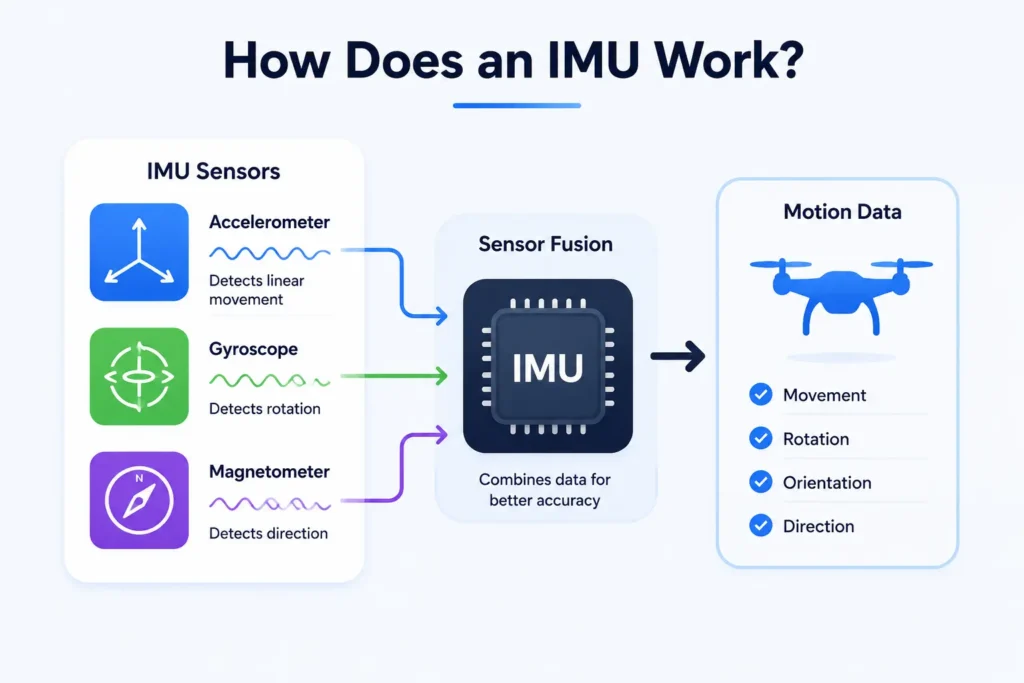
An IMU works by collecting data from multiple sensors and sending that data to a processor. The processor then uses the data to estimate movement, rotation, orientation, and direction.
The main sensors inside an IMU usually include an accelerometer, a gyroscope, and sometimes a magnetometer. These sensors work together through a process called sensor fusion.
Sensor fusion means combining data from different sensors to create a more accurate picture of motion. One sensor alone may not be enough. For example, an accelerometer can detect movement and tilt, but it may not track rotation perfectly. A gyroscope can measure rotation, but it may drift over time. A magnetometer can help with heading, but it can be affected by magnetic interference.
When these sensors work together, the IMU can give better motion data than any single sensor could provide by itself.
For example, when a drone is flying, the IMU constantly checks whether the drone is tilting, rotating, moving upward, moving downward, or changing direction. The flight controller uses this data to keep the drone stable.
In a smartphone, the IMU detects when you rotate the device. This allows the screen to switch from portrait mode to landscape mode. In virtual reality, an IMU helps track head movement so the view changes naturally when the user looks around.
Main Components of an IMU
An IMU works because of the sensors inside it. The most important components are the accelerometer, gyroscope, and magnetometer.
Accelerometer
An accelerometer measures linear acceleration. This means it detects changes in speed or movement along straight lines.
Most modern IMUs use a 3-axis accelerometer. It measures movement along three directions: X-axis, Y-axis, and Z-axis. This helps the device understand movement left and right, forward and backward, and up and down.
Accelerometers are used in smartphones, fitness trackers, smartwatches, drones, robots, and industrial equipment. For example, a fitness tracker uses accelerometer data to detect steps and body movement.
Gyroscope
A gyroscope measures angular velocity, which means rotational movement. It helps detect how quickly an object is turning.
A 3-axis gyroscope measures rotation around roll, pitch, and yaw. These three movements are important for orientation tracking. For example, a drone uses gyroscope data to detect if it is tilting left, pointing upward, or turning sideways.
Gyroscopes are also important in aircraft, VR headsets, gaming controllers, robots, and camera gimbals.
Magnetometer
A magnetometer measures magnetic fields. In many IMUs, it works like a digital compass. It helps the system understand direction and heading.
For example, a magnetometer can help a device know which direction is north. When combined with accelerometer and gyroscope data, it improves orientation tracking and navigation accuracy.
Magnetometers are useful in smartphones, drones, autonomous vehicles, marine navigation systems, and robotics.
What Does an IMU Measure?
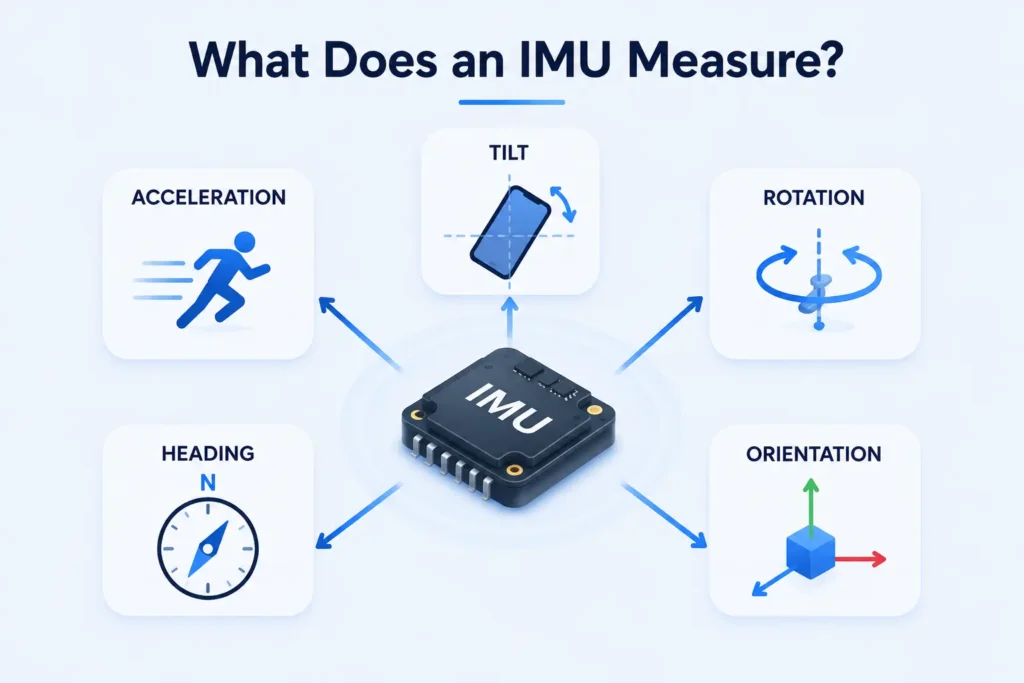
An IMU measures motion and orientation. The exact data depends on the type of IMU, but most IMUs measure linear acceleration, angular velocity, tilt, heading, and orientation.
Acceleration tells the system how speed is changing. Rotation tells the system how an object is turning. Heading tells the system which direction it is facing. Orientation tells the system how the object is positioned in space.
This data is useful in many systems. Drones use it for stable flight. Robots use it for balance and navigation. Smartphones use it for screen rotation and motion apps. Autonomous vehicles use it for movement tracking. VR systems use it for head and controller motion.
So, the IMU meaning is more than just a technical term. An IMU is a key motion-sensing unit that helps modern devices understand movement in real time.
Different Types of IMUs
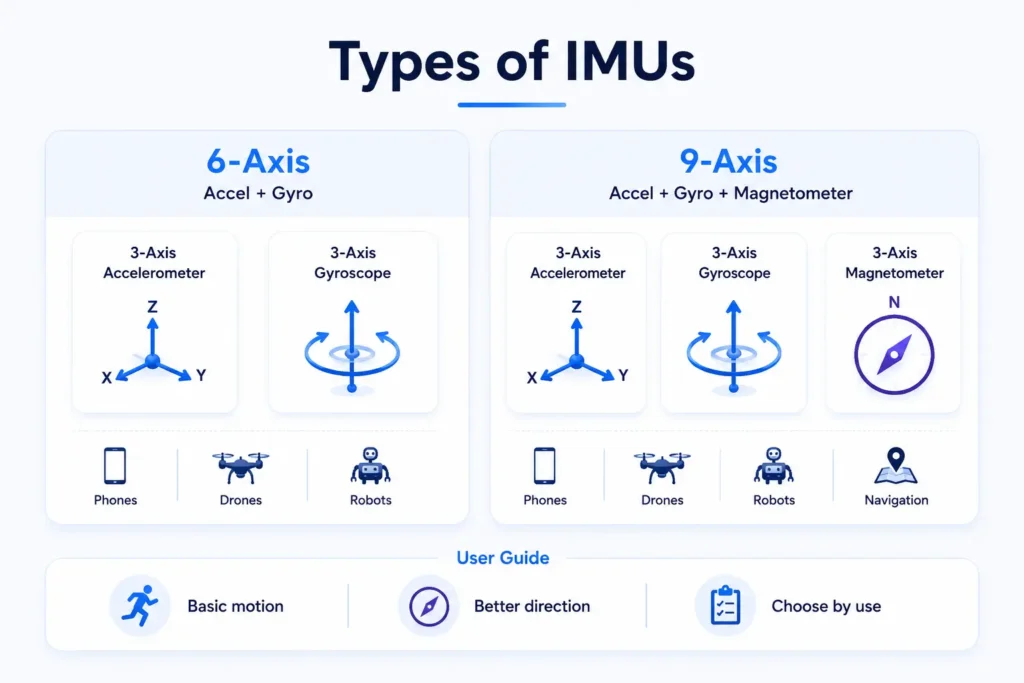
Different IMUs are made for different needs. Some are small and affordable for everyday devices, while others are highly accurate and used in aircraft, satellites, robotics, and industrial systems.
A 6-axis IMU includes a 3-axis accelerometer and a 3-axis gyroscope. It measures linear acceleration and rotational movement. This type is common in smartphones, fitness trackers, drones, gaming controllers, and wearable devices. It is compact, affordable, and useful for many consumer products. However, because it does not include a magnetometer, heading accuracy may drift over time.
A 9-axis IMU includes a 3-axis accelerometer, 3-axis gyroscope, and 3-axis magnetometer. The magnetometer works like a digital compass and helps improve heading, direction, and orientation accuracy. 9-axis IMUs are often used in drones, robotics, virtual reality, augmented reality, autonomous navigation systems, and advanced motion tracking devices.
Many modern IMUs are MEMS-based. MEMS stands for Micro-Electro-Mechanical Systems. These sensors are very small, lightweight, energy-efficient, and affordable. Because of MEMS technology, IMUs are now common in smartphones, smartwatches, cars, drones, robots, fitness trackers, and gaming devices.
Industrial and aerospace IMUs are built for higher accuracy and long-term stability. They may include better gyroscopes, temperature compensation, advanced calibration, and precise sensor fusion. These IMUs are used in aircraft, satellites, spacecraft, defense systems, surveying equipment, and autonomous machines.
IMU vs Similar Motion Sensors
An IMU is often compared with accelerometers, gyroscopes, GPS, and AHRS systems. These technologies are related, but they are not the same.
An accelerometer measures linear acceleration. It detects movement, tilt, vibration, impact, and changes in speed. An IMU includes an accelerometer, but it also uses a gyroscope and sometimes a magnetometer. In simple words, an accelerometer measures one part of motion, while an IMU gives a more complete motion picture.
A gyroscope measures angular velocity, which means rotational movement. It detects how quickly something turns around roll, pitch, and yaw axes. An IMU uses gyroscope data, but it combines that data with acceleration and sometimes magnetic heading. A gyroscope is one sensor, while an IMU is a complete motion-sensing unit.
GPS uses satellite signals to find a location. An IMU uses internal sensors to measure movement and direction. GPS is useful outdoors, but it can struggle indoors, underwater, underground, in tunnels, parking garages, or areas with weak satellite signals. An IMU can still work in these places because it does not depend on satellites.
AHRS means Attitude and Heading Reference System. An IMU provides raw sensor data, while an AHRS processes that data to calculate roll, pitch, yaw, heading, and orientation. In simple words, IMU means sensor hardware, while AHRS means sensor hardware plus orientation calculations.
Is IMU Easy or Technical to Understand?
IMU technology can sound technical because it includes terms like accelerometer, gyroscope, magnetometer, sensor fusion, angular velocity, linear acceleration, roll, pitch, yaw, heading, calibration, and sensor drift. However, the basic idea is simple.
An IMU helps a device understand how it is moving.
A phone uses it to rotate the screen. A drone uses it to stay balanced. A robot uses it to navigate. A VR headset uses it to track head movement. An autonomous vehicle uses it to estimate motion when GPS is weak.
So, you do not need to understand every mathematical detail to understand the IMU meaning. You only need to know that it measures motion, rotation, direction, and orientation in real time.
Some abbreviations are technical, like IMU, while others are used in everyday texting, such as [TTM Meaning], which is common in casual chats.
Origin and Evolution of IMU Technology
IMU technology grew from the need for accurate navigation and motion tracking. Early inertial systems were used in aircraft, ships, missiles, and spacecraft because these systems needed to understand position, movement, and orientation even when outside signals were not available.
Over time, sensors became smaller, cheaper, and more efficient. MEMS technology made it possible to place IMUs inside everyday devices like smartphones, smartwatches, fitness trackers, gaming controllers, drones, and VR headsets.
Today, IMUs are used in consumer electronics, robotics, autonomous vehicles, aerospace systems, industrial automation, marine navigation, medical devices, and virtual reality. The future of IMU technology is also growing. AI-powered sensor fusion, improved MEMS sensors, smart glasses, indoor navigation, edge AI devices, and autonomous robots will continue to make IMUs more important.
Popular Terms Related to IMU
Several important terms help explain how an IMU works.
An accelerometer is a sensor that measures linear acceleration.
A gyroscope is a sensor that measures rotational movement.
A magnetometer is a sensor that measures magnetic fields and helps determine heading.
Sensor fusion is the process of combining data from multiple sensors to improve accuracy.
Roll, pitch, and yaw are the three main rotational movements used to describe orientation.
MEMS means micro-electro-mechanical systems. It is the tiny sensor technology used in many modern IMUs.
Sensor drift is a gradual error that builds up over time in sensor readings.
Calibration is the process of adjusting a sensor to improve accuracy.
These terms may sound technical at first, but they all connect to the same main idea: helping devices measure motion more accurately.
For readers who also want to understand common online abbreviations, [NVM Meaning] is another useful guide that explains a popular texting shortcut.
Final Thoughts
The IMU meaning is simple: IMU stands for Inertial Measurement Unit. It is a motion-sensing device that measures acceleration, rotation, tilt, heading, and orientation.
Most IMUs use accelerometers, gyroscopes, and sometimes magnetometers. These sensors work together through sensor fusion to help devices understand how they are moving in real time.
IMUs are important in smartphones, drones, robots, autonomous vehicles, VR headsets, aircraft, satellites, marine systems, wearable devices, gaming controllers, and industrial machines. They are especially useful when GPS is weak or unavailable.
Although IMUs can face challenges like sensor drift, calibration needs, magnetic interference, vibration, and temperature changes, they remain one of the most important technologies in modern motion tracking and navigation.
Frequently Asked Questions
What does IMU stand for?
IMU stands for Inertial Measurement Unit. It is a device that measures motion and orientation.
What does an IMU measure?
An IMU measures linear acceleration, angular velocity, tilt, heading, and orientation.
Is an IMU the same as a gyroscope?
No. A gyroscope is one part of an IMU. An IMU usually includes a gyroscope, accelerometer, and sometimes a magnetometer.
What is the difference between IMU and GPS?
GPS uses satellite signals to find positions. An IMU uses internal sensors to measure motion and direction.
What is a 6-axis IMU?
A 6-axis IMU includes a 3-axis accelerometer and a 3-axis gyroscope.
What is a 9-axis IMU?
A 9-axis IMU includes an accelerometer, gyroscope, and magnetometer.
Why do drones use IMUs?
Drones use IMUs to stay stable, track orientation, detect movement, and support flight control.
Does an IMU work indoors?
Yes. An IMU can work indoors because it does not rely on satellite signals.
Can an IMU find the exact location?
Not by itself for long periods. It can estimate movement, but errors can build up over time.
What devices use IMUs?
Smartphones, smartwatches, fitness trackers, drones, robots, gaming controllers, VR headsets, aircraft, satellites, and autonomous vehicles use IMUs.