
If you see “FYI” in a text, email, or workplace chat, the sender usually wants to share information with you. The FYI meaning is “For Your Information.” People use this abbreviation to give an update, provide context, or point out something useful without always asking for a response.
You may encounter FYI in text messages, professional emails, Slack, Microsoft Teams, group chats, and social media conversations. In many situations, it simply means “just letting you know.” However, the exact tone can change depending on the wording, relationship, and communication context.
Understanding FYI is especially useful in professional communication because an informational message may sometimes include a request or action. This guide explains what FYI means, how people use it in texting and email, and how context affects its meaning.
What Does FYI Mean?
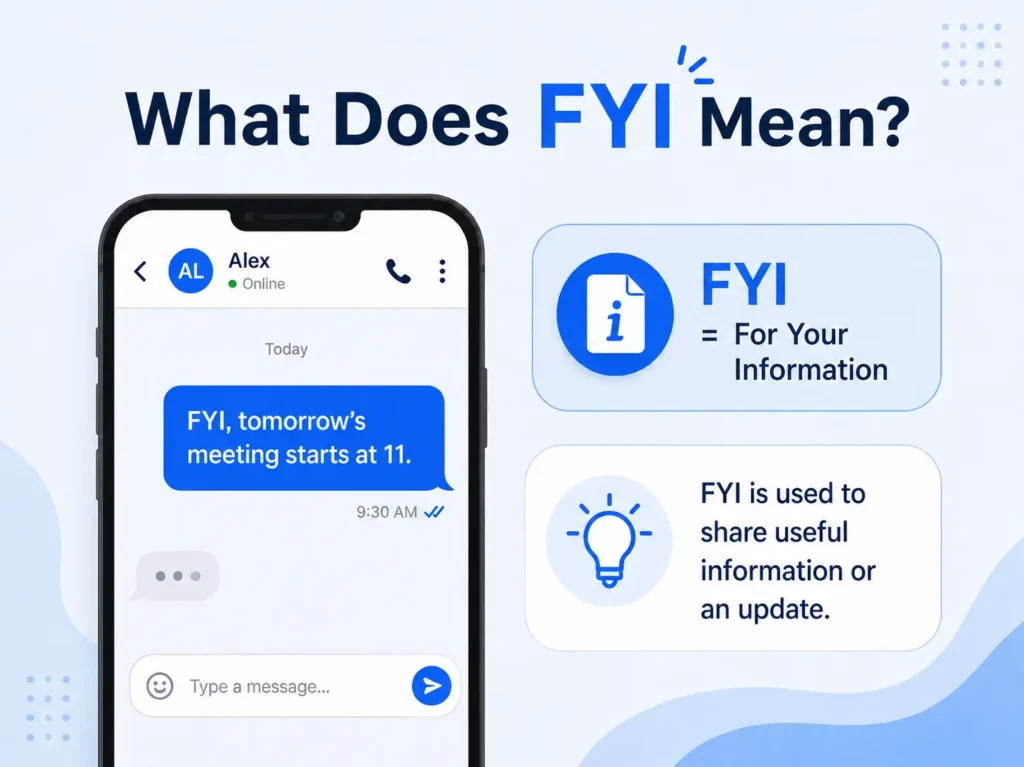
FYI stands for “For Your Information.” It is used when someone wants another person to know a fact, update, or detail.
For example:
“FYI, tomorrow’s meeting starts at 11.”
The sender is sharing information that may be useful to the recipient.
In simple terms, FYI often means:
“Just letting you know.”
The FYI meaning usually relates to awareness rather than a direct command. However, you should still read the entire message because FYI does not automatically mean that no action is required.
What Does FYI Stand For?
The full form of FYI is For Your Information.
Example:
“FYI, I uploaded the new report to the shared folder.”
The phrase tells the recipient that the following information is relevant and worth knowing.
Is FYI an Acronym, Initialism, or Abbreviation?
FYI is an abbreviation and, more specifically, an initialism because people usually pronounce the letters separately as “F-Y-I.”
It is commonly written in uppercase, especially in emails and professional messages. You may also see fyi in casual texts or online chats.
FYI Meaning at a Glance
| Meaning | Full Form | Main Purpose | Tone | Common Context |
| Sharing information | For Your Information | Keep someone informed | Neutral to casual | Texts, emails, chats, workplace |
What Does FYI Mean in Text Messages?
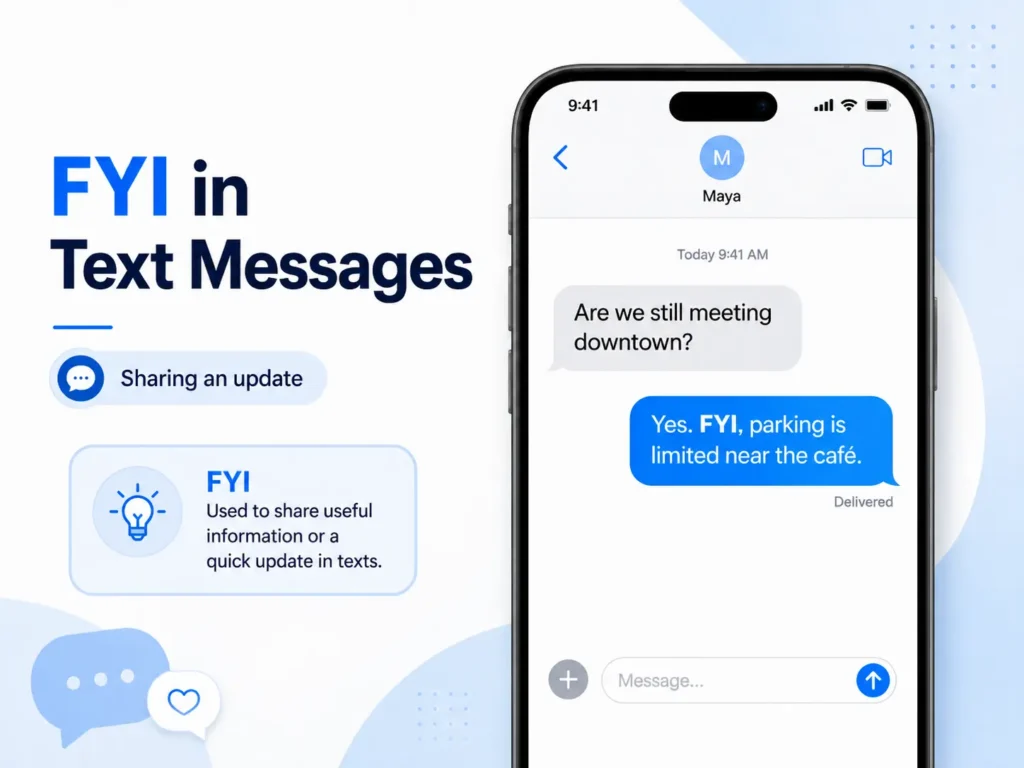
The FYI meaning in text is usually the same as in other communication: “For Your Information.”
People use it to share updates quickly without writing a long explanation.
For example:
“FYI, the restaurant closes at 9.”
This tells the other person something that may affect their plans.
Another example:
“FYI, Mark is coming with us tonight.”
Here, the sender provides an update rather than asking a question.
FYI Between Friends and Family
In casual conversations, FYI often sounds similar to “just so you know.”
Friend: “Are we still meeting downtown?”
You: “Yes. FYI, parking is limited near the café.”
Family member: “When will you be home?”
You: “Around 8. FYI, I have a meeting after work.”
These examples show how FYI helps people add useful information without making the message complicated.
FYI in Group Chats
FYI is also useful when several people need the same update.
Examples:
“FYI, the venue has changed.”
“FYI, I posted the new schedule in the group.”
“FYI, tickets are cheaper if we book today.”
In a group chat, FYI can quickly draw attention to information that everyone should know.
Does FYI Require a Reply?
Not always.
If someone says:
“FYI, tomorrow’s class is canceled.”
You may not need to reply because the sender is simply sharing information.
However, a short response such as “Thanks,” “Got it,” or “Noted” can be polite, especially in workplace communication.
You should also check whether the message contains a request.
For example:
“FYI, the deadline changed to Friday. Please send your draft by Thursday.”
This message includes both information and a clear action. The presence of FYI does not cancel the request.
FYI Meaning in Email and Professional Communication
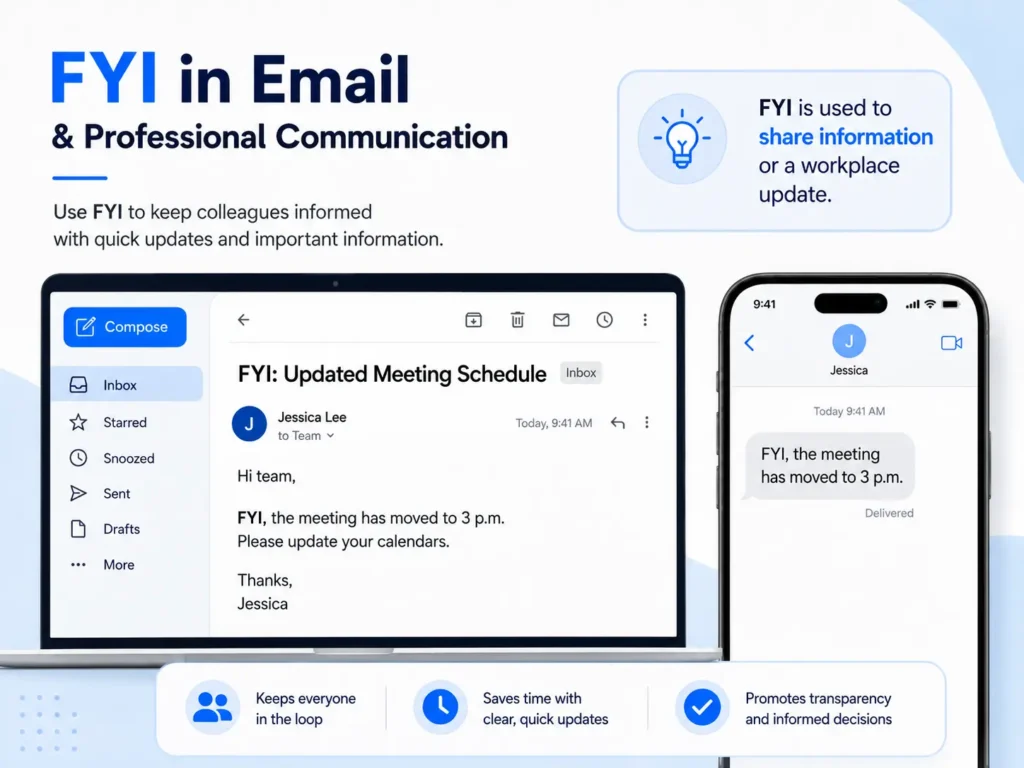
FYI is common in professional emails because it allows coworkers, managers, and team members to share information efficiently.
The FYI meaning in email is still “For Your Information,” but its purpose may include keeping someone updated, forwarding relevant information, or giving background context.
Why People Use FYI in Emails
People may use FYI to:
- Share a project update
- Forward a useful email
- Announce a schedule change
- Provide additional context
- Keep a coworker informed
- Give visibility to a decision
For example:
“FYI, the client approved the final design.”
This message gives the recipient useful information without directly asking for a response.
FYI at the Beginning of an Email
FYI often appears at the start of a short email:
“FYI, the meeting has moved to 3 p.m.”
This tells the reader immediately that the email contains an informational update.
FYI When Forwarding an Email
Someone may forward an email and write only:
“FYI.”
In this case, the message usually means:
“I thought you should see this.”
For example, a manager may forward client feedback to a team member without assigning a task. The recipient should still read the forwarded message because the information may become relevant later.
FYI in an Email Subject Line
FYI can also appear in an email subject line.
Examples:
FYI: Updated Meeting Schedule
FYI: Client Feedback
A descriptive subject line is more useful than writing only “FYI” because it immediately tells the recipient what the email is about.
Does FYI Mean “No Action Required”?
FYI often introduces information rather than a task, but it does not always mean no action required.
Compare these examples:
Information only:
“FYI, the office will be closed Monday.”
Information plus action:
“FYI, the office will be closed Monday. Please submit your report by Friday.”
The second message still requires a response or action.
In professional communication, always look for clear instructions rather than assuming that every FYI email can be ignored.
FYI Meaning on Social Media and Online Chats
On social media and online platforms, FYI still means “For Your Information.”
People may use it in comments, posts, direct messages, and online discussions to share a fact, correction, reminder, or useful detail.
Example:
“FYI, the event starts at 6, not 7.”
On platforms such as Slack or Microsoft Teams, FYI often introduces a workplace update:
“FYI, the client call has been moved to tomorrow.”
The meaning remains the same across platforms, but the tone may change depending on the conversation.
Social media conversations also use agreement-based slang such as IKR Meaning, short for “I Know, Right?”, when people strongly agree with someone’s comment or opinion.
Different Uses of FYI Depending on Context
Context helps you understand why someone used FYI.
A friend may use it casually:
“FYI, I’ll be late.”
A coworker may use it professionally:
“FYI, the revised contract is attached.”
A person in an online discussion may use it to correct information:
“FYI, that feature was added last year.”
The abbreviation itself is usually neutral. The surrounding words, punctuation, and relationship between the sender and recipient determine whether the message sounds friendly, formal, abrupt, or critical.
The most important rule is simple: read the full message. FYI tells you that information is being shared, but the rest of the sentence tells you what the sender actually expects from you.
FYI vs Similar Texting Abbreviations and Phrases
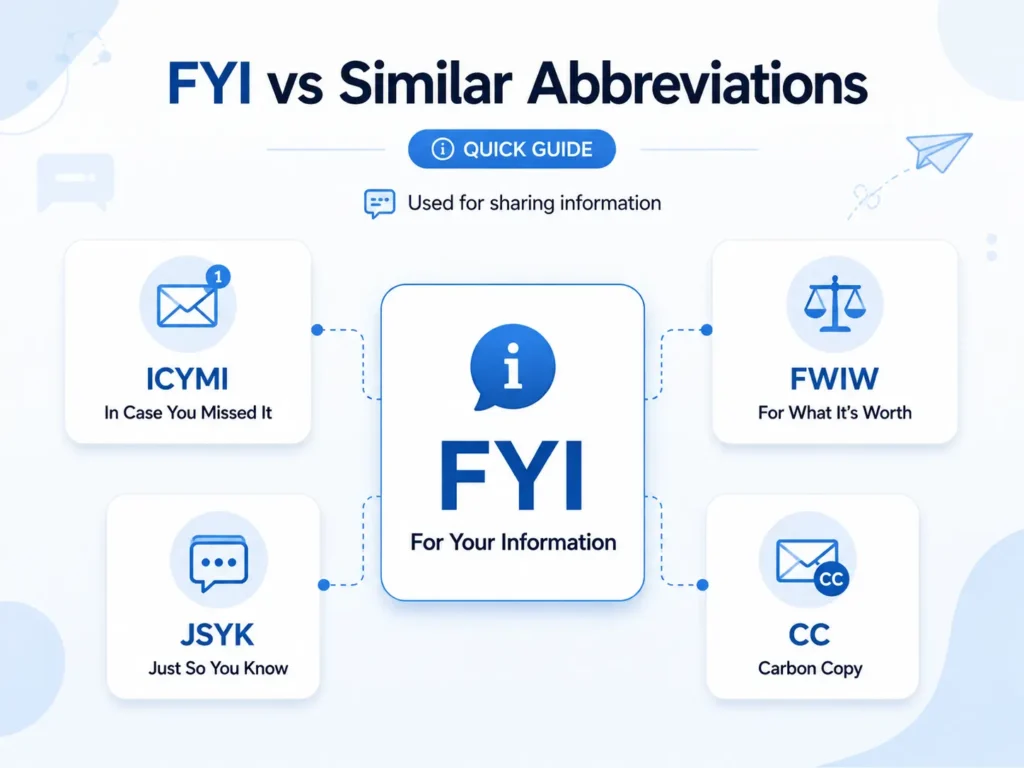
FYI is not the only abbreviation people use to share information online. Several terms look similar, but they serve different purposes.
| Term | Full Form | Main Purpose | Typical Tone |
| FYI | For Your Information | Share information | Neutral |
| ICYMI | In Case You Missed It | Reshare something | Casual |
| FWIW | For What It’s Worth | Offer an opinion | Casual |
| JSYK | Just So You Know | Share informal information | Casual |
| CC | Carbon Copy | Include another email recipient | Professional |
FYI vs “Heads Up”
FYI usually shares information, while “heads up” often warns someone about something that may happen.
“FYI, the meeting starts at 2.”
“Heads up, the client may ask about the delay.”
Both are useful, but “heads up” often suggests that the recipient should prepare for something.
FYI vs ICYMI
ICYMI means “In Case You Missed It.” People often use it when resharing a post, article, announcement, or earlier message.
FYI introduces useful information, while ICYMI highlights something the reader may not have seen.
FYI vs FWIW
FWIW means “For What It’s Worth.” It usually introduces an opinion, suggestion, or personal perspective.
For example:
“FWIW, I think the first design looks better.”
FYI focuses more on information than personal opinion.
If you want to learn another abbreviation used for sharing personal viewpoints, our IMO Meaning guide explains how IMO means “In My Opinion” in texts, chats, and social media.
FYI vs JSYK
JSYK means “Just So You Know.” Its purpose is very similar to FYI, but JSYK usually feels more casual.
You may use FYI in a professional email, while JSYK is more common in texts and informal chats.
FYI vs CC in Email
FYI is language used inside a message. CC, or carbon copy, is an email field that sends the same message to additional recipients.
Someone may CC a coworker because they want them informed, but that does not make CC another meaning of FYI.
Is FYI Formal, Informal, Rude, or Passive-Aggressive?
FYI can work in both formal and informal communication.
In casual texting, it often sounds relaxed:
“FYI, I’ll be about 10 minutes late.”
In a professional email, it can sound neutral:
“FYI, the client approved the revised proposal.”
However, tone depends heavily on the surrounding words.
Can FYI Sound Rude?
FYI itself is not necessarily rude. Problems usually come from how a person uses it.
Compare:
“FYI, the report is in the shared folder.”
and:
“FYI, I already explained this yesterday.”
The first sounds informational. The second may sound irritated or critical.
Can FYI Sound Passive-Aggressive?
Yes. FYI can sound passive-aggressive when someone uses it to point out a mistake, criticize another person, or emphasize that they should already know something.
For example:
“FYI, the deadline was yesterday.”
A softer version would be:
“Just an FYI—the deadline was yesterday in case you missed the earlier message.”
When the topic is sensitive, clearer and more polite wording usually works better.
How to Use FYI Correctly
Using FYI correctly is mostly about clarity, placement, and tone.
Should FYI Come at the Beginning or End?
FYI most commonly appears at the beginning:
“FYI, the document has been updated.”
It can also appear at the end:
“The document has been updated, FYI.”
The first version usually sounds more natural because it immediately tells the reader that an informational update follows.
Do You Need a Comma After FYI?
A comma commonly follows FYI when it introduces a sentence:
“FYI, tomorrow’s call has been canceled.”
In an email subject line, a colon is also useful:
FYI: New Project Timeline
Should You Write FYI or fyi?
Uppercase FYI is the clearest form and works well in professional communication.
Lowercase fyi may appear in casual texts, social media comments, and online chats. The meaning does not change.
Can FYI Stand Alone?
Yes. A person may forward a message and simply write:
“FYI.”
This usually means they want you to read the information for awareness.
However, adding one sentence of context is often more helpful:
“FYI—sharing the latest client feedback.”
Is “For Your FYI” Correct?
No. The phrase is redundant because the “F” in FYI already stands for “For.”
Instead of saying:
“For your FYI, the schedule changed.”
Write:
“FYI, the schedule changed.”
Origin and Evolution of FYI
FYI did not begin with social media or texting. The phrase “for your information” was used in workplace and written communication before modern digital messaging.
It became especially useful in memos, business correspondence, and professional communication because it quickly signaled that the recipient should be aware of certain information.
As email, instant messaging, texting, and workplace chat platforms became common, FYI remained useful because it is short and easy to understand.
Today, the FYI meaning has stayed largely the same even though the places where people use it have expanded.
Popular Abbreviations Related to FYI
If you regularly see FYI in online communication, you may also encounter these abbreviations:
- ICYMI: In Case You Missed It
- FWIW: For What It’s Worth
- JSYK: Just So You Know
- BTW: By The Way
- ASAP: As Soon As Possible
- ETA: Estimated Time of Arrival
- TBD: To Be Determined
- N/A: Not Applicable or Not Available
Another common expression is TBH Meaning, which stands for “To Be Honest” and is often used when someone wants to share an honest thought or opinion.
Each abbreviation serves a different communication purpose. FYI is specifically useful when the main goal is to keep someone informed.
Final Thoughts
The FYI meaning is “For Your Information.” People use it in texts, emails, group chats, social media, and professional communication to share information or provide context.
FYI is usually neutral, but wording and tone can make it sound friendly, formal, abrupt, or even passive-aggressive. It also does not always mean that no action is required, so readers should check the full message for instructions.
Used clearly and appropriately, FYI is a simple way to keep another person informed without adding unnecessary explanation.
Frequently Asked Questions About FYI Meaning
What does FYI mean?
FYI means “For Your Information.” It introduces information that the sender believes the recipient should know.
What does FYI mean in a text?
In texting, FYI usually means “just so you know” or “just letting you know.”
What does FYI mean in an email?
In email, FYI commonly introduces updates, forwarded messages, background information, or details shared for awareness.
Does FYI mean no action is required?
Often, but not always. An FYI message can still contain a request or instruction, so read the entire message.
Do you need to reply to FYI?
Not necessarily. If the message only provides information, no response may be needed. A short “Thanks” or “Got it” can still be polite.
Is FYI rude?
FYI is not inherently rude. Its tone depends on the surrounding wording and the relationship between the sender and recipient.
Is FYI formal or informal?
FYI works in both settings. It appears in professional emails and workplace chats as well as casual texts.
Can you use FYI with your boss?
Yes. However, consider your workplace culture. In very formal communication, “For your awareness” or “Please note” may sound more polished.
What does “just FYI” mean?
“Just FYI” means “just so you know.” The word “just” can make the message sound more conversational.
What is a polite alternative to FYI?
Polite alternatives include “For your awareness,” “Please note,” “For your reference,” “I wanted to let you know,” and “I’m sharing this for context.”