
ALL Meaning is simple in most situations: “all” refers to the whole amount, every person, everything, or something complete. In texts, chats, and social media posts, people usually use ALL with the same basic meaning, although capital letters can add emphasis.
Uppercase ALL can resemble an acronym, but context usually reveals the intended meaning.
What Does ALL Mean?
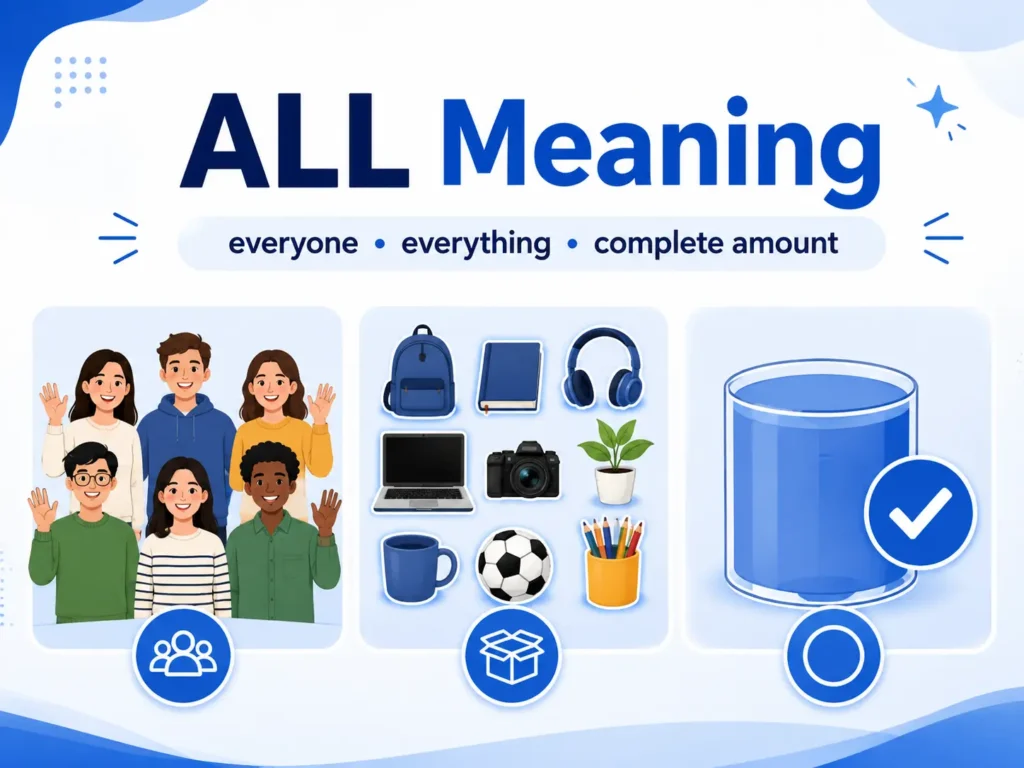
Simple Definition of ALL
The word “all” expresses completeness. It can mean the entire amount, every member of a group, everything involved, or something done completely.
Examples include “all students,” “all day,” “all of us,” and “I ate it all.” Each points to a complete group, time, or quantity.
Is ALL a Word, Slang Term, or Acronym?
“All” is primarily a standard English word, not a texting abbreviation. People may write ALL to show emphasis, excitement, frustration, or contrast.
In specialized fields, ALL can also appear as an acronym. Readers should check the topic before assuming a specific expansion.
Different Meanings of ALL in English
ALL as a Determiner
As a determiner, “all” comes before a noun or noun phrase, as in “all people,” “all my friends,” and “all information.”
ALL as a Pronoun, Adverb, or Noun
As a pronoun, “all” can replace people or things. “All are welcome” means everyone is welcome. “That is all” means nothing more remains.
As an adverb, it can mean completely, as in “She was all alone.” As a noun, “give it your all” means make your greatest effort.
What Does ALL Mean in Text Messages?
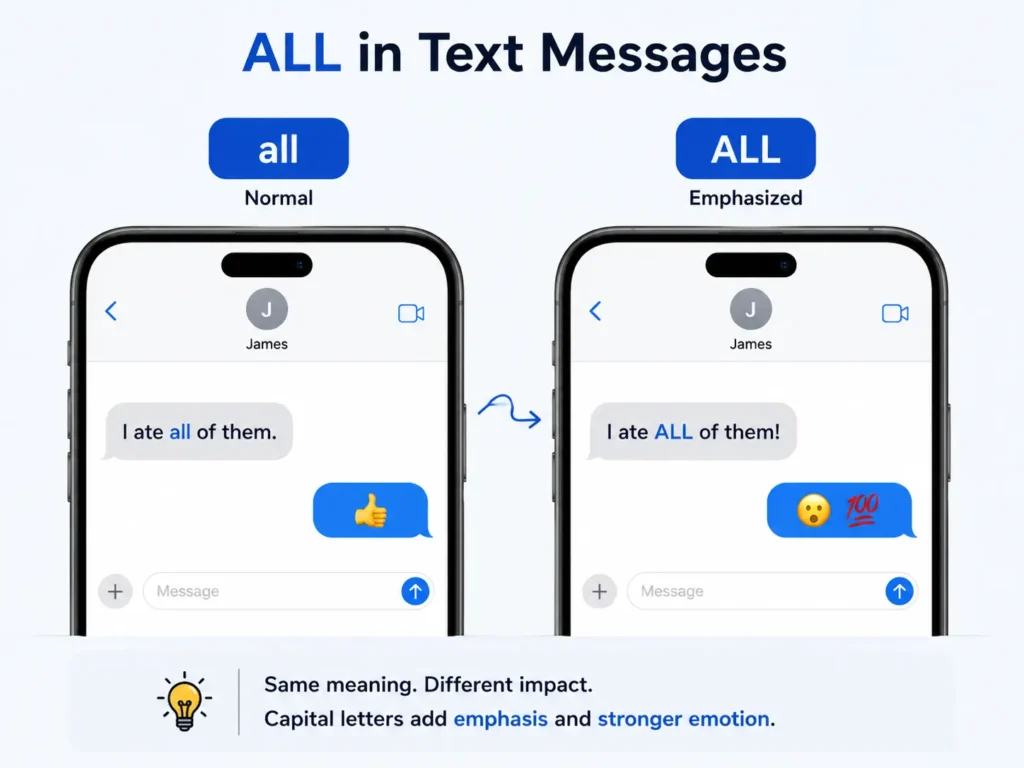
In texting, ALL usually keeps its normal English definition. It does not become slang simply because someone types it in capital letters.
For example, “I ate ALL of them” means the entire amount, while capitalization adds emphasis. “Are ALL of you coming tonight?” means every person in the group.
This matters because capital letters often change tone rather than definition.
For another abbreviation whose meaning can change with the conversation, see our JT Meaning guide to learn how JT is used in texts and online chats.
Why Do People Write ALL in Capital Letters?
People use uppercase words to make a message stronger. ALL can show excitement, disbelief, annoyance, or urgency.
Compare “I like them all” with “I like them ALL.” Both have the same basic meaning, but the second sounds more forceful.
ALL Meaning on Social Media
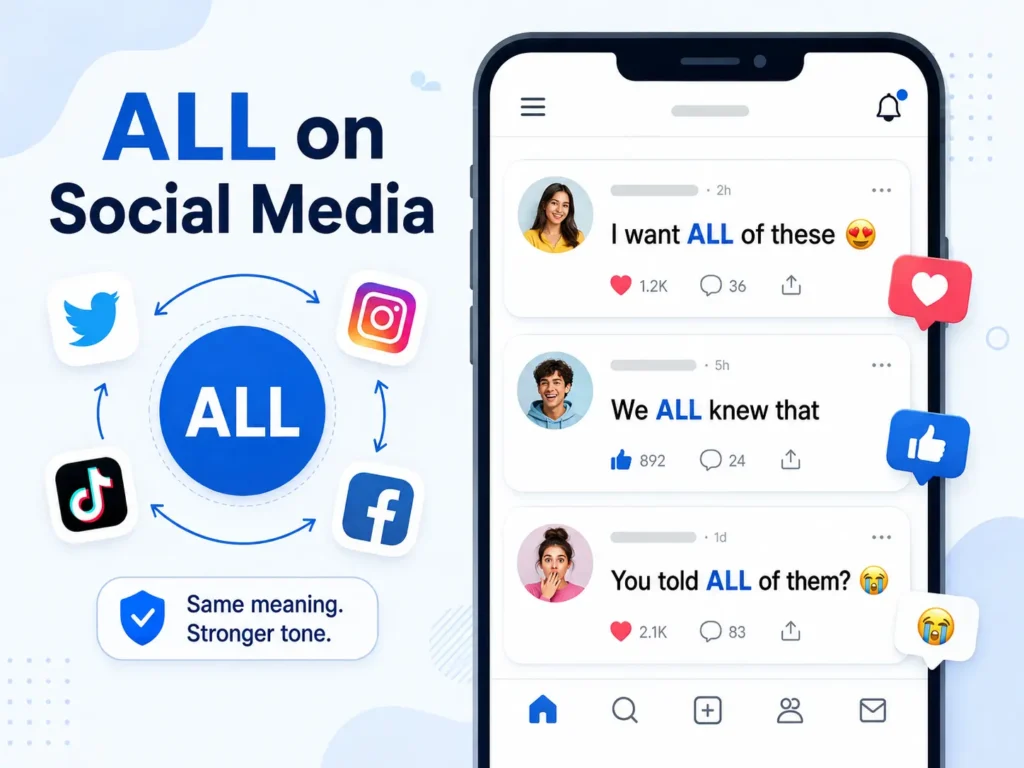
On TikTok, Instagram, Snapchat, WhatsApp, and Messenger, ALL depends on the sentence around it. There is no universal platform-specific definition.
“I want ALL of these outfits” uses ALL for emphasis. “We ALL knew that” means everyone in the relevant group.
Emojis can also affect tone. “I want them ALL 😍” suggests excitement, while “You told ALL of them? 😭” may suggest shock or embarrassment.
Social media is also full of short terms with context-dependent meanings, so our BB Meaning guide can help you understand another commonly used expression in messages and chats.
How Tone and Context Change ALL
Context matters more than capitalization alone. Read the full sentence, notice punctuation and emojis, and consider the topic.
Use this quick process:
- Read the complete message.
- Check whether ALL means everyone, everything, or the whole amount.
- Notice whether capitals add emotional emphasis.
- Look for an established phrase.
- Consider whether the discussion involves a specialist acronym.
Common Phrases With ALL
“All good” usually means everything is fine or there is no problem.
“All set” means ready or finished.
“All in” often means fully committed or completely involved.
“All out” can describe maximum effort or intensity.
“All in all” means considering everything.
“Once and for all” suggests something will be settled finally.
“Above all” means most importantly.
“Give it your all” means use your maximum effort, energy, or ability.
Does ALL Stand for Something?
ALL can function as an acronym in medical, technical, educational, or business contexts. Do not assume an acronym meaning without supporting context.
If someone writes “I watched ALL the episodes,” ALL is clearly the ordinary word. If ALL appears beside specialist terminology, a specific abbreviation may be intended.
For everyday texting, check the ordinary meaning first.
If you often come across unfamiliar abbreviations online, our ITR Meaning guide also explains how context helps identify the intended meaning of a short term.
ALL vs Similar Words
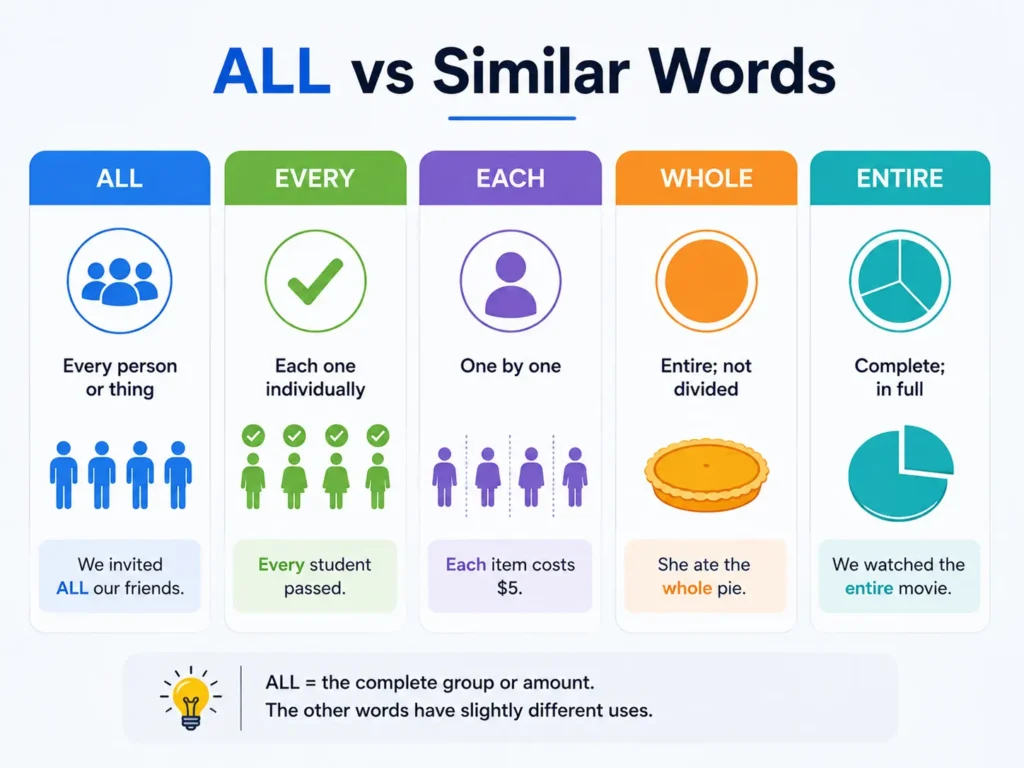
“All” describes a complete group or quantity. “Every” focuses on each member within a group, while “each” emphasizes individuals separately.
“Whole” usually describes one complete thing, as in “the whole day.” “Entire” has a similar meaning and can sound more formal. “Total” often fits calculated amounts or quantities. “Both” normally refers to exactly two people or things.
How to Use ALL Correctly
Use “all” before nouns: “all students,” “all people,” and “all information.”
Use “all of” before pronouns: “all of us,” “all of them,” and “all of you.”
Both “all the people” and “all of the people” can work. Verb agreement depends on what “all” refers to. “All the water is gone” uses a singular verb, while “All the students are ready” uses a plural verb.
Origin of the Word ALL
The word comes from Old English “eall.” Its central idea remains connected with completeness and the whole quantity. Digital communication adds visual emphasis through capitalization, but the core meaning stays the same.
Final Thoughts
Final Thoughts
The meaning of ALL depends mainly on context, but the word usually means the whole amount, everyone, everything, or completely. In texts and social media, uppercase ALL often adds emotion or emphasis rather than creating a new slang definition.
Check the full sentence before treating ALL as an acronym. Phrases such as “all good,” “all set,” and “give it your all” are also easier to understand in context.
Frequently Asked Questions
What does ALL mean in text?
It usually means everyone, everything, or the complete amount. Capital letters often add emphasis.
What does ALL mean in slang?
ALL is usually the ordinary English word, although phrases containing “all” can have informal meanings.
Why do people type ALL in capital letters?
They often want to emphasize the word or express stronger emotion.
Is ALL an acronym?
It can be in specialized contexts, but uppercase ALL in an ordinary message is often simply the word “all.”
What does “all good” mean in texting?
“All good” usually means everything is fine, there is no problem, or the situation is acceptable.
Is ALL formal or informal?
The word works in both formal and informal English. Its surrounding phrase and capitalization determine the tone.