
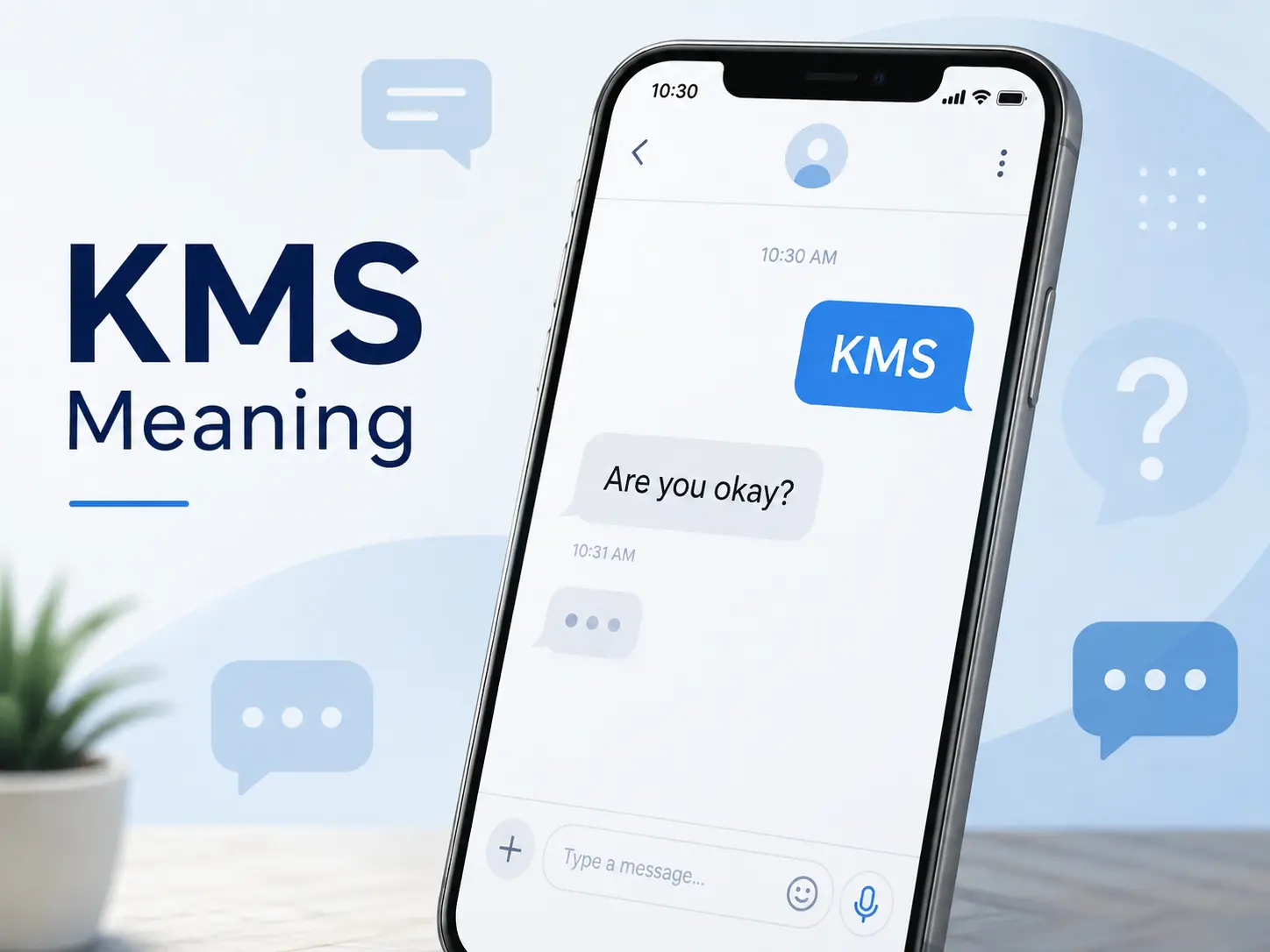
Seeing “KMS” in a text message can feel confusing, uncomfortable, or alarming. Unlike harmless abbreviations such as LOL or BRB, KMS contains language connected with self-harm. Some people use it as exaggerated internet slang after an embarrassing mistake, a frustrating moment, or a bad day. Others may use it to communicate real emotional distress.
That difference makes the KMS meaning important to understand. You should not assume that every message is an emergency, but you should not dismiss it automatically as a joke either. The safest approach is to look at the full conversation, ask a calm question, and pay attention to warning signs.
Quick Answer: What Does KMS Mean?
In texting and internet slang, KMS usually stands for “kill myself” or “killing myself.”
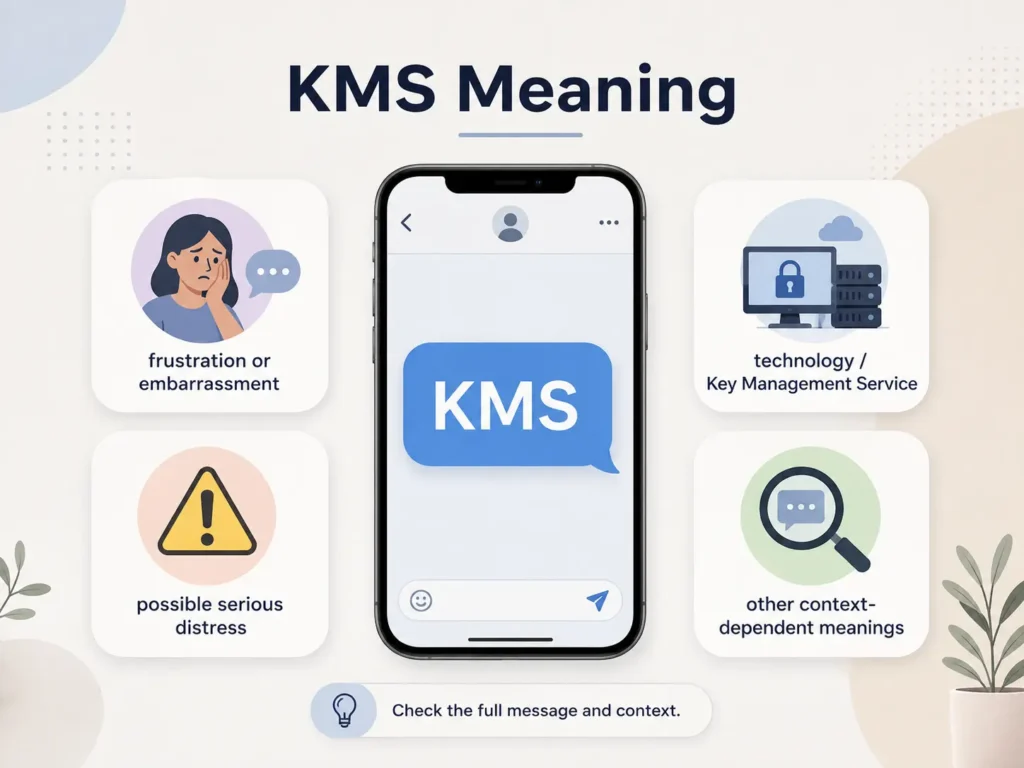
People sometimes use it as dramatic or exaggerated language when they feel embarrassed, annoyed, bored, disappointed, or overwhelmed.
For example:
“I sent the message to the wrong group. KMS.”
In this case, the sender may be expressing embarrassment rather than a real intention to harm themselves.
However, the same abbreviation can also communicate hopelessness, suicidal thoughts, emotional pain, or a cry for help. A message that includes repeated despair, goodbye language, a plan, or immediate intention needs urgent attention.
KMS can also have unrelated meanings. In technology, it may mean Key Management Service. In a sentence about travel or distance, “kms” may informally refer to kilometers, although the standard symbol is “km.”
| Context | Likely meaning | Best response |
| Minor mistake or embarrassment | Dramatic slang | Check in briefly |
| Repeated distressed messages | Possible emotional crisis | Ask about safety |
| Plan or goodbye message | Possible immediate danger | Seek real-world help |
| Technology discussion | Key Management Service | Follow the technical topic |
| Distance sentence | Kilometers | Check the wording |
What Does KMS Mean in Text Messages?
The KMS meaning in text depends on the message, tone, relationship, and recent situation. The letters alone cannot show whether the sender is joking, exaggerating, or asking for help.
KMS as an Expression of Frustration
Many people use KMS as hyperbole after an awkward, disappointing, or frustrating experience. It may appear after:
- Missing a deadline
- Losing a game
- Forgetting an important task
- Receiving bad news
- Experiencing rejection
- Posting an embarrassing picture
- Sending a message to the wrong person
Examples include:
“I forgot my presentation was today. KMS.”
“We lost in the final second. KMS.”
“That photo is so embarrassing. KMS.”
Within some friend groups, these messages work as dark humor or dramatic reactions. The sender may not mean the words literally.
However, text messages do not include facial expressions, body language, or tone of voice. That makes even familiar slang easy to misunderstand.
A simple reply can clarify the situation:
“That sounds rough. Are you okay?”
This response acknowledges the person’s feelings without immediately assuming either a joke or an emergency.
KMS as a Serious Statement
KMS may also express genuine hopelessness, suicidal thinking, self-harm thoughts, or emotional distress.
A more concerning message may include statements about feeling alone, being a burden, having no reason to continue, or believing that nothing will improve.
Examples include:
“Nobody would care if I disappeared. KMS.”
“I can’t handle this anymore. I’m serious.”
You should not diagnose someone from one message. However, you should take the statement seriously enough to ask whether the person is safe.
You could reply:
“I care about you, and I’m taking that seriously. Are you safe right now?”
Direct communication gives the sender a chance to explain their emotional state and say whether they need immediate support.
Is KMS Always a Joke?
No. KMS is sometimes used as exaggerated online slang, but it can also communicate real distress.
Why People Use KMS as Hyperbole
Short-form digital communication encourages people to express strong feelings through abbreviations. Someone may type KMS after losing a match, missing a bus, forgetting a password, or feeling embarrassed.
Even so, repeated use can normalize self-harm language. It may also upset people who have personal experience with depression, suicide, self-harm, or bereavement.
Why Context Matters
To understand the intended KMS meaning, review the conversation before and after the abbreviation.
Consider:
- What happened immediately before the message?
- Is the sender reacting to a minor inconvenience?
- Have they recently experienced bullying, loss, rejection, or family conflict?
- Have they repeated hopeless statements?
- Has their communication style changed suddenly?
- Are they withdrawing from friends or relatives?
- Do they mention a plan, time, location, or dangerous item?
- Are they saying goodbye or making final arrangements?
Context can guide your response, but it cannot confirm someone’s safety. Asking directly is more reliable than guessing.
Instead of saying, “You are joking, right?” try:
- “Are you safe right now?”
- “Do you mean that seriously?”
- “Are you thinking about hurting yourself?”
- “I’m here. Can you tell me what happened?”
These questions focus on the person rather than arguing about their wording.
Warning Signs That KMS May Be Serious
A KMS message becomes more concerning when it appears with other signs of emotional distress.
The Person Mentions a Plan or Time
Treat the situation as urgent if the sender describes:
- How they may harm themselves
- When they intend to act
- A specific location
- Access to dangerous means
- A final request
- A goodbye message
If someone mentions an immediate plan or intention, contact a person who can reach them and seek urgent real-world support.
Repeated Hopeless or Burden-Based Language
Concerning statements may include:
- “Nothing will improve.”
- “Everyone would be better without me.”
- “There is no point anymore.”
- “Nobody cares about me.”
- “I can’t keep doing this.”
One message may be unclear, but repeated hopeless language deserves a direct safety check.
Sudden Emotional or Behavioral Changes
Pay attention to major changes such as:
- Withdrawing from friends or family
- Giving away meaningful belongings
- Acting recklessly
- Showing severe agitation
- Becoming suddenly calm after intense distress
- Sleeping much more or less than usual
- Stopping normal communication
- Posting farewell-style messages
These signs do not prove that someone intends to harm themselves. They indicate that the person may need emotional or professional support.
How to Respond When Someone Says KMS
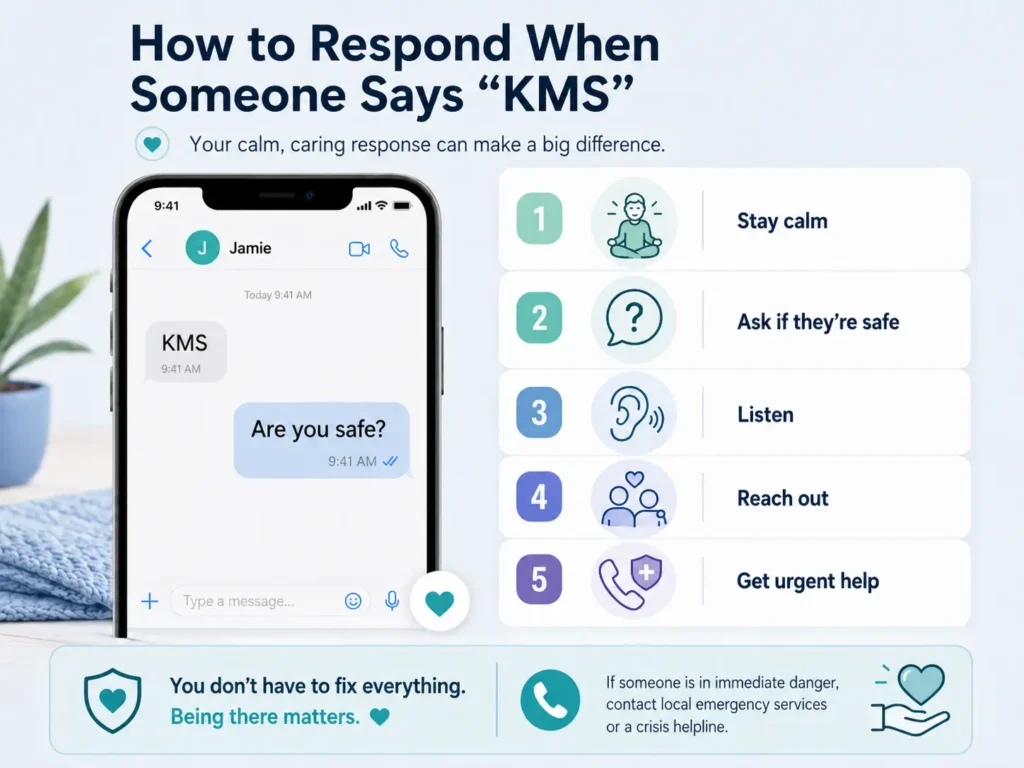
Begin with a calm, direct check-in.
You can say:
- “I’m taking that seriously. Are you safe?”
- “Are you thinking about suicide?”
- “I care about you. Tell me what is happening.”
- “Are you alone right now?”
Listen carefully and allow the person to speak. Avoid reacting with anger, shock, panic, or shame.
Do not say:
- “You’re being dramatic.”
- “You don’t really mean that.”
- “Other people have it worse.”
- “Stop looking for attention.”
These replies may make the person feel dismissed and less willing to communicate.
Do not promise complete secrecy. If the person may be in immediate danger, involve a trusted adult, close relative, counselor, mental-health professional, crisis service, or emergency responder. When urgent harm may be possible, safety must come before privacy.
What to Do If the Person May Be in Immediate Danger
If a KMS message includes a plan, timing, location, access to harmful means, or goodbye language, treat the situation as urgent.
Ask clear questions such as:
- “Have you made a plan?”
- “Are you planning to act soon?”
- “Do you have access to anything dangerous?”
- “Where are you right now?”
- “Is someone nearby who can stay with you?”
Do not suddenly leave the conversation if the risk appears serious. Stay connected while contacting someone who can reach the person in real life.
That person may be a parent, guardian, roommate, close relative, trusted friend, school counselor, mental-health professional, or emergency responder.
If immediate harm seems possible, contact local emergency services or an appropriate crisis service. At that point, the priority is protecting the person, not deciding whether KMS was slang.
How to Reply When KMS Seems Exaggerated
Even when someone uses KMS after a minor inconvenience, a brief check-in is still appropriate.
You might reply:
- “That sounds frustrating. Are you okay?”
- “I know you may be joking, but I want to check.”
- “That sounds rough. Do you want to talk?”
- “Can you tell me what happened?”
These replies acknowledge the person’s emotional state without encouraging self-harm language.
You can also suggest clearer alternatives:
- “I’m overwhelmed.”
- “I’m embarrassed.”
- “I need a break.”
- “I’m really upset.”
- “That was a disaster.”
- “I need support.”
Clear emotional language reduces misunderstanding and helps others respond more effectively.
KMS Meaning on Social Media
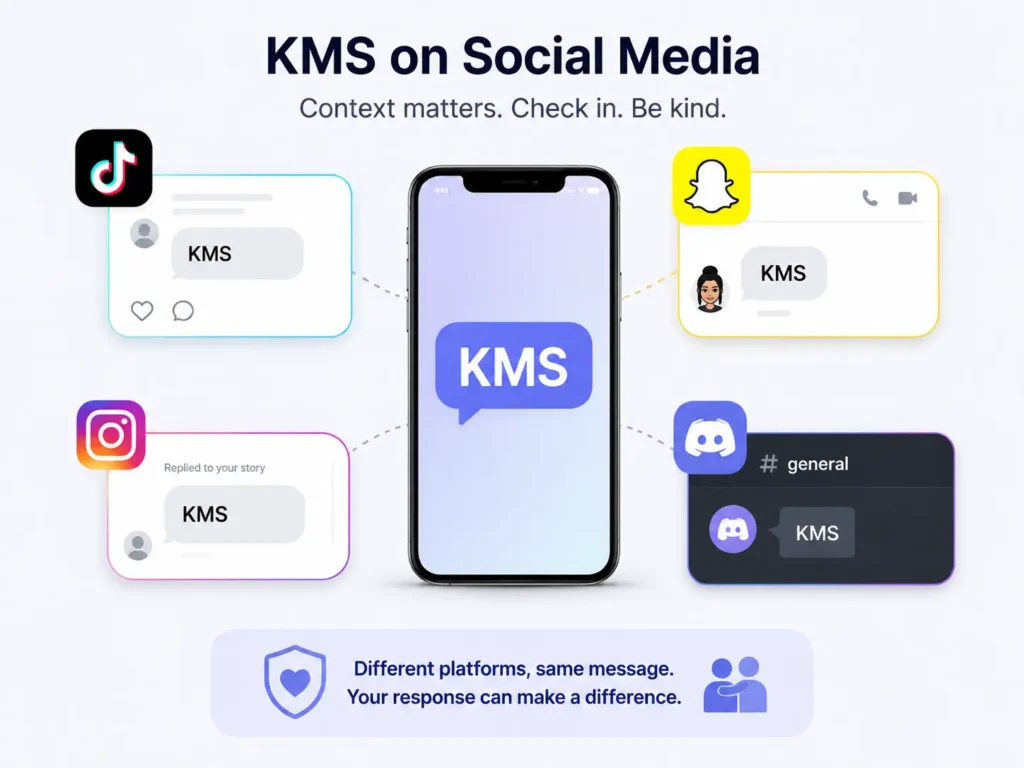
The basic KMS meaning usually remains the same across social-media platforms, but the surrounding content affects how people interpret it.
Online abbreviations can change meaning depending on the platform, tone, and surrounding message. Our TMU Meaning guide explains another social-media expression that users may interpret differently across comments, captions, and private chats.
KMS Meaning on TikTok, Snapchat, and Instagram
On TikTok, KMS may appear in comments, reaction videos, captions, or posts about school, relationships, embarrassment, and gaming.
On Snapchat, it may appear in private messages, story replies, or disappearing chats. Personal confessions may be harder to review later because the messages can vanish.
On Instagram, users may include KMS in captions, comments, story replies, direct messages, and group chats.
A short comment may seem like harmless exaggeration, but limited context makes tone difficult to judge. If a message includes repeated hopelessness, farewell language, or references to a plan, take it seriously.
If a post suggests immediate danger, use the platform’s safety-reporting tools and contact someone who can reach the person.
KMS Meaning in Online Chats and Gaming
In Discord servers, group chats, and gaming communities, someone may write KMS after losing a match, missing an easy shot, or making a costly mistake.
For example:
“I missed the final move. KMS.”
This may be exaggerated gaming frustration. However, a gaming setting does not automatically make the phrase harmless.
Repeated despair, social withdrawal, sudden behavior changes, or mention of a real plan should not be dismissed as normal game-related anger. The safest response is still a calm check-in.
KMS Meaning From a Friend, Partner, or Child
Your relationship with the sender may affect how you respond, but safety should remain the first concern.
When a Friend Sends KMS
Ask whether your friend is safe before assuming they are joking.
A supportive reply could be:
“I’m here for you. Do you mean that seriously, and are you safe right now?”
Let your friend speak without immediately giving advice. If the situation seems serious, help them contact a trusted adult, close relative, counselor, or crisis professional.
When a Romantic Partner Sends KMS
Do not automatically label the message as manipulation. First, check whether your partner is safe.
You can offer emotional support while maintaining healthy boundaries. One person should not carry complete responsibility for another person’s mental health. Encourage them to connect with family, trusted friends, or professional support.
When a Child or Teen Uses KMS
Parents and guardians should stay calm and avoid beginning with punishment, anger, or accusations.
Instead:
- Ask what the phrase means to them
- Ask directly whether they feel safe
- Review recent stress, bullying, rejection, or loss
- Notice changes in sleep, mood, or communication
- Explain why the phrase may alarm others
- Involve a qualified professional when necessary
Open parent-child communication usually provides more useful information than silently monitoring every slang term.
Is It Appropriate to Use KMS as Slang?
KMS is informal internet slang, but it can easily be misunderstood. Text removes facial expression, tone of voice, and body language.
The phrase may also distress people who have personal experience with suicide, self-harm, depression, or bereavement.
Clearer wording is usually a better choice. Avoid using KMS in:
- Workplace communication
- School assignments
- Customer-service conversations
- Public brand accounts
- Messages to strangers
- Group chats where tone is uncertain
Phrases such as “I’m frustrated,” “I need a minute,” or “I’m overwhelmed” express the emotion without causing unnecessary concern.
Different Meanings of KMS Depending on Context
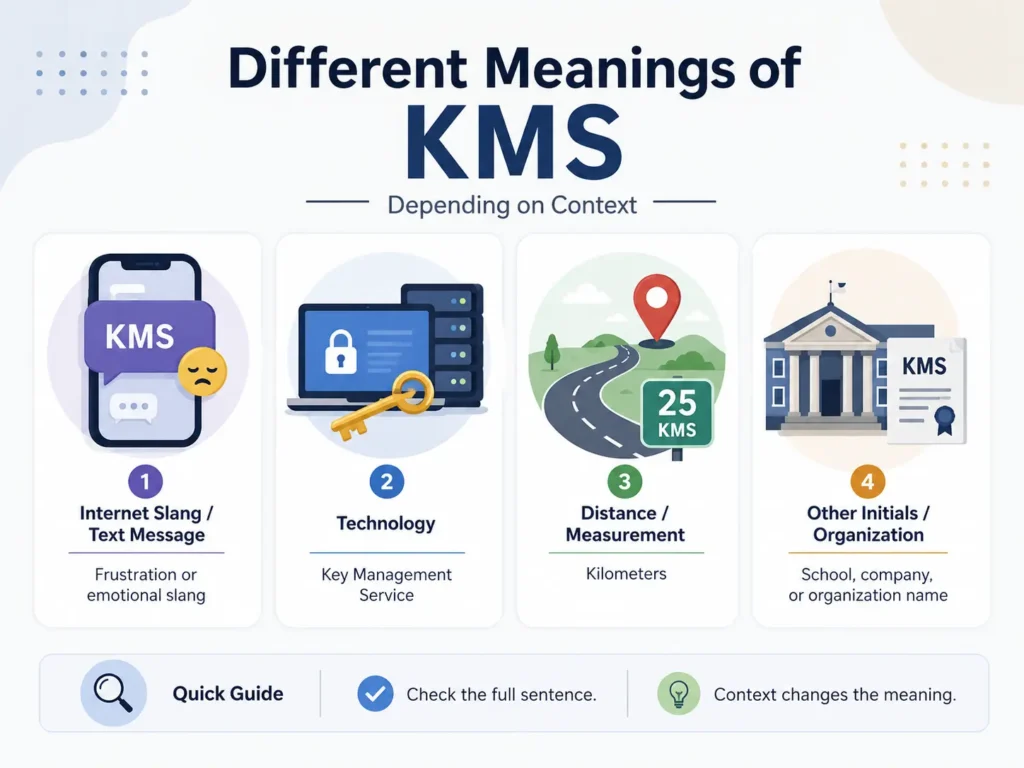
Although the common slang meaning is “kill myself,” KMS can have unrelated definitions.
Like KMS, some short abbreviations can have both casual and specialized definitions. Read our CS Meaning guide to see how the conversation topic helps separate slang meanings from gaming, technology, and professional uses.
KMS in Technology
In technology, KMS may mean Key Management Service. The term is often associated with software activation, encryption keys, and network administration.
Example:
“The administrator checked the KMS server.”
KMS as Kilometers
People sometimes use “kms” informally to refer to kilometers.
Example:
“We drove 20 kms today.”
However, the standard measurement symbol is km.
KMS as Initials or an Organization
KMS may also represent:
- A business
- A school
- A software system
- A username
- An internal project code
The topic and sentence usually reveal the correct meaning.
KMS vs Similar Online Expressions
KMS vs FML
FML expresses strong frustration through a vulgar phrase. KMS contains direct self-harm language, so it may carry greater safety concerns.
KMS vs SMH
SMH means “shaking my head.” It usually communicates disappointment, disbelief, or annoyance.
KMS vs “I Can’t”
“I can’t” often expresses laughter, embarrassment, or feeling overwhelmed. It does not literally include self-harm language.
These expressions should not be treated as interchangeable. Always read the full message.
Comparing related abbreviations can make confusing messages easier to understand. Our WLC Meaning guide explains how another short texting term can carry different meanings depending on context and the sender’s intent.
Is KMS Formal or Informal?
In texting, memes, social media, gaming chats, and group messages, KMS is informal slang.
In technology, business, or organizational settings, KMS may function as a formal abbreviation. Because people usually pronounce each letter separately, it is technically an initialism.
Origin and Evolution of KMS
KMS became common through short-form digital communication. Texting and social media encouraged users to shorten emotional statements into a few letters.
Over time, it became part of online humor and appeared after embarrassment, boredom, rejection, and frustration.
However, casual use does not erase the literal meaning. Different communities may interpret the same message differently. Friends may see familiar dark humor, while a parent, counselor, or mental-health professional may see a reason to check in.
Frequently Asked Questions About KMS Meaning
What does KMS mean in text?
KMS usually means “kill myself” or “killing myself” in texting and internet slang.
Does KMS always mean someone is suicidal?
No. Some people use it as exaggeration or dark humor. However, it may also express genuine emotional distress, so checking in is important.
How should I respond when someone says KMS?
Ask whether they are safe, listen without judgment, and involve real-world support if the message includes serious warning signs.
What does KMS mean on Snapchat or TikTok?
It usually carries the same slang meaning, but it may appear as a dramatic reaction, joke, personal confession, or serious statement.
What does KMS mean in gaming?
Players may use it after losing or making a mistake. Context still matters, especially if the person repeats hopeless language.
Can KMS have another meaning?
Yes. It may mean Key Management Service in technology or informally refer to kilometers.
Is KMS appropriate to use as a joke?
Clearer wording is safer because KMS can alarm, confuse, or distress other people.
Final Thoughts on KMS Meaning
The primary KMS meaning in text is “kill myself” or “killing myself.” Some people use it as exaggerated internet slang after frustration or embarrassment, while others may use it to express serious emotional pain.
Do not rely on the letters alone. Review the surrounding conversation, ask direct questions, and listen without judgment.
If the person mentions a plan, timing, harmful means, or goodbye language, seek immediate real-world support. In technology, measurement, or organizational contexts, KMS may have a completely different definition, so always consider the full sentence before deciding what it means.