
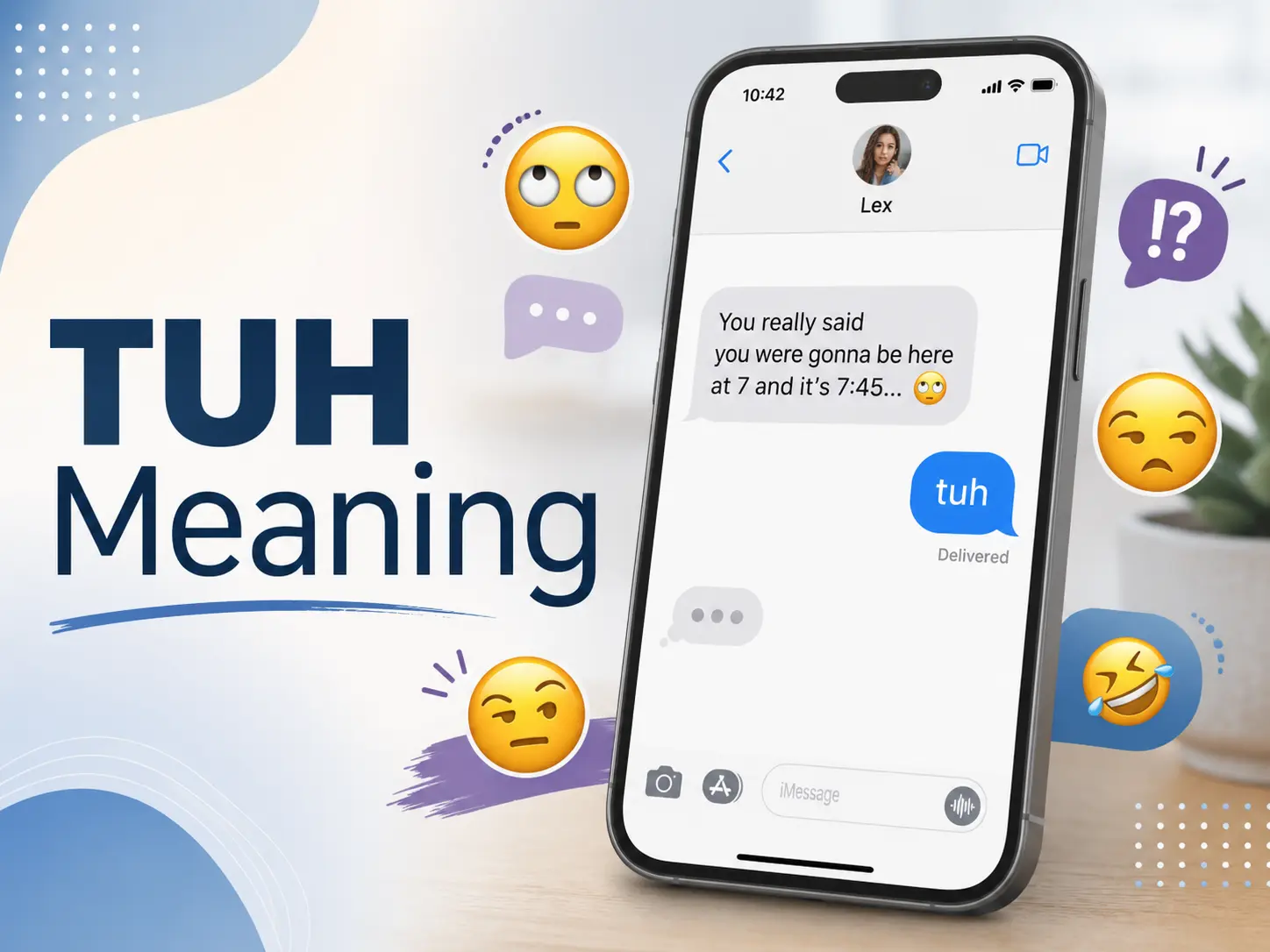
You are reading a chat when someone suddenly replies, “tuh.” The message looks tiny, but it may carry sarcasm, disbelief, annoyance, humor, or confidence. Without hearing the speaker’s voice, you may struggle to decide whether the person is joking, dismissing you, or agreeing.
That confusion is common because TUH is not a standard abbreviation like LOL or BRB. It works like a written sound that copies a vocal reaction.
This guide explains TUH Meaning. You will learn what the expression communicates, how tone changes its interpretation, and how punctuation, emojis, and context affect it. You will also see realistic examples.
Quick Answer: What Does TUH Mean?
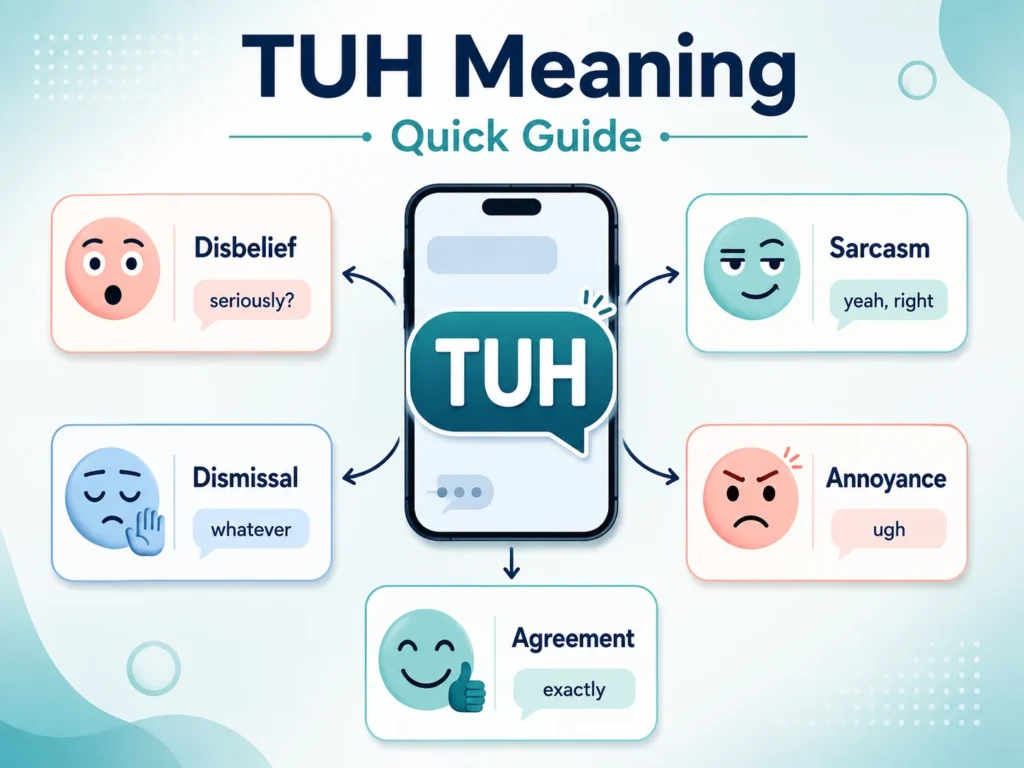
TUH is an informal reaction used in texts, chats, and comments. It commonly expresses disbelief, sarcasm, dismissal, annoyance, or an unimpressed laugh.
Depending on the situation, it can sound like “yeah, right,” “as if,” “please,” “whatever,” or “pfft.” It may also add emphasis when someone strongly agrees.
Here is a simple example:
Maya: “He said every person at the party wanted his number.”
Rina: “Tuh, sure they did.”
Rina does not believe the claim. Her reply sounds sarcastic and dismissive.
The exact TUH meaning depends on the surrounding conversation. You cannot understand it correctly by looking at the word alone.
Is TUH an Acronym or a Sound?
TUH usually does not stand for a longer phrase. It is not an initialism in which each letter represents a word. Instead, it is an expressive sound written as text.
People type sounds such as “hmm,” “ugh,” “tsk,” or “pfft” to show feelings that words may not capture. TUH works similarly by turning a vocal reaction into a short written expression.
This type of language acts as a tone signal. In speech, facial expressions, pauses, and voice quality communicate emotion. Text messages remove those clues, so writers use sounds, emojis, punctuation, and capitalization to replace them.
In rare cases, someone may spell “to” as “tuh” to imitate casual pronunciation. For example, a humorous caption might say, “I’m going tuh the store.” There, “tuh” simply represents “to.” When it appears alone as a reply, it usually functions as a reaction.
The Most Common Meanings of TUH in Text
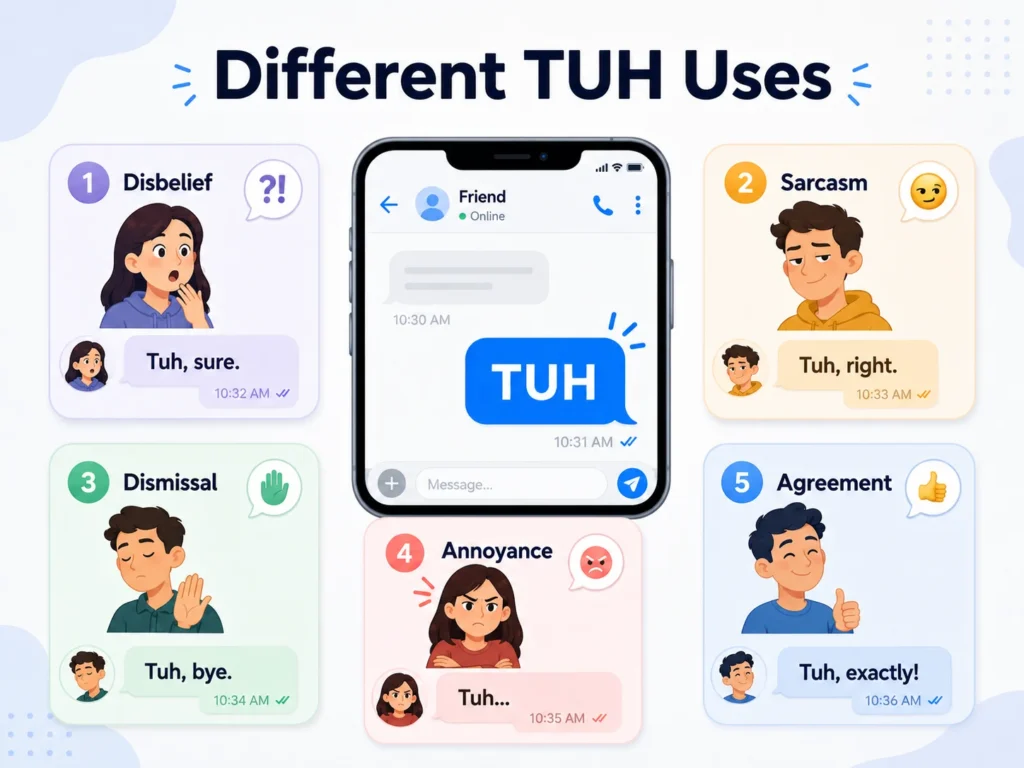
The expression does not communicate one fixed emotion. Its meaning changes with the previous message, the relationship between the people, and the way it is written.
1. Disbelief
One common use is to show that the sender does not believe a statement. In this context, TUH feels similar to “yeah, right” or “as if.”
Leo: “I could beat the entire team by myself.”
Sam: “Tuh, you barely won yesterday.”
Sam doubts Leo’s boast and uses a teasing response to challenge it.
Disbelief can sound playful between friends, but rude during a serious discussion. Consider the subject before using it.
2. Sarcasm or Mockery
TUH can make fun of an exaggerated, unrealistic, or ridiculous comment. The sender may use it instead of writing a full sarcastic sentence.
Nadia: “I’m definitely waking up at five tomorrow.”
Areeba: “Tuh, you said that last week.”
Areeba mocks Nadia’s promise because she has heard it before. The reply may remain friendly if they often tease each other.
Sarcasm becomes sharper when the conversation feels tense. A stranger writing “TUH!” may sound more confrontational than a close friend writing “tuh 😂.”
3. Dismissal
Sometimes, TUH rejects a statement without inviting further discussion. It can mean “whatever,” “please,” or “I’m not buying that.”
Alex: “You are only upset because I won.”
Jordan: “Tuh, bye.”
The word “bye” makes the dismissal obvious. Jordan does not want to continue debating the claim.
This use may shut down a conversation, so avoid it when someone shares a serious concern or asks for an honest response.
4. Annoyance or Disapproval
The TUH meaning can also involve irritation. A person may use it when tired of excuses, repeated behavior, or an unimpressive explanation.
Friend: “I forgot to call you again.”
You: “Tuh… of course you did.”
The ellipsis creates a pause that sounds tired and unimpressed. It suggests the mistake has happened before.
Punctuation matters. “Tuh 😂” may feel playful, while “TUH!” can sound angry or dramatic. The same expression can create different impressions.
5. A Sarcastic or Unimpressed Laugh
People sometimes use TUH as a written scoff or mock laugh. It does not necessarily mean something is genuinely funny. Instead, it may suggest that the sender finds a claim absurd.
Chris: “My excuse was completely believable.”
Dani: “Tuh, not even a little.”
This reaction differs from LOL. LOL usually signals amusement, even when used casually. TUH often communicates skepticism, mockery, or an eye roll.
6. Agreement or Emphasis
Although disbelief and sarcasm are more common, some people use TUH to reinforce agreement. The following words usually reveal this meaning.
Amina: “That meeting could have been an email.”
Sara: “Tuh, exactly!”
Sara agrees strongly. “Exactly” removes the possibility that she is mocking Amina.
This usage may vary across friend groups and online communities. Slang develops through shared habits, so a meaning that feels natural in one group may confuse another.
How to Identify What TUH Means in a Conversation
Understanding TUH Meaning requires more than memorizing a definition. Use these clues to interpret the sender’s intention.
Read the Previous Message
Start with the statement that caused the reaction. Was it a boast, joke, complaint, excuse, insult, or surprising claim?
A reply to a boast often signals disbelief. A reply to a shared complaint may show agreement. A reply during an argument may communicate dismissal or annoyance.
Check the Words After TUH
The next words often provide the clearest clue.
- “Tuh, sure” usually expresses disbelief.
- “Tuh, exactly” usually shows agreement.
- “Tuh, bye” signals dismissal.
- “Tuh, please” often communicates annoyance or mockery.
- “Tuh, I knew it” may express confidence.
Read the complete message rather than isolating the reaction.
Context is equally important when interpreting abbreviations such as WYN because the intended meaning may change with the conversation. Our WYN Meaning guide explains how to identify the correct interpretation.
Look at Capitalization and Punctuation
Lowercase “tuh” often feels casual or dry. “TUH!” appears stronger or more dramatic. “Tuh…” creates an unimpressed pause, while “TUH??” may show shocked disbelief.
Repeated letters can increase emotion. Someone might write “tuhhh” to sound playful, drawn out, or especially dismissive.
Notice Emojis and Reaction Images
Emojis act as tone indicators. A laughing emoji can soften the message and show teasing. An eye-roll emoji may strengthen annoyance. A side-eye image can make the response feel suspicious or judgmental.
Compare these examples:
- “Tuh 😂” sounds playful.
- “Tuh 🙄” sounds irritated.
- “Tuh 😏” sounds confident or smug.
- “Tuh 😭” may signal dramatic humor.
Consider Your Relationship
Close friends often understand each other’s humor and habits. They may use TUH as harmless teasing. The same word from a stranger, coworker, or person in an argument may feel disrespectful.
Context includes more than the sentence. Your history with the sender, the subject, and the mood all shape the interpretation.
TUH Tone Guide
| Form | Likely tone | Possible interpretation |
| tuh | Casual or dry | “I do not believe that.” |
| TUH! | Strong or dramatic | “Absolutely not.” |
| tuh… | Unimpressed | “That was not convincing.” |
| tuh 😂 | Teasing | “That is ridiculous but funny.” |
| tuh 🙄 | Annoyed | “Please, give me a break.” |
| tuh, exactly | Agreement | “That is what I was thinking.” |
This TUH meaning guide offers likely interpretations, not rigid rules. Always read the full conversation before deciding what the sender means.
Examples of TUH in Text Conversations
TUH Expressing Disbelief
Ava: “I finished the whole project in ten minutes.”
Noor: “Tuh, you were still working on it an hour ago.”
Noor uses TUH to question Ava’s claim.
TUH Used Sarcastically
Lina: “I never check my phone during work.”
Maya: “Tuh 😂, your screen time says otherwise.”
The laughing emoji softens the sarcasm.
A sharper version might be the following:
Lina: “I did nothing wrong.”
Maya: “TUH! You started the argument.”
TUH as a Dismissive Response
Omar: “You are just jealous.”
Zain: “Tuh, whatever.”
TUH Showing Annoyance
Sam: “I forgot to bring it again.”
Alex: “Tuh… you always say that.”
TUH Between Friends
Ella: “I am clearly the funniest person here.”
Nina: “Tuh, keep telling yourself that 😂.”
TUH During an Argument
Person A: “You never listen to me.”
Person B: “Tuh, here we go again.”
What Does TUH Mean on Social Media?
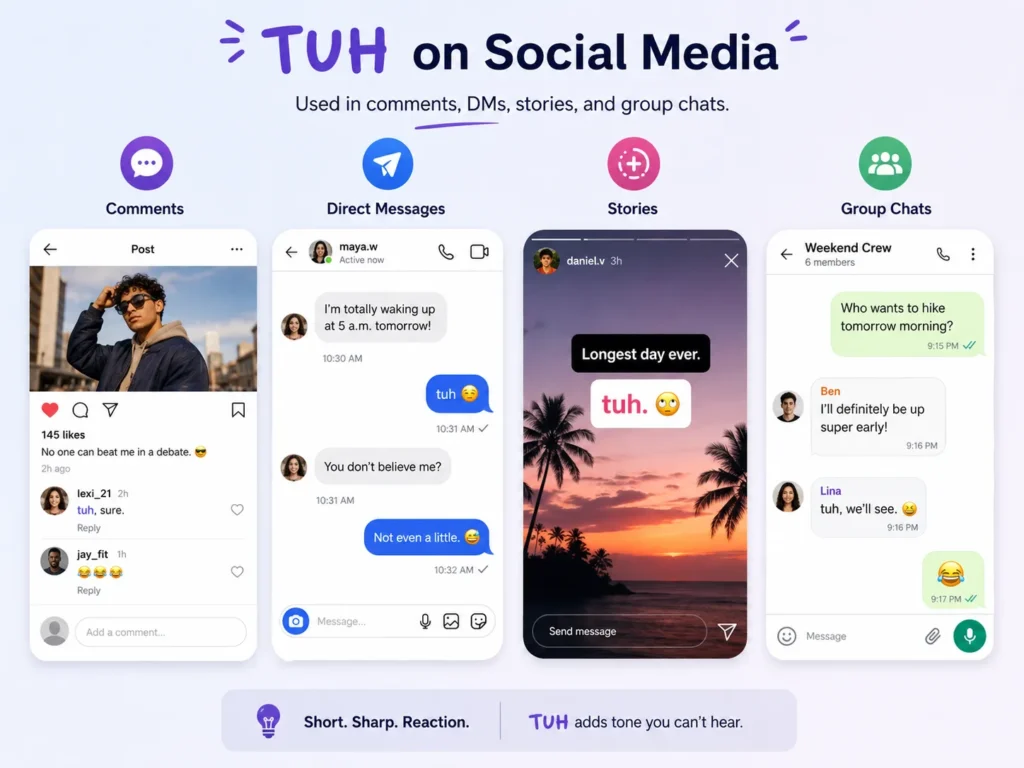
The TUH meaning stays broadly similar across platforms, but the audience can shape the tone.
TUH on TikTok
On TikTok, people use TUH in comments, captions, or reaction videos. It often responds to an unrealistic claim, dramatic story, unpopular opinion, or exaggeration.
“Tuh, nobody believes that” shows disbelief. A shorter “tuh 😂” may signal playful mockery.
TUH on Instagram
Instagram users may write TUH in comments, Stories, captions, and direct messages. It often reacts to a photo, boast, joke, or opinion.
TUH on Snapchat
Snapchat encourages quick replies. Someone might send “tuh” after a friend makes a dramatic claim or playful joke. Shared history usually makes the tone easier to understand.
TUH on X, Threads, and Group Chats
On X or Threads, TUH may respond to opinions, announcements, or questionable statements. In group chats, meaning depends on inside jokes, relationships, and mood.
Is TUH Rude or Offensive?
TUH is not automatically offensive. It becomes rude when someone uses it to mock, belittle, ignore, or dismiss another person.
It is usually playful during friendly teasing, shared jokes, and light exaggerations. A laughing emoji or warm follow-up can clarify that intention.
It may sound disrespectful during arguments, serious disclosures, conversations with strangers, or replies to teachers, managers, and customers.
Written messages lack voice and facial expressions, so sarcasm can be misunderstood. Avoid TUH when the subject is emotional or respect matters.
How to Respond When Someone Says TUH
Your reply should match the context instead of reacting to the word alone.
When They Are Joking
Continue the playful mood:
- “You know I am right 😂.”
- “Do not act like you do not believe me.”
- “Okay, you will see.”
A sender may also use IWK after a sarcastic or teasing comment to clarify the tone. Visit our IWK Meaning guide for examples of how this abbreviation appears in casual chats.
When They Do Not Believe You
Offer context instead of becoming defensive:
- “What part do you not believe?”
- “I can explain what happened.”
- “I am serious. Let me show you.”
When They Sound Annoyed
Avoid escalating the conversation. Ask, “Is something wrong?” or “Did I upset you?” A calm question may prevent a misunderstanding.
When the Meaning Is Unclear
Ask directly:
- “What do you mean by ‘tuh’?”
- “Are you joking or being serious?”
When You Want to End an Argument
Use a neutral response such as “Let us talk later” or “I do not want this to become an argument.”
When Should You Use TUH?
Use TUH in casual chats with people who understand your humor. It works best for playful disbelief, light sarcasm, or a quick reaction.
When Should You Avoid Using TUH?
Avoid it in professional emails, workplace chats, academic writing, customer-service conversations, and serious emotional discussions.
TUH vs Similar Slang and Reactions
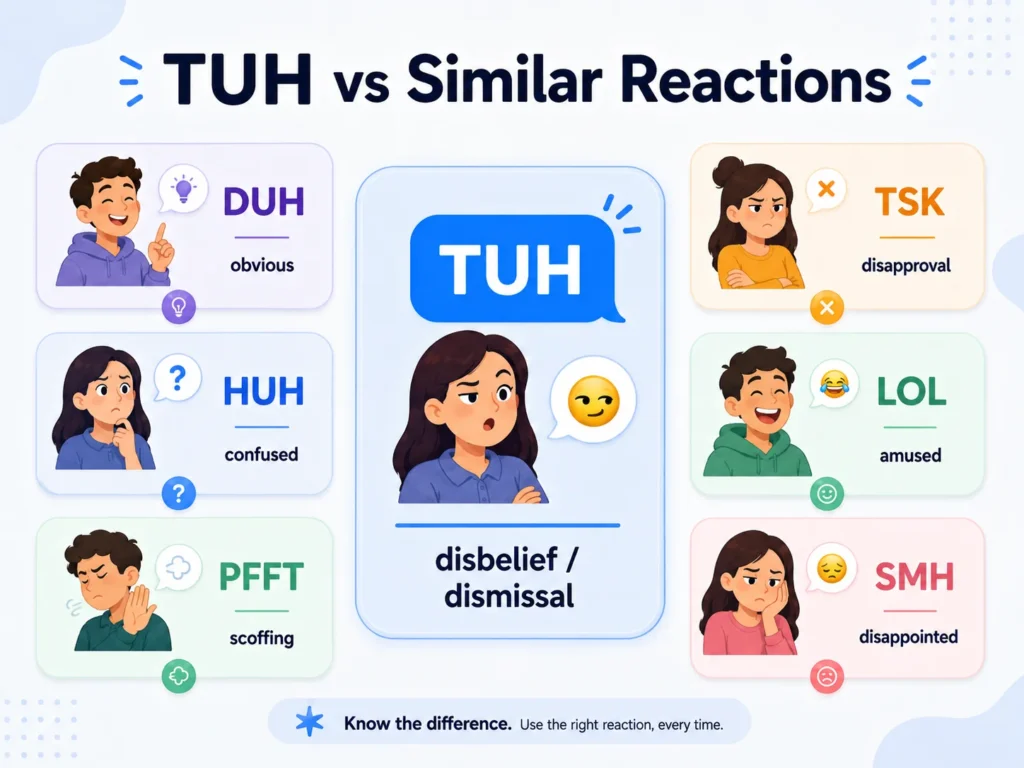
TUH vs DUH
TUH often expresses disbelief, sarcasm, or dismissal. DUH usually suggests that something is obvious.
TUH vs HUH
TUH is an emotional reaction. HUH normally shows confusion, surprise, or a request for repetition.
TUH vs PFFT
Both can express disbelief or dismissal. PFFT more clearly imitates a scoffing sound.
Another reaction you may see is PSH, which can also communicate dismissal, disbelief, or an unimpressed attitude. Read our PSH Meaning guide to understand its tone and usage in text conversations.
TUH vs TSK
TUH may sound sarcastic or unimpressed. TSK commonly signals criticism or disapproval.
TUH vs LOL
TUH can represent mock laughter. LOL generally communicates amusement or softens a message.
TUH vs SMH
TUH copies a vocal reaction. SMH means “shaking my head” and usually shows disappointment or disbelief.
Common Misunderstandings About TUH
TUH does not have one fixed emotion. It can communicate humor, disbelief, annoyance, emphasis, or agreement.
It is not usually an acronym, so you should not invent a full form for each letter.
TUH does not always mean “to.” That interpretation applies only when it imitates pronunciation inside a sentence.
It is not always an insult. Relationship, timing, punctuation, and mood matter more than the word alone.
Where Did the Expression TUH Come From?
TUH developed from spoken reaction sounds rather than a formal abbreviation. People use interjections and noises to communicate feelings quickly.
Digital communication encouraged users to write these sounds because texts cannot reproduce voice, pauses, or facial expressions. Its exact modern origin remains unclear, and usage varies between communities.
Other Meanings of TUH Outside Texting
TUH may also function as an institutional abbreviation. It can refer to Temple University Hospital in a medical or educational context. Teachers Union Health uses the same letters in Australian health insurance.
Specialized fields may use TUH differently. Casual dialogue suggests slang, while hospital, insurance, or technical language suggests an abbreviation.
Frequently Asked Questions
What does TUH mean in texting?
It usually expresses disbelief, sarcasm, dismissal, annoyance, or mock laughter.
What does TUH mean on TikTok?
It commonly reacts to exaggerated claims, dramatic stories, opinions, or relatable content.
Is TUH an acronym?
Usually, no. It is an expressive sound written as a reaction.
Does TUH mean “to”?
Sometimes it imitates the pronunciation of “to,” but context must support that meaning.
Is TUH the same as DUH?
No. DUH emphasizes obviousness, while TUH usually communicates attitude, disbelief, or dismissal.
Is saying TUH rude?
It can be, especially during arguments. Among friends, it may be playful.
How should I reply to TUH?
Match the tone, explain yourself, or ask what the sender means.
Can I use TUH professionally?
No. Clear, formal language is safer in professional communication.
Conclusion
TUH Meaning depends on tone, context, punctuation, emojis, and relationships. It usually acts as a written vocal reaction rather than an acronym. It may show disbelief, sarcasm, dismissal, annoyance, humor, or agreement.
Read the surrounding message before responding. When the sender’s intention remains unclear, ask for clarification instead of assuming the worst.