
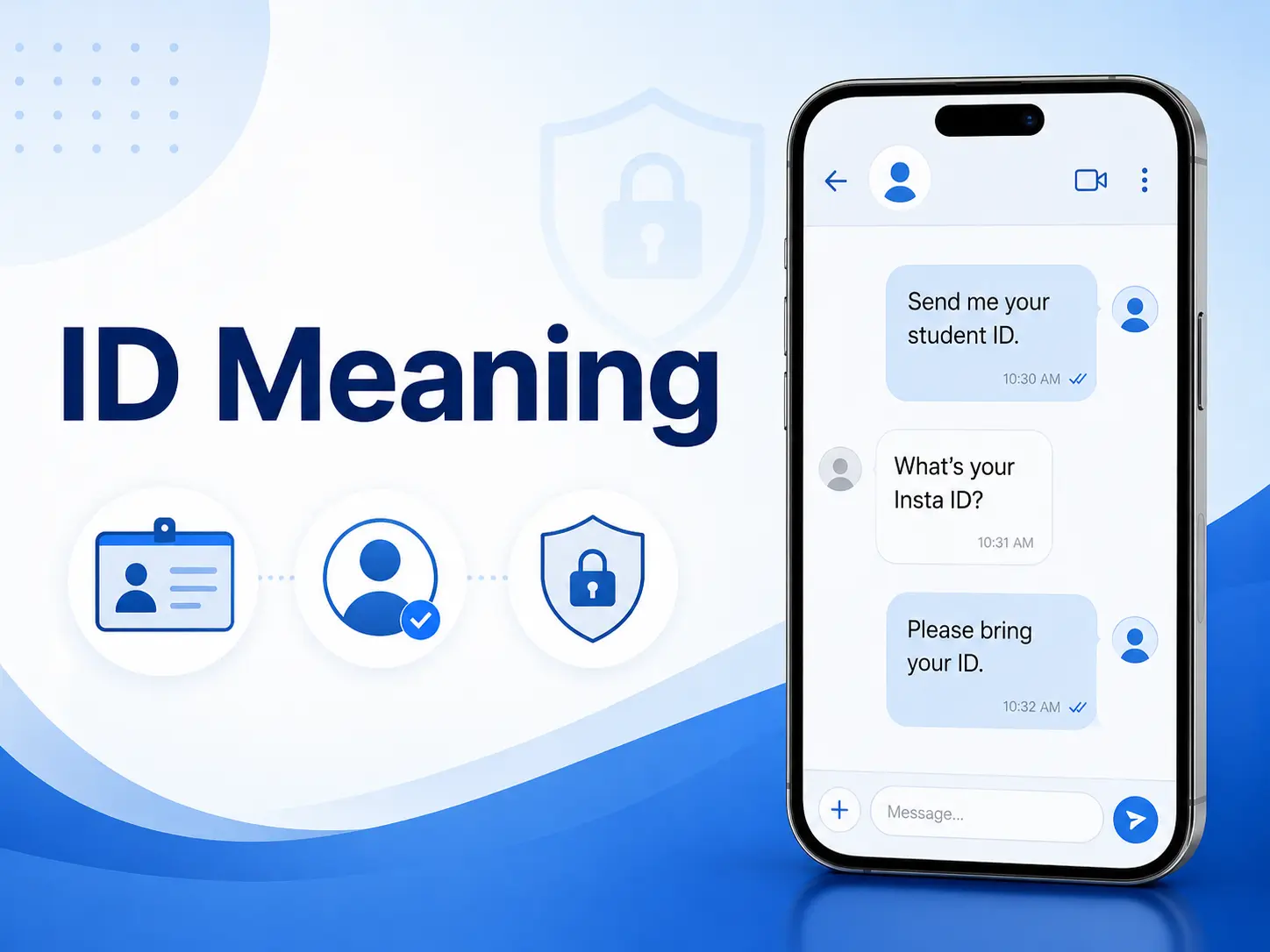
Have you ever seen “ID” in a text message, social media profile, online game, website form, or official document and wondered what it means? You are not alone. ID is a very common abbreviation, but its meaning can change depending on where it appears.
In most situations, ID means Identification or Identity. It can refer to a document, number, username, account identifier, profile name, student card, employee badge, government-issued ID, or digital identity. For example, a school may ask for a student ID, a website may create a User ID, and a bank may request a photo ID for verification.
That is why understanding ID meaning is important in both online and offline communication. The same abbreviation can appear in casual texting, Instagram DMs, gaming chats, job applications, banking systems, and technology platforms. To understand it correctly, you need to look at the topic, platform, and surrounding words.
In this guide, you will learn what ID meaning in text messages, social media, online chats, gaming, official documents, technology, and everyday life. You will also see practical examples, similar terms, and context clues that help you identify the correct meaning.
What Does ID Mean?
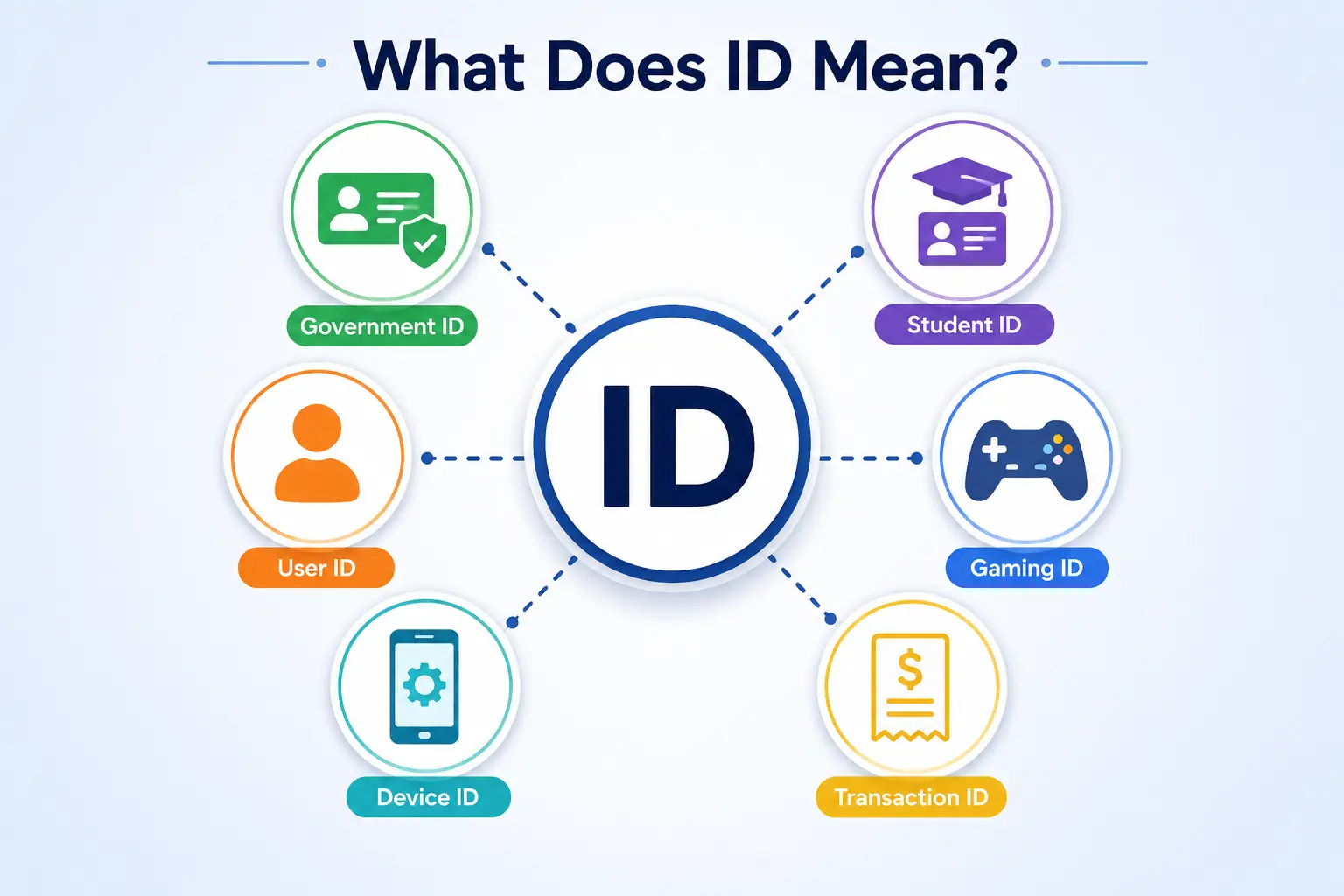
ID most commonly stands for Identification or Identity. It is used to describe something that helps confirm who a person is or what something represents.
In simple words, an ID helps distinguish one person, account, object, device, or record from another.
Common examples of ID include:
- Government-issued ID
- Photo ID
- Student ID
- Employee ID
- User ID
- Gaming ID
- Social media ID
- Device ID
- Transaction ID
- Customer ID
For example:
“Please bring your ID.”
This usually means an official identification document, such as a passport, driver’s license, or national identity card.
“Send me your Instagram ID.”
This often means your username or profile name.
“I forgot my User ID.”
This means the identifier used to access an online account.
“My payment has a Transaction ID.”
This means the unique number connected to a payment or transfer.
The meaning depends on context. In a school, ID may mean student identification. In a workplace, it may mean an employee ID. In technology, it may mean a unique identifier used by software systems. In psychology, “id” can even refer to Sigmund Freud’s personality concept, although that is different from the common abbreviation.
What Does ID Mean in Text Messages?
In text messages, ID usually means identification, identity, username, or account identifier. People use it because it is short, simple, and widely understood.
Example:
Friend: “Can you send me your student ID number?”
You: “Sure, I’ll send it after class.”
Here, ID means student identification number.
Another example:
Person A: “The website is asking for my ID.”
Person B: “Check your account settings.”
In this case, ID may mean User ID, login ID, or account identifier.
Another common text message example:
Person A: “Do you have a photo ID?”
Person B: “Yes, I have my driver’s license.”
Here, ID means an official document used to prove identity.
Unlike many internet slang terms, ID is not only casual. It can appear in everyday messages, school chats, workplace texts, banking conversations, online shopping updates, and support messages. People use it whenever they need to refer to identity, verification, accounts, or records quickly.
ID Meaning from a Girl
When a girl uses ID in a text message, the meaning depends on the topic. She may be asking for your Instagram ID, Snapchat ID, gaming ID, student ID, or another identifier.
Example:
“What’s your Insta ID?”
This usually means she is asking for your Instagram username or profile name.
Another example:
“Do you have your ID with you?”
This may mean an identification card, especially if you are going somewhere that requires age verification, entry permission, or registration.
The meaning does not depend on gender. It depends on the conversation.
ID Meaning from a Guy
When a guy sends ID, it usually has the same meaning: identification, identity, username, or account identifier.
Example:
“Send me your game ID so I can add you.”
Here, ID means gaming account identifier or player ID.
Another example:
“Bring your ID tomorrow.”
Here, ID means an official identification document.
Again, the sender’s gender does not decide the meaning. The platform, topic, and surrounding words are more important.
ID Meaning on Social Media
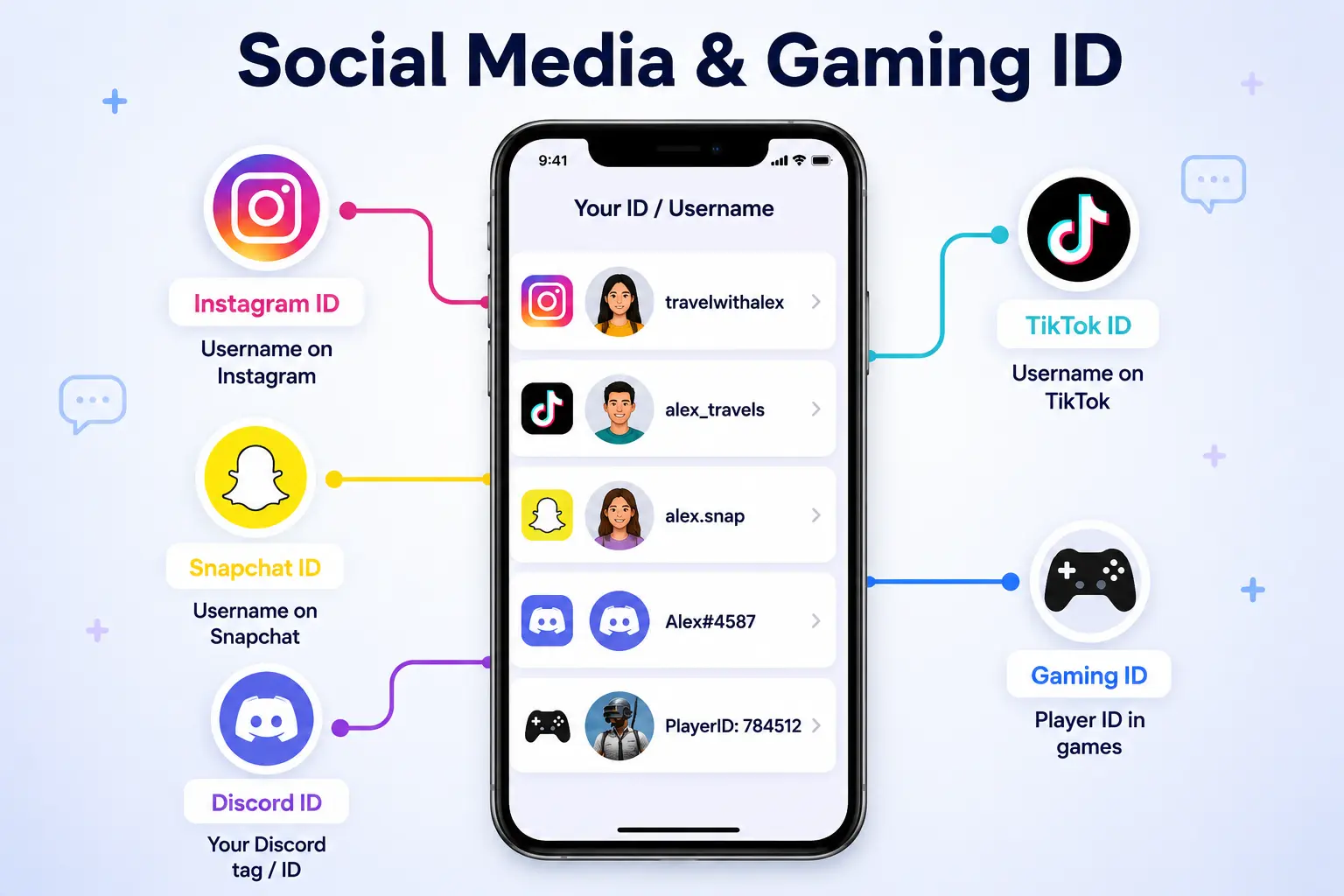
On social media, ID often refers to a profile, username, account identifier, or digital identity. People may use the phrase “social media ID” when asking how to find or connect with someone online.
You may see ID used on:
- TikTok
- Snapchat
- YouTube
- X or Twitter
- Discord
Example:
Friend: “What’s your Instagram ID?”
You: “It’s travelwithalex.”
In this example, the person is not asking for a government document. They are asking for the Instagram username.
On TikTok, someone may ask:
“Send your TikTok ID.”
This usually means the TikTok username or profile handle.
On Snapchat, someone may say:
“What’s your Snap ID?”
This means they want your Snapchat username so they can add you.
Social media platforms also use technical account IDs behind the scenes. These unique identifiers help platforms manage millions of profiles, prevent duplicates, protect accounts, and organize user data. However, in normal conversation, most people use “ID” to mean username or handle.
ID Meaning in Online Chats and Gaming
In gaming communities, people may use ID along with other short terms like PK Meaning. ID usually helps identify a player or account, while PK can have different meanings depending on the game, chat, or platform.
In online chats and gaming communities, ID usually means a player ID, gaming ID, friend ID, account ID, clan ID, or profile identifier. These IDs help players find each other, add friends, join teams, recover accounts, and track progress.
Example:
Player 1: “Send me your game ID.”
Player 2: “My ID is 8437291.”
Here, ID means the unique identifier connected to a gaming account.
Gaming IDs are important because many players may have similar usernames. A unique identifier helps the system recognize the correct account. This is common in mobile games, multiplayer games, esports platforms, and online gaming communities.
On Discord or gaming servers, someone may also ask for your ID to invite you to a group, match, clan, or private server.
Example:
“Drop your player ID and I’ll add you.”
In this case, ID is practical and account-related. It is not slang. It helps users connect and communicate inside the game or platform.
Different Meanings of ID Depending on Context
The meaning of ID changes based on where and how it is used. Most of the time, ID means Identification or Identity, but the exact type of ID depends on the topic.
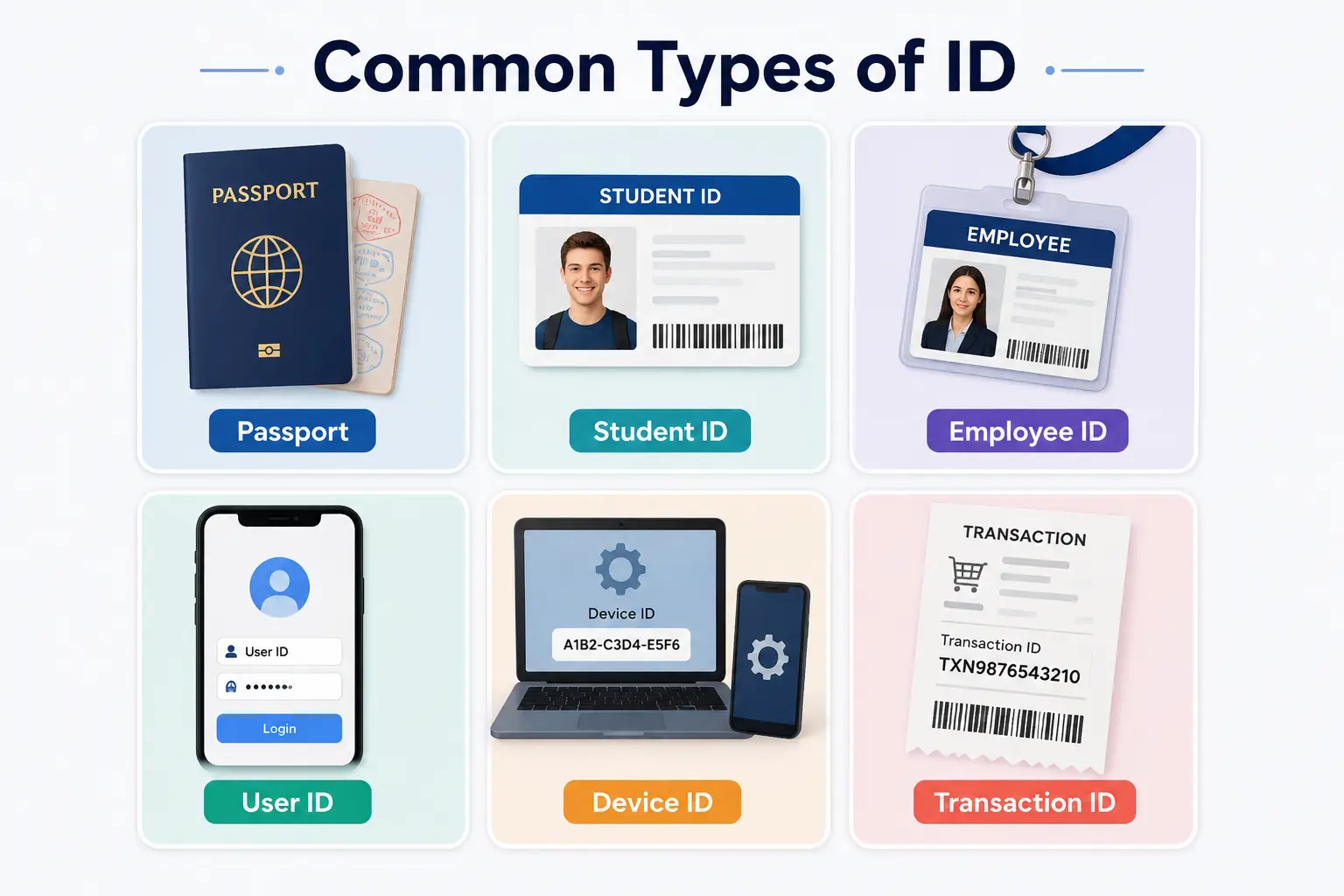
ID as Identification Document
In official situations, ID usually means a document that proves who you are.
Examples include:
Passport
Driver’s license
National identity card
Residence permit
Student ID
Employee ID
Photo ID
Example:
“Please show your ID at the entrance.”
Here, ID means an official identification document.
ID as Identity
Sometimes, ID refers to a person’s identity rather than a physical card.
Example:
“Protect your online ID.”
This means protect your digital identity, personal information, login details, and account access.
ID as User ID
In websites, apps, and online accounts, ID often means User ID. A User ID is a unique identifier connected to an account.
Example:
“I forgot my User ID.”
This means the person forgot the identifier used to access or recognize their account.
ID as Device ID
In technology, a Device ID is a unique code assigned to a smartphone, tablet, computer, smart TV, or gaming console.
Example:
“The app needs your Device ID for verification.”
This helps systems recognize a specific device.
ID as Transaction ID
In banking, shopping, and online payments, a Transaction ID is a unique number connected to a payment or transfer.
Example:
“Please share your Transaction ID.”
This helps customer support find the correct payment record.
ID in Psychology
In psychology, “id” has a different meaning. It refers to a part of Sigmund Freud’s personality theory. The id represents basic instincts, desires, and impulses. This meaning is usually found in psychology books, classes, or discussions, not everyday texting.
ID vs Similar Terms and Abbreviations
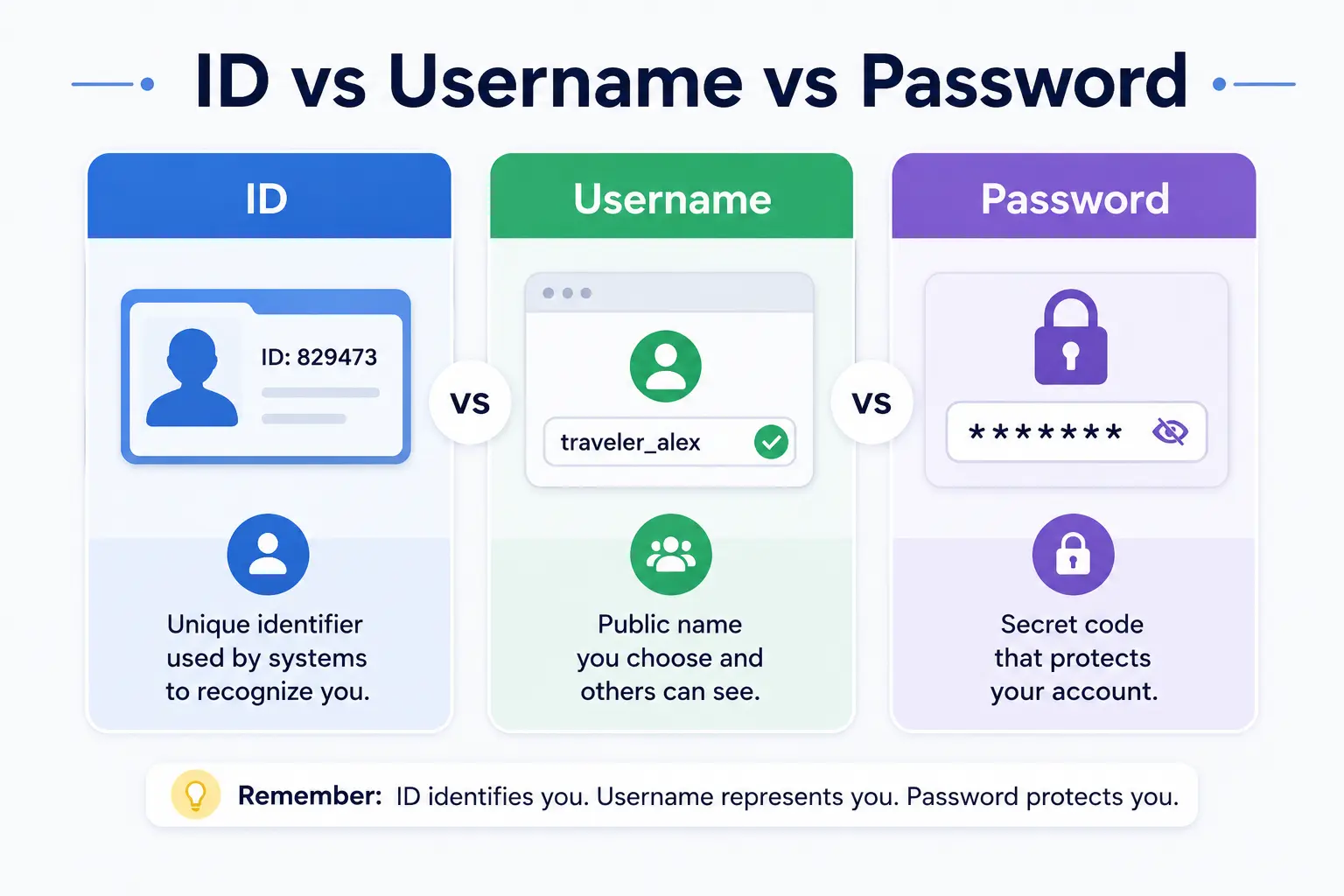
ID is often used with similar terms like username, account number, password, and profile handle. These words are related, but they are not always the same.
ID can also be confused with other short abbreviations like PP Meaning. The correct meaning depends on the topic, platform, and surrounding words, so it is always better to read the full message.
ID vs Username
An ID is usually a unique identifier used by a system. A username is often the public name chosen by a user.
Example:
Username: travelwithalex
User ID: 45682917
Other people may see your username, while the platform may use your User ID internally.
ID vs Password
An ID identifies the account. A password protects the account.
Example:
Your User ID tells the system who you are.
Your password proves that you are allowed to access the account.
You should never share passwords publicly, even if you share a social media ID or gaming ID.
ID vs Account Number
An account number is usually used in banking, customer service, subscriptions, or official records. An ID can be broader and may refer to a person, device, transaction, product, or profile.
Example:
A bank account number identifies a bank account.
A User ID identifies an online account.
ID vs Profile Handle
A profile handle is a public social media name, such as an Instagram handle or TikTok username. Many people casually call it an ID.
Example:
“What’s your Insta ID?”
This usually means “What’s your Instagram username?”
Is ID Formal or Informal?
ID can be both formal and informal.
In casual communication, people use ID in text messages, social media chats, gaming communities, and online conversations.
Example:
“Send me your game ID.”
This is informal but normal in gaming chats.
In formal settings, ID is also widely accepted. Banks, schools, workplaces, airports, hospitals, government offices, and websites use the term ID regularly.
Example:
“Please provide a valid government-issued ID.”
This is formal and professional.
So, ID is different from many slang terms. It is short, but it is not only internet slang. It works in both casual and official communication.
However, the meaning must be clear. In professional writing, it is better to use full phrases when needed, such as:
Identification document
User identification number
Employee identification card
Transaction identification number
This avoids confusion.
Origin and Evolution of ID
ID comes from the word identification. Over time, people shortened it because it is faster and easier to use.
Instead of saying:
“Please provide your identification document.”
People simply say:
“Please provide your ID.”
As technology developed, the meaning of ID expanded. It no longer refers only to physical identity cards. Today, ID can also mean a digital identifier, account ID, Device ID, Transaction ID, Customer ID, Product ID, or online profile ID.
Social media, online banking, e-commerce, gaming platforms, mobile apps, and digital registration systems have made ID a normal part of everyday life.
In the past, most people thought of ID as a card or document. Today, ID can be physical, digital, public, private, temporary, or system-generated.
Popular Texting Acronyms Related to ID
You may also see reaction-based slang like ONG Meaning in casual chats and social media comments. ONG is used more as an expression, while ID usually refers to identification, identity, usernames, or account details.
Here are some common abbreviations that often appear in online communication:
DOB means Date of Birth.
Example: “Enter your DOB.”
OTP means One-Time Password.
Example: “Send me the OTP.”
PIN means Personal Identification Number.
Example: “Enter your PIN.”
PW means Password.
Example: “I forgot my PW.”
DM means Direct Message.
Example: “Send your ID in DM.”
UN can mean Username.
Example: “What’s your UN?”
BTW means By The Way.
Example: “BTW, send your student ID.”
FYI means For Your Information.
Example: “FYI, you need a photo ID.”
These acronyms are common in texting, online forms, account registration, social media, banking apps, and digital communication.
Final Thoughts
ID is a common abbreviation that usually means Identification or Identity. It can refer to a government-issued ID, photo ID, student ID, employee ID, User ID, gaming ID, Device ID, Transaction ID, social media ID, or digital identity.
The correct ID meaning depends on context. A bank asking for ID is usually requesting proof of identity. A gamer asking for your ID wants your player identifier. A website asking for a User ID needs your account identifier. A psychology article using “id” may refer to Freud’s personality theory.
To understand ID correctly, look at the topic, platform, sender, and surrounding words. Terms like photo ID, User ID, student ID, Device ID, and Transaction ID usually make the meaning clear.
As online services continue to grow, IDs will remain important for security, account access, identity verification, record management, and digital communication.
Frequently Asked Questions
What does ID mean in text?
In text, ID usually means identification, identity, username, or account identifier. The exact meaning depends on the conversation.
What does ID stand for?
ID commonly stands for Identification or Identity.
What does ID mean on social media?
On social media, ID usually means username, profile handle, profile ID, or account identifier.
What is a User ID?
A User ID is a unique identifier assigned to an account on a website, app, or digital platform.
Is a username the same as an ID?
Not always. A username is usually public, while a User ID may be an internal identifier used by the platform.
What is a government-issued ID?
A government-issued ID is an official document used to verify identity, such as a passport, driver’s license, or national identity card.
What does ID mean in gaming?
In gaming, ID usually means player ID, game ID, friend ID, account ID, or profile identifier.
What does ID mean in psychology?
In psychology, the id is part of Sigmund Freud’s personality theory and represents basic instincts and desires.
Why are IDs important?
IDs help verify identity, protect accounts, prevent fraud, organize records, track transactions, and improve security.